
What SE2 PowerMap® Is — and Why It Matters
At SE2, our work has always been rooted in one core belief: Real change happens through people, relationships, and trust. While today’s communications often focus on technology, platforms, and media channels, the most powerful driver of change remains human connection.
That belief is the foundation of SE2 PowerMap®, a strategic framework used at SE2 to understand how influence flows through communities and how trusted networks can be mobilized to advance meaningful social change.
For me, PowerMap is not just a methodology, it reflects decades of experience working in communities, in media, and in the political arena where relationships and trusted voices often determine whether a message truly resonates.
What SE2 PowerMap® Is
SE2 PowerMap® is a community-centered strategy that identifies and activates trusted networks, leaders, and influencers within communities to drive awareness, engagement, and action.
Rather than relying solely on traditional advertising or top-down messaging, PowerMap focuses on understanding how communities communicate internally who people trust, where information flows, and how influence spreads across relationships.
Through this process, we:
- Identify key community leaders and connectors
- Build coalitions and partnerships around shared goals
- Co-create messages with the community
- Deliver messages through credible voices
- Mobilize communities to participate in solutions
In essence, PowerMap helps ensure that communications efforts move through authentic, two-way human networks rather than simply broadcasting messages outward.
Where the Approach Comes From
My understanding of PowerMap grew out of years of experience across community organizing, media, and public affairs.
I have seen firsthand how important it is to meet communities where they are. Early in my career, I worked extensively in both Spanish-language and general-market media. That experience showed me how different audiences consume information and, more importantly, how trust shapes whether a message is accepted or ignored.
In broadcasting, the most effective communicators are those who understand their audience and reflect their audience’s lived experiences. The same principle applies to public policy and community engagement, people listen to voices they know, respect, and identify with.
Later, through my work in political campaigns and community organizing, I saw how critical these networks could be when mobilizing voters, advancing policy initiatives, or addressing complex public issues. Campaign success often depended less on paid media and more on trusted messengers within neighborhoods, faith communities, local organizations, and advocacy networks.
Those experiences reinforced a simple but powerful lesson: Influence travels through relationships.
Strengthening the Model: The PowerMap Advisory Council
As the PowerMap model continued to evolve and shape how we approach communications and community engagement at SE2, it became clear that the model itself should reflect the very principles it is built on, collective wisdom and trusted leadership.
To deepen this work, we established the PowerMap Advisory Council, a group of respected community leaders, advocates, and subject-matter experts who bring diverse perspectives and lived experiences to the table.
The Advisory Council helps ensure that PowerMap strategies remain grounded in the communities they serve. By bringing together voices from different sectors, community leadership, advocacy, public health, civic engagement, and education, the council provides invaluable insight into how messages resonate, how communities mobilize, and how trust is built.
The creation of the PowerMap Advisory Council represents an important evolution of the framework. It reinforces our commitment to collaboration, accountability, and community-centered strategy, ensuring that PowerMap is continually informed by the voices and experiences of the people closest to the issues.
Why PowerMap Matters in Today’s Communications Landscape
Today’s information environment is more crowded and fragmented than ever. Traditional media alone rarely reaches audiences in ways that inspire action. The rise of AI creates a tsunami of slop that is both overwhelming and alienating.
SE2 PowerMap® addresses this challenge by recognizing that people often rely on their personal networks, friends, community leaders, local organizations, and cultural institutions, as their most trusted sources of information.
By mapping these networks and engaging them intentionally, we:
- Build credibility and trust with communities
- Reach audiences that traditional media may overlook
- Deliver culturally relevant and authentic messages
- Strengthen coalitions around shared goals
- Drive sustained behavioral and policy change
In many cases, this approach turns communications campaigns into community movements rather than one-way messaging efforts.
How SE2 Uses PowerMap
PowerMap guides how we approach complex issues across public health, education, environmental sustainability, and civic engagement.
A PowerMap-driven strategy typically includes:
- Community listening and research | Understanding the needs, concerns, and cultural context of the communities involved.
- Identifying trusted messengers | Working with community leaders, educators, health professionals, advocates, and local organizations that already have credibility.
- Coalition building | Aligning partners and stakeholders around shared messaging and goals.
- Strategic communications integration | Combining community engagement with earned media, digital outreach, and paid media to amplify reach and impact.
This integrated approach ensures that campaigns are not only visible—but also inspire action.
SE2 PowerMap® and the Future of Community Engagement
As communications technology continues to evolve, the importance of human relationships becomes even more apparent. Algorithms and platforms may change, but trust remains the constant.
SE2 PowerMap® recognizes that communities themselves hold the power to create lasting change. When campaigns invest in authentic partnerships and elevate trusted voices, they do more than share information, they build momentum, ownership, and collective action.
That results in change for good.
For me, PowerMap represents the intersection of everything I have learned over more than two decades working in communications, media, and civic engagement. It reflects the belief that the most effective campaigns are built with communities, not just directed at them.
That philosophy continues to guide our work every day as we partner with organizations, leaders, and communities to create change that is inclusive, lasting, and driven by the people most affected.


Emmy-Worthy Impact: State of Colorado’s Stories of Connection Campaign Earns Heartland Emmy®
The Challenge
Research shows that connection is an important factor in protecting youth from numerous health challenges, including poor mental health and negative behaviors related to substance use, sexual health, and violence.
According to the Healthy Kids Colorado Survey conducted by the Colorado Department of Public Health and Environment (CDPHE), youth who have a parent, guardian or other trusted adult they can talk with are less likely to use marijuana, vape or experience feelings of depression.
That impact makes it especially rewarding that the Stories of Connection campaign we created in partnership with CDPHE won a Heartland Emmy® Award.
The winning ad, called “Christine”, introduces us to a mother in Fort Collins, Colorado, who opens her heart to her transgender daughter, Sahara. Through Christine’s emotional journey of acceptance and understanding, viewers gain valuable insights into navigating the complexities of parental relationships with changing children. Her heartfelt advice serves as a beacon of support for other parents facing similar experiences.
Our Approach
It’s part of the State of Colorado’s Forward Together initiative, which provides actionable information and resources to help adults better connect with youth and to help teens develop healthy relationships with their peers.
This Heartland Emmy® is a testament to the campaign’s collaborative approach and dedication to amplifying Coloradans’ important stories about fostering connections with young people in their lives.
Our team believes the most powerful stories are those shared by the people who have lived them. So, we partnered with parents, mentors, educators, and other trusted adults who have played pivotal roles in the lives of young people. Through in-depth interviews and open-ended discussions, we discovered the beautiful intricacies of these relationships and the transformative impact they have on the lives of youth in Colorado.
To ensure these stories were brought to life with care and creativity, we teamed up with our exceptional video production partner, Lumenati. Lumenati’s expertise in video storytelling captured the raw emotion and authenticity of each story.
The Impact
The result? A collection of powerful and emotionally resonant TV spots that tugged at the heartstrings of audiences.
The Heartland Emmy® Award wouldn’t have been possible without the passion and dedication of everyone who contributed to this campaign. We are immensely grateful to the Coloradans who bravely shared their stories and trusted us to amplify their voices.
We believe that stories have the power to connect us all, and it’s our privilege to be part of the journey toward a more connected and empathetic world.
We extend our deepest gratitude to CDPHE for entrusting us with this important campaign, and to Lumenati for their exceptional collaboration. Together, we are making a difference in the lives of many young people, and this Heartland Emmy® serves as a symbol of the positive change that can be achieved through the power of storytelling.
Watch the other Forward Together campaign ads here and explore the campaign at ForwardTogetherCO.com.


Rise Above Colorado asks what's Denver's plan for fentanyl
Imagine if an airliner dropped from the sky. It would dominate the news. Yet far more people died from fentanyl in Denver just last year than would fit in a typical passenger jet.
In fact, many more people died in Denver last year from fentanyl than from both traffic accidents and homicides combined.
In all, 233 lives were lost last year from fentanyl, according to the Denver Medical Examiner. That’s roughly the same as fentanyl’s 2021 death toll.
We need to treat this overdose epidemic as the public health crisis it has become.
The statistics tell only part of the story.
Each one of these deaths is a unique human tragedy. Each person leaves behind loved ones. Their pain may last for generations.
That’s why the Rise Above Colorado educational campaign uses broken hearts to symbolize each of the lives lost.
The stark and thought-provoking imagery asks: What Is Denver’s Plan?
Rise Above Colorado asked the 17 candidates running for Denver mayor about their plans and 10 have responded so far to four specific questions. Their answers are provided through a convenient candidate comparison tool at WhatIsOurPlan.org.
The website also provides information for parents, educators and everyone else about how to limit fentanyl’s toll. The resources were curated with help from Rise Above Colorado’s partners on the project, the Colorado Consortium for Prescription Drug Abuse Prevention and 5280 High School. Boys and Girls Clubs of Colorado also is partnering on the campaign.
“Fentanyl has created a public health epidemic that directly or indirectly impacts everyone in the community,” said Kent MacLennan, executive director of Rise Above Colorado. “Our goal is to give practical information that anyone can use to make a positive impact. By asking ‘What Is Our Plan?’, we want to prompt everyone to think about their role.”
The educational campaign, which uses outdoor and digital ads to reach Denver residents, will continue through June.
SE2 is grateful for the opportunity collaborate with trusted community partners on this life-and-death issue. We all have a role to play.
So, what is our plan?



Knowing Your Why Can Increase Your Success When Quitting Tobacco
People who quit tobacco know it can be a difficult process. Often, it takes multiple attempts before someone can quit for good.
I have been exposed to secondhand smoke from family members and close friends. I knew early on that I wanted to support those close to me in their quit journeys.
Over the years, I have watched those close to me repeatedly try to quit tobacco with various approaches (e.g., cold turkey, nicotine replacement therapy, support from their local Quitline, etc.). For some, those approaches worked immediately. For others, it was a long, winding road. There are a lot of reasons why it takes multiple attempts.
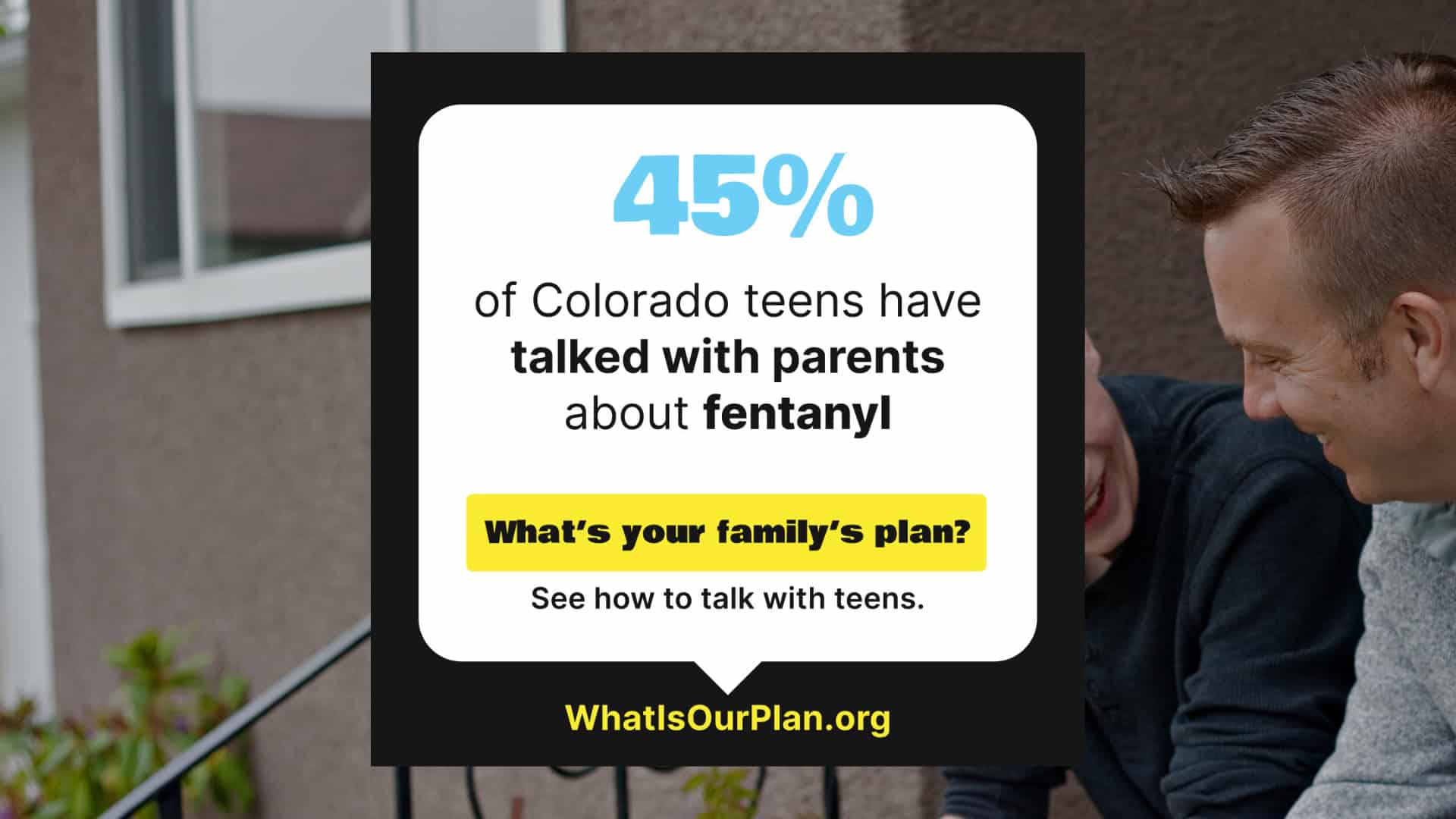
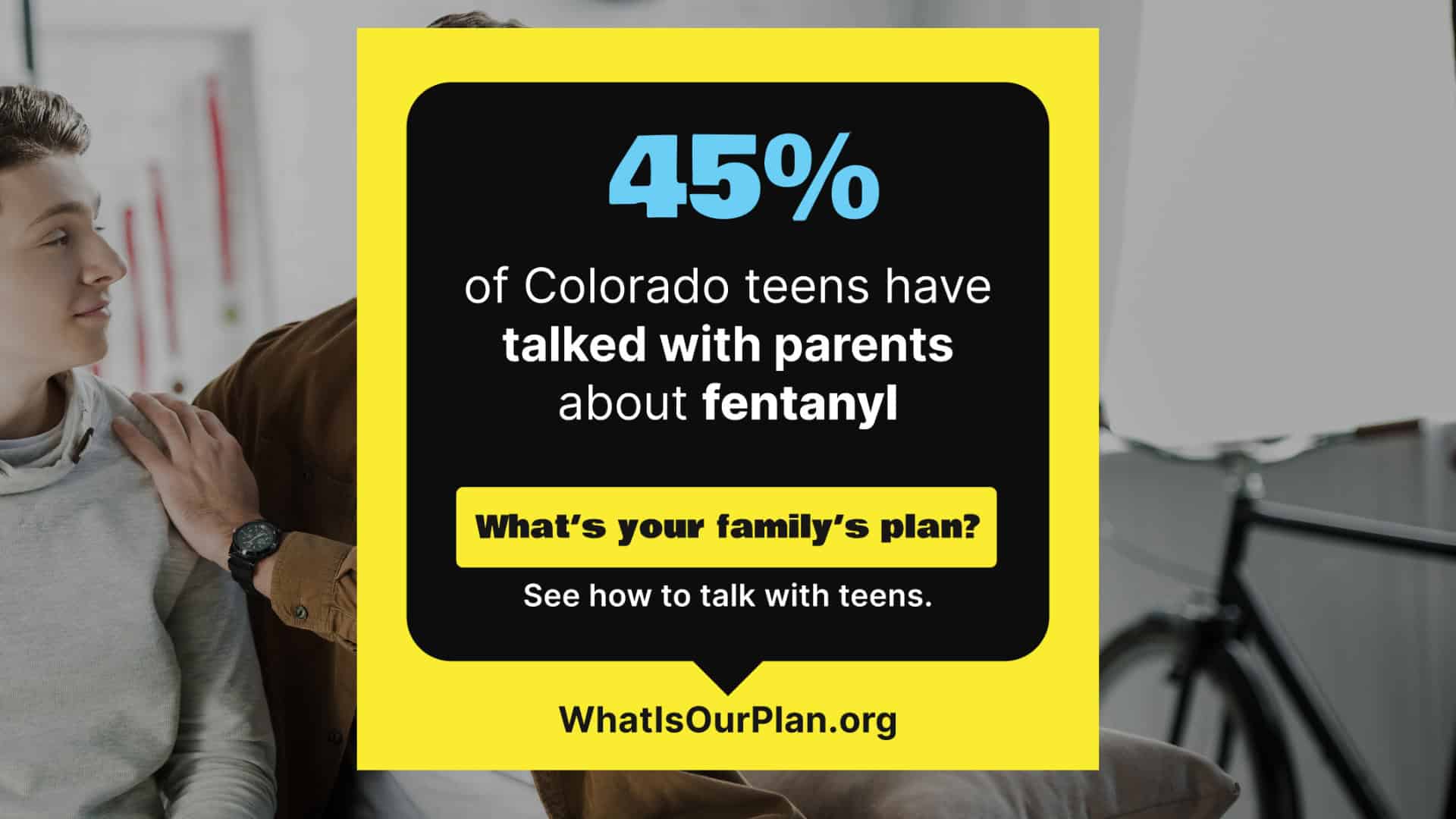
The Colorado Department of Law’s Opioid Response Unit engaged SE2 to develop and launch the Connect Effect campaign to harness the protective power of peer and lore ipsum delore est adult connections and highlight positive social norms.
The campaign emphasizes that a vast majority of Colorado teens are making healthy choices and are willing to protect their friends from potential dangers. Key components of the approach include:
- Highlighting Positive Statistics: Promoting data that shows 87% of Colorado teens would intervene to stop a friend from taking a pill not prescribed to them, reinforcing that these protective behaviors are the norm.
- Educational Resources: Providing accessible information about the risks of fentanyl, recognizing signs of an overdose, and the life-saving potential of naloxone (known by the brand name Narcan).
- Facilitating Open Dialogue: Offering guidance for parents and other trusted adults on how to engage in meaningful conversations with teens about substance misuse and peer pressure.
- Multilingual Support: Ensuring parent resources are available in both English and Spanish to reach a broad audience.
A statewide paid media campaign used social, digital, and targeted out-of-home placements in schools and community centers. Using our SE2 PowerMap™ process, we engaged our network of community partners to disseminate campaign messages (e.g., inserting Connect Effect content into their newsletters and social media channels), hanging materials throughout their facilities, and speaking about the campaign in presentations and trainings.
Resources To Help You or a Loved One Quit
Quitting tobacco is a process. Whether you are thinking about quitting, are not yet ready to quit or you’re ready to try again, Colorado QuitLine can help you every step of the way. Find out how the Colorado QuitLine (in Spanish at https://dejeloyacolorado.org) can support you on your quit journey.
TobaccoFreeCO.org (in Spanish at www.coloradosintabaco.org) has tools and resources. Learn more about how to quit tobacco for good here.
For those supporting a loved one on their quit journey, know that those quitting tobacco are more likely to succeed when they have support. Find ways you can support your loved ones quit tobacco here.

New COVID-19 Vaccine Campaign Educates Coloradans about Vaccine Safety and Effectiveness
The Challenge
SE2 and our long-time partners Inline Media, Lumenati, and Kupersmit Research are honored to support the Colorado Department of Health and Environment (CDPHE) to educate Coloradans about the COVID-19 vaccines.
A new statewide campaign is empowering Coloradans with the facts so that they can make an informed choice when it’s their turn to get vaccinated.
The far-reaching campaign puts an emphasis on communities disproportionately impacted by COVID-19.
The new COVID-19 vaccine education campaign explains why the COVID-19 vaccines are safe and effective and urges Coloradans to get the facts now so they’re ready when it is their turn.
Trusted messengers – including doctors and nurses of color and rural health workers – volunteered to serve as spokespeople in the TV spots and other materials.
The new Get the COVID-19 Vaccine Facts campaign, which will run through the end of March, uses various media to reach all Coloradans – including TV and digital advertising, community engagement, media outreach, and social media via influencers.
To amplify the campaign in local communities, a toolkit of campaign resources is available for local public health agencies and other community partners. Materials are available English and Spanish. If your organization is interested in promoting the campaign, a toolkit of resources can be accessed here.
It’s an honor to play a small part of the Herculean effort to combat this hopefully once-in-a-century pandemic. We thank all public health and health care workers for their relentless efforts to save lives.
To learn more about the COVID-19 vaccines, visit COCovidVaccine.org (English) and VacunaCovidCO.org (Spanish).


When Life Gets Harder, Messaging Must Get More Human
The latest Colorado Health Foundation Pulse Poll tells a stark story.
People are worried. They are uncertain about the future. And they are not convinced that the systems meant to support them are keeping up with the realities of daily life.
While the data are Colorado specific, the patterns are not.
National polling and research, from sources like Ipsos and Pew, show the same underlying dynamics playing out across the United States. Cost pressures are dominating attention. Housing feels increasingly out of reach. At the same time, rapidly changing immigration policies and enforcement actions are introducing new layers of fear and uncertainty, contributing to stress and mental strain across many communities.
Taken together, the data suggest that this is not just a moment of political disagreement or shifting priorities. It is a moment of widespread strain rooted in lived experience. And that has big implications for how organizations frame issues, communicate solutions, and engage the people they serve.
The Economy Is Personal
In the Pulse survey, cost-of-living and affordability concerns quickly rise to the surface. National data reinforce this pattern.
Pew Research has found that economic concerns today are less about macro indicators and more about whether people feel financially secure in their daily lives.
This distinction matters.
When institutions talk about the economy using technical language – inflation rates, labor participation, market trends – they often miss what people are actually experiencing. For most people, the economy is not a set of indicators. It is the stress of rent increases. The anxiety of grocery bills. The feeling that working harder does not necessarily lead to progress or even stability.
Communications that focus on economics can feel disconnected or even dismissive when they do not reflect that emotional reality. People are not looking to be told that conditions are improving on paper. They want acknowledgment of how hard it feels to get by right now, and they want to understand how systems, policies, or programs might ease that pressure in real and tangible ways.
For organizations, this means framing matters as much as facts. Effective communication starts by acknowledging lived experience, then connecting solutions to relief, stability, and a greater sense of control over everyday life.
Everything Starts with Housing
Housing affordability and housing insecurity show up repeatedly in both Colorado and national data. But their significance goes beyond housing alone.
Housing is one of the clearest signals of whether systems are working for people. When housing is unstable, everything else becomes harder. Health suffers when people must move frequently or live in overcrowded conditions. Mental strain increases when people do not know if they will be able to stay in their homes. Education is disrupted when children move from school to school. Productivity declines when workers commute long distances or constantly manage financial stress.
Research from Harvard’s Joint Center for Housing Studies and national homelessness data from the National Alliance to End Homelessness show that housing instability is rising and affordability is a growing concern for households across income levels.
For organizations working in health, behavioral health, education, workforce development, immigration, or environmental issues, housing insecurity offers an important reminder. People experience challenges as interconnected. When communications assume stability, time, trust, or bandwidth, they can miss the reality that many people are navigating.
When messages are organized around programs, they often assume people have time, trust, and capacity to navigate complexity. Framing issues around stability instead starts with what people are trying to protect in their daily lives, making communications feel more relevant and human. It also shifts the burden from asking individuals to navigate complexity to showing how systems can reduce pressure and support resilience.
Stress Is Widespread
Behavioral and mental health concerns appear throughout the Pulse data, sometimes directly and often indirectly. People may not always name mental health as their top issue, but stress, anxiety, and exhaustion are woven into how they talk about cost, housing, safety, and the future.
National data from the National Institute of Mental Health show that mental health conditions are common and that many people do not receive care for them. But just as important is how people understand their own distress. For many, it does not feel like a diagnosis. It feels like being overwhelmed, stretched too thin, or constantly bracing for what might come next.
When mental health is framed only through clinical language or crisis response, it can feel distant or irrelevant to people who are struggling but do not see themselves as needing treatment. At the same time, people are increasingly aware that stress is not just personal. It is shaped by external conditions like housing instability, job insecurity, discrimination, and environmental threats.
Communications that name stress as a reasonable response to relatable conditions are more likely to resonate. They reduce stigma and invite engagement by reflecting reality rather than labeling it.
Experiences Color Policy Views
One of the clearest signals across the data is this: While political language often dominates public conversation, the concerns people express are grounded in material conditions and daily life.
People feel pressure. They feel uncertain. They worry about maintaining stability for themselves and their families. These experiences cut across geography, ideology, and identity.
When communications fail to reflect this shared reality, people disengage, not because they do not care, but because they feel unseen. When messages acknowledge interconnected pressures and speak to universal needs like dignity, stability, and hope, they create space for trust.
What This Moment Requires
The Pulse survey and national data together point to the same recommendations:
- Start with what people are feeling before explaining what systems are doing.
- Connect issues that are too often treated separately.
- Recognize that building trust starts with empathy.
At their core, these are not communications tactics. They are responses to a deeper need people are expressing right now: the need for a sense of footing in a world that feels increasingly unstable.
As David Brooks recently wrote in The New York Times,
“…all of life is a series of daring explorations from a secure base. People need a secure base. Part of that base is emotional — unconditional attachments to family and friends. Part of that secure base is material — living in a safe community, with a measure of financial stability. Part of that secure base is spiritual — living within a shared moral order, possessing faith that hard work will be rewarded, faith in a brighter future.”
That idea helps make sense of what the data are showing. When housing feels out of reach, when costs keep rising, when policies shift quickly and unpredictably, that secure base starts to erode. And when it does, people experience issues not as isolated challenges, but as a constant state of pressure.
If we want our work to matter in this moment, our communications must reflect the reality people are navigating every day. Not the world as it looks on paper, but the world as it feels to live in.
That is where trust begins. And in a moment like this, trust is the foundation for everything else.

The Human Side of AI: How SE2 Uses Technology Without Losing Touch
We’ve always believed in the power of people — their stories, their insights, and their ability to move communities to action. So when artificial intelligence entered the conversation, we saw it not as a replacement for human creativity, but as a tool to strengthen it.
Yes, we use AI. But we use it thoughtfully.
AI helps us work smarter — handling repetitive or time-consuming tasks so that our energy stays focused where it matters most: strategy, storytelling, and human connection. When the machines take care of the rote work, our team can spend more time in the community, listening, learning, and shaping campaigns that reflect real lives and experiences.
That’s how our clients benefit. Efficiency increases. Budgets go further. And the work — the deeply human work — gets even better.
Of course, we also take great care to use AI responsibly. Our team works within a private, secure workspace to ensure client materials never enter the public cloud. And no AI-generated content ever goes unchecked. Every fact, phrase, and footnote is reviewed by our strategists, writers, and designers to make sure it’s accurate, ethical, and aligned with your goals.
At its best, AI amplifies what people can do. But it can’t replace what makes SE2, SE2 — our empathy, our critical thinking, our purpose, and our commitment to community.
Technology may evolve, but our values remain the same: listen first, think deeply, and create change for good.


The Search for Community Takes Us to New and Different Places
Where do you find community these days?
Where do you connect with people who are different from you?
For many, social media isn’t that place anymore. Sure, we may still spend a lot of time on these platforms, but they’re no longer providing the sense of human connection we crave, and often they add to our stress.
We know that newborns respond to faces from birth, and human touch and closeness are key to their healthy development. Adults need human-to-human interaction too, beyond what any screen can provide.
“Electronic communication is here to stay, so we need to learn how to integrate it into our lives. But if it replaces live interactions, you’re going to be missing some important benefits and probably be less fulfilled,” says a professor whose newly released summary of research found that digital communications are better than nothing but fall short of in-person interactions.
I’ll always choose an in-person meeting over a video call if time and distance allow. A one-on-one meeting provides an opportunity to connect beyond the business at hand, ideally with frequent digressions.
In larger in-person groups, we can read facial expressions and head nodding across the room. I usually find the most important connections in the unstructured time before or after the formal agenda starts. It’s rooted in my experience in journalism, where the best quotes were delivered in the hallway, not the meeting room.
While the big coffee chains have embraced drive-through, it can be hard to find seats inside at my local independent coffee houses. Clearly, these local spots are meeting a need.
Blue Sparrow, the coffee shop in our building’s lobby near the Colorado Capitol, stays full most of the day, and most customers are talking with others while they’re there. I joke that lobbyists could camp out there and run into all the policymakers they’re trying to reach.
The holidays always offer an opportunity to unplug, and our family enjoyed a jigsaw puzzle from Boulder-based Liberty Puzzles, which just celebrated its 20th birthday. A puzzle provides a great opportunity to sit together for a long time and talk about completely unrelated topics.
Interestingly, Liberty Puzzles was co-founded by the son of former Colorado U.S. Sen. Tim Wirth, who got an early taste of the political toxicity that defines today’s D.C. dynamics. Maybe there’s an origin story there.
Of course, digital connections allow us to communicate with people who live far away, when in-person meetings are impractical. And it allows us to communicate at scale.
I had a great video conversation this month with community builder Kenny Andejeski in Chattanooga. We both value in-person conversations, yet he lives 1,200 miles from me. Now that we’ve connected through Teams, maybe we’ll find an opportunity to meet in person this year!
My social media time is now spent almost exclusively on LinkedIn, and I’m not the only person increasingly drawn there.
These days, LinkedIn is not just for job seekers – it’s a good platform for sharing and consuming compelling content, and includes a range of users from students to retirees. It’s got some key benefits I appreciate:
- People use their real names and professional profiles so they’re accountable for what they say. This reduces toxicity and trolling.
- It allows users to limit political content in their feed. Many still offer strong points of view on their areas of interest and expertise, including controversial topics that aren’t restricted by LinkedIn’s definition of political content. But rarely does blatantly partisan and unconstructive content slip through the filter.
- The algorithm doesn’t seem to reward bad behavior and, in fact, offers opportunities to report problematic content.
Yes, there’s also a lot of self-promotional BS on LinkedIn from those who are perpetually “humbled and honored” by awards for which they asked others to nominate them. However, LinkedIn provides tools to help curate our feeds so we can get less of that. And the unfollow button is your friend!
Whether it happens in person or virtually, coming together to listen to one another, increase understanding of our differences, and look for solutions together feels more urgent than ever. People feel they belong when they have a voice and opportunities to help shape the future of their community – neighborhoods, schools, and workplaces. And when people feel heard, connected, and supported, everyone benefits.
Feeling connected and having a sense of belonging is essential for physical and mental health.
In school, belonging improves academic achievement; at work, belonging boosts job satisfaction and engagement. Research shows that belonging also strengthens community well-being and resilience. Unfortunately, only about half of Coloradans say they feel a strong sense of belonging in their local community.
Our friends at Belonging Colorado are working to change that. Through locally based projects across the state made possible by a special fund at The Denver Foundation, communities are working to find new ways to bridge divides and increase belonging.
Learn more about Belonging Colorado here.
But back to you:
Where do you find community these days? Where do you connect with people who are different from you?
Email me at Eric@SE2ChangeForGood.com or find me on LinkedIn if you’d like to share or just connect.


Anatomy of Ethical Storytelling: How We Tell Stories That Heal, Not Harm
At SE2, we believe storytelling is one of the most powerful tools we have to shape opinions, influence policy, and connect with communities. That’s why we’re proud to share our “Anatomy of Ethical Storytelling” poster at ComNet25 in Denver this month—a visual guide that reflects our commitment to telling stories that heal, not harm.
We created this piece to challenge communicators to think critically about the impact of their narratives. Too often, stories are shaped by the agenda of the storyteller rather than the lived experiences of the people at the heart of them. When that happens, storytelling can unintentionally reinforce stereotypes, retraumatize communities, and miss opportunities for truth and transformation.
So what’s the alternative? Ethical storytelling. For us, that means listening deeply, respecting lived experiences, and elevating community voices. It’s not just about visibility—it’s about influence, resistance, and connection.
To bring this concept to life, we used the metaphor of the human body. Each part represents a principle we believe is essential to ethical storytelling:
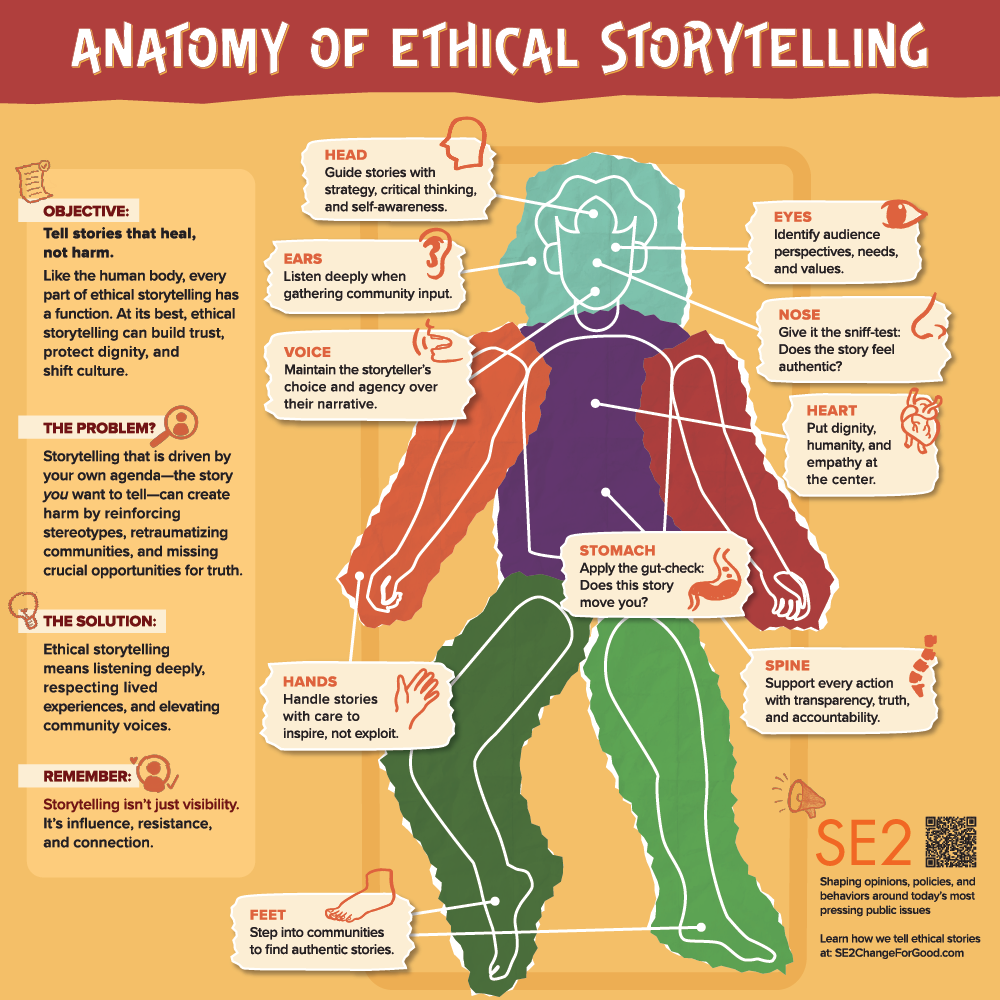
- Head – Strategy, critical thinking, and self-awareness guide the narrative.
- Eyes – We consider audience perspectives, needs, and values.
- Ears – We listen deeply to community input.
- Nose – We apply the “sniff test”: Does the story feel authentic?
- Voice – We ensure storytellers maintain agency over their own narratives.
- Heart – We center dignity, humanity, and empathy.
- Stomach – We use the “gut check”: Does the story move us?
- Hands – We handle stories with care to inspire, not exploit.
- Spine – We support storytelling with transparency, truth, and accountability.
- Feet – We step into communities to find authentic stories.
This framework isn’t just theoretical—it’s how we work every day. Whether we’re crafting a campaign, producing a video, or writing a feature, we strive to honor the people whose stories we tell. Download a PDF version of the Ethical Storytelling Framework here.
If you’re at ComNet25, come see the poster in person and let’s talk about how we can all do better by the stories we share. And if you’re curious to learn more, check out our other blogs.
Let’s keep storytelling human.

Hispanic Heritage Month: Honoring Our Roots, Strengthening Our Future
We believe that stories shape the way people see themselves and each other. Every campaign, partnership, and conversation we’re part of is rooted in the belief that representation matters and that honoring where we come from is essential to moving forward together.
Each year, from September 15 to October 15, the United States celebrates Hispanic Heritage Month, a time dedicated to recognizing the histories, cultures, and contributions of Americans whose ancestors came from Mexico, the Caribbean, Central America, South America, and Spain. The dates are significant: They encompass the independence anniversaries of several Latin American countries, including Costa Rica, El Salvador, Guatemala, Honduras, Nicaragua, Mexico, and Chile.
But more than dates on a calendar, Hispanic Heritage Month is a celebration of identity, one that is both collective and deeply personal. It’s an opportunity to celebrate the communities whose stories, strength, and innovation continue to move our country forward.
This year, our team at SE2 took time to reflect on what this month means and how it connects to the work we do every day.
Elizabet Garcia Hernandez | Public Relations & Community Outreach Specialist
As I think about Hispanic Heritage Month this year, I find myself sitting with a mix of emotions. On one hand, it’s hard to ignore the ways in which our communities continue to face resistance, moments when our contributions aren’t fully seen or valued. But alongside that tension, I feel a deep sense of gratitude. Working at SE2 has given me the opportunity to stay connected to my roots and to uplift the very communities that raised me.
This past year, I’ve had the privilege of helping distribute mini-grants and building partnerships for SE2’s work with the Behavioral Health Administration’s 988 Colorado Mental Health Line marketing campaign. Through that work, I’ve collaborated with incredible community partners who are making a real difference in people’s lives, especially in moments when access to care and understanding truly matter.
I also had the chance to take part in community events across Colorado, including Fiestas Patrias and the Greeley Stampede, events that mean so much to me personally because I grew up in Greeley. Standing there, surrounded by the same kind of energy and pride that shaped my own story, I felt a renewed sense of purpose. It reminded me that representation is not just about visibility; it’s about belonging.
Another meaningful project this year was SE2’s alcohol moderation campaign in the Yampa Valley, where I worked directly with Spanish-speaking community members to gather their stories. Hearing them share their experiences and emotions in their native language was incredibly powerful. It reminded me how essential it is to create space for people to express themselves authentically, to give agency to their voices, not shape them for convenience.
This year has reinforced why I do this work. Despite the challenges, it’s moments like these, standing in community spaces, listening to people’s stories, and seeing them reflected in campaigns that honor their experiences that keep me going.
Willy Chamu | Graphic Designer
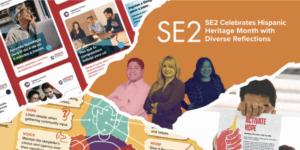
As a recent addition to the SE2 team, I feel so honored to be part of such a talented group of people whose values and commitment to positive change are at the forefront of all the work they do. As a recent graduate of MSU Denver, at the start of my career, being part of this team is a huge honor and privilege.
My new role as SE2’s graphic designer is invaluable for helping me stay connected to what’s going on with the diverse communities around me.
Having people within my family and community – whose stories and contributions have impacted not only me, but others whose stories are woven into the history of this country – serves to encourage reflection on how their stories can continue to be told through the work I produce in this role.
As a graphic designer, I am fully aware of the importance of written and visual language within design. With the perspective my diverse background brings, I am able to create visuals that convey narrative, inform and resonate with audiences in ways that go above and beyond simple, written language.
I am grateful for projects like Adelante Connect, where I can look to people within my own community who struggle with language and technology. I see first-hand how limited access to the technological knowledge, and common grasp of the English language, that we take so much for granted make life increasingly difficult for these people in a world that is becoming more and more digital.
Working on deliverables for the Safe Yakima Valley County schools in Washington brings to mind my personal experiences in my local public middle and high school. I consider how I can utilize my background to create items that will leave a lasting impact on these students to make better choices that will positively influence their future.
This position serves as a powerful reminder to appreciate my Latino heritage and unique life experiences, which serve as a wellspring of inspiration and an opportunity to connect with the audiences I intend to help serve.
Alvina Vasquez | Principal
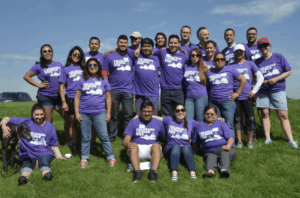
My commitment to Community is rooted in generations of resistance and resilience. The challenges Latino families face today are not new—they are part of a long, ongoing struggle for equity and dignity. My ancestors fought colonialism and oppression; Colorado Civil Rights leaders like Rudy Gonzales, Nita Gonzales, and former State Senator Polly Baca paved the way; and my grandparents and parents stood up to everyday racism. I honor their legacy by dedicating my work to advancing children, women, Latine, and other under-resourced and at-risk communities.
At SE2, our mission is to move people to action through powerful, purpose-driven communication—and that begins with truly listening to the communities we serve and understanding their lived experiences. Through our work in behavioral health, substance use prevention, and public health, we’ve seen how culturally relevant storytelling can break down stigma and build genuine connection.
Language equity, cultural representation, and authentic partnership aren’t seasonal values for us—they’re the foundation of everything we do. Whether we’re collaborating with local nonprofits, uplifting bilingual voices, supporting grassroots organizations, or learning from the wisdom and leadership of community trailblazers like Polly, Nita, and many others, we are grateful to work alongside leaders who continue to shape and strengthen our communities. SE2 remains deeply committed to ensuring that every story we tell reflects the richness, resilience, and diversity of Colorado’s people.
The Celebration Doesn’t End Here
As Hispanic Heritage Month comes to a close, we’re reminded that this celebration doesn’t end here. The spirit of la comunidad—of resilience, pride, and solidarity—continues in every campaign, every partnership, and every story that moves someone to act.
At SE2, we carry that spirit forward. We celebrate the people who make this work possible, the partners who inspire us, and the stories that connect us.
Because honoring heritage isn’t just about looking back. It’s about shaping a future where every community sees itself represented, respected, and heard.

A Turning Point for Democracy & Belonging in Colorado
Last week’s killing of conservative political commentator and activist Charlie Kirk is a tragedy – for his loved ones, of course, and for anyone who believes in the principle of being able to express their opinions without fear or retribution.
It was another in a string of attacks on political leaders in recent years but hopefully is a turning point for a country that surely now sees that something inside us is broken.
We can’t look at political leaders, pundits, or influencers to solve this problem. It’s something only we can fix – one relationship, interaction, and conversation at a time.
Seeing the humanity in others and approaching conversations with tolerance and a commitment to working together is what a bold new effort here in Colorado is all about. Belonging Colorado is focused on bringing Coloradans together across lines of difference – regardless of their race, political affiliation, income, or where we are from – to foster a greater sense of belonging in our state. Across Colorado, people are stepping up to lead locally based efforts to bridge differences and create belonging in their communities.
This unique, innovative statewide approach includes support for community-based organizations that are bringing people together to connect around shared interests and address shared challenges; funding for entrepreneurs to pioneer new ways to increase connection and belonging; and training and support for community-led leadership networks that are working to spread strategies for bridging differences. The initiative is made possible by a special fund at The Denver Foundation and supported with the expertise of the Greater Good Science Center, Colorado Health Institute (CHI), and Startup Colorado.
The Belonging Colorado project is based on research conducted by CHI that found that only about half of Coloradans feel a strong sense of belonging in their local community. According to the 2024 Colorado Belonging Barometer:
“While a majority of Coloradans reported belonging, there was a significant percentage who felt uncertain, at best, about whether they belonged in the state, community, workplace, and in their child’s school. Socioeconomic factors, such as education level and income, as well as people’s feelings about belonging, loneliness, and political ideology, are most often associated with whether someone feels they belong.”
The effects and benefits of belonging range from individual to community wide.
“An emerging body of research,” the CHI report says, “indicates that belonging is associated with better physical and mental health, greater workforce retention, increased trust in one’s neighbors and in local government, more openness to diversity and less fear of demographic change, and greater satisfaction with U.S. democracy.”
Bridging our inevitable differences involves seeing the humanity of people whose backgrounds or views differ from our own and better understanding them. It does not ignore the differences that make us unique, nor does it mean agreeing on everything – or tolerating hate, bigotry, or incitement to violence. It is about valuing one another, extending mutual respect, and working towards shared goals and a future we can co-create.
Regardless of whether you shared Kirk’s opinions, no person deserves to be dehumanized or killed because of their views, background, or beliefs. Belonging means being valued and accepted for who you are, without the need to act in ways that erase your identity or what you believe.
When people are given a seat at the table and treated as valued participants in shaping their future, they feel heard, connected, and supported – which benefits everyone. Belonging ensures that progress for one person strengthens the whole community.
Colorado is not immune to many of the political and social dynamics that divide people. But, by focusing on ensuring all voices are welcome at the table to talk about our issues, we can walk out of this darkness together and create a brighter future in a state where everyone can thrive.


The Return of Things We Thought Were Gone
“Gays are not welcome here,” said the man through the window of the blacked-out Tesla.
My sheepish response, “Oh, really?” But in my defense, it’s not something you expect to hear while walking your dog with your husband of 21 years in the City Park neighborhood of Denver. After all, Denver is a fairly progressive, major city. And it had been years since the last time I had someone so brazenly verbally harass me in public. Had I expected it, I might have had a more thoughtful response that made him think twice about believing he could be so cavalier with his bigotry.
“Gays are not welcome here.” It kept ringing in my head all night.
If you haven’t been on the receiving end of hate speech, it’s difficult to imagine the violation you feel. It’s scary because you think, if someone can so easily say such awful things to a stranger, what might they be willing to do to you physically as a demonstration of their intolerance for who you are?
I think I have a somewhat interesting perspective on the issue of growing intolerance.
As a white, cisgender man who can “pass”, I can blend in. I see and experience the privilege that white, cisgender men have. But at the same time, I can also understand what it feels like to live as a minority. Certainly not in the same ways and to the same degree that many people experience it. But at least a little.
I have also been around long enough to have gained the perspective that time brings.
Back when my husband and I first met, it wasn’t ok to be gay. We faced nearly daily harassment. However, as time passed, things improved for us. I can now see that 20 years of progress are being lost.
Not just for the LGBTQ+ community, but for immigrants, women, people of color, people with disabilities, religious minorities, and anyone whose existence challenges the rigid boundaries of those who define belonging through fear.
It feels like we’re slipping backward into something darker—something we thought we’d outgrown as a country. And maybe that’s what unsettles me most. Not the words themselves, but the realization that this kind of hate can exist comfortably in daylight again, met too often with silence.
We tell ourselves it’s isolated. We scroll past the stories. We say, “That’s terrible,” and move on with our day. But silence is not neutrality. It’s permission. When we don’t speak up, when we look away, we make space for hate to take root and grow bolder.
This isn’t about politics. It’s about people, our neighbors, our friends, our families, being told they don’t belong. We all have a stake in the kind of community we choose to build.
So, if you’ve found yourself sitting on the fence, wondering whether it’s really that bad, I invite you to look closer. Listen to what’s being said in your neighborhood, your workplace, your statehouse. Pay attention to who’s being targeted and who’s staying quiet.
And if you know me — if you consider me a good neighbor, a friend, a colleague — I ask you to think about what it would feel like to watch someone stand by while I was told I don’t belong. Then extend that thought to the people you don’t know, the ones being targeted, dismissed, or dehumanized in ways that might feel distant from your own life.
Today, it’s, “Gays are not welcome here.” Tomorrow, it will be someone else. As Pastor Martin Niemöller warned:
“First they came for the socialists, and I did not speak out—because I was not a socialist. Then they came for the trade unionists, and I did not speak out—because I was not a trade unionist. Then they came for the Jews, and I did not speak out—because I was not a Jew. Then they came for me—and there was no one left to speak for me.”
Because being complacent is being complicit. And right now, what’s needed most isn’t outrage. It’s courage. The courage to see clearly, to speak up, and to stand beside those who are being pushed to the margins.
Progress doesn’t sustain itself. People do.

Nicotine: Big Tobacco’s Latest Dangerous Lie
When I started consulting in tobacco prevention nearly three decades ago, some of the anti-tobacco pioneers I came across seemed almost paranoid to me. It was like they saw Big Tobacco conspiracies everywhere they turned.
Well, as the saying goes, you’re not paranoid if they’re really out to get you.
Over time I learned that the tobacco industry’s dirty tricks are stranger than fiction, and much more deadly.
Here’s the simple truth: Big Tobacco’s superpower is that its customers are physically addicted to its products. It’s the best customer retention strategy ever.
This strategy had just one flaw: Cigarettes kill about half of lifelong smokers. So, the customers were hooked, but they then died, an inconvenient fact for the industry.
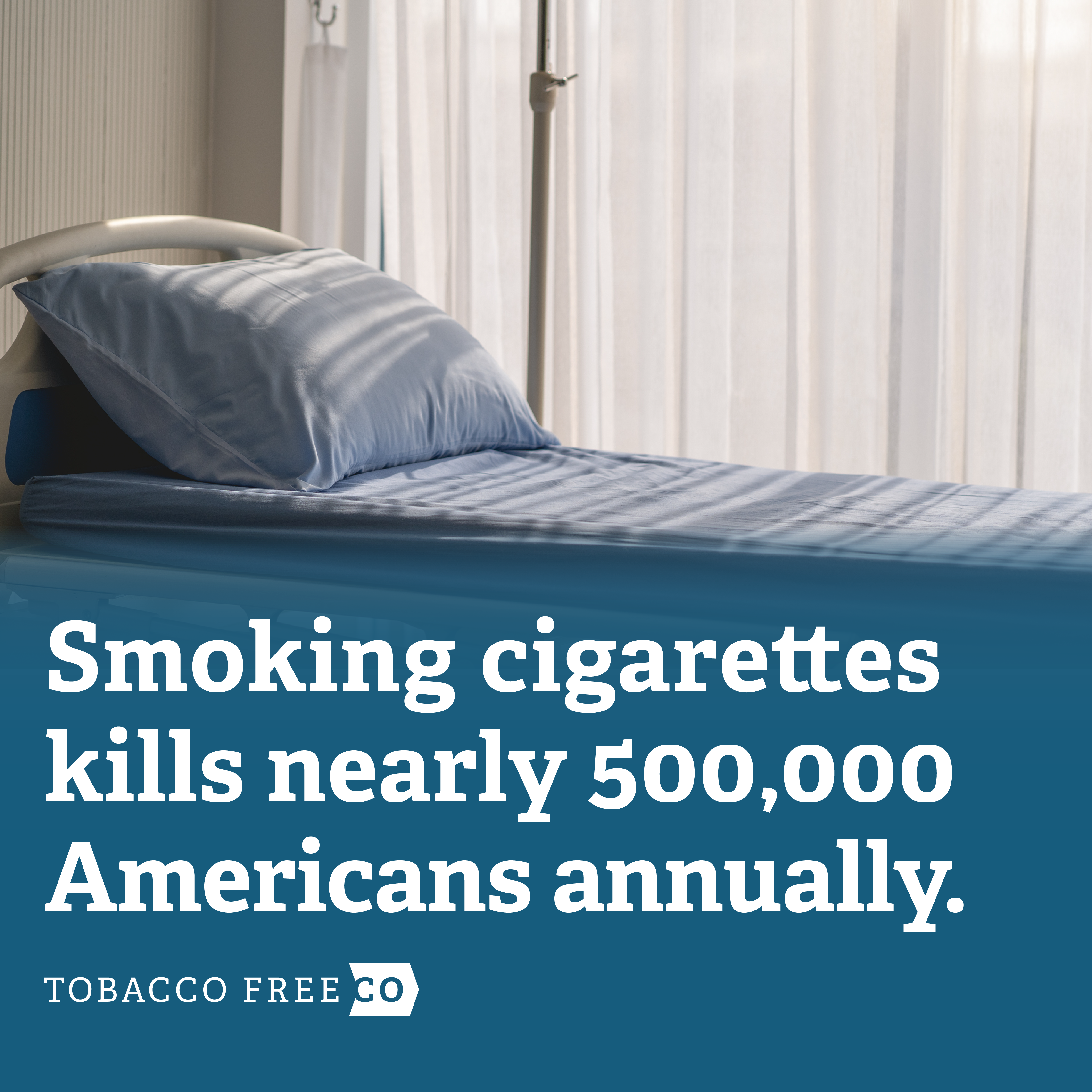
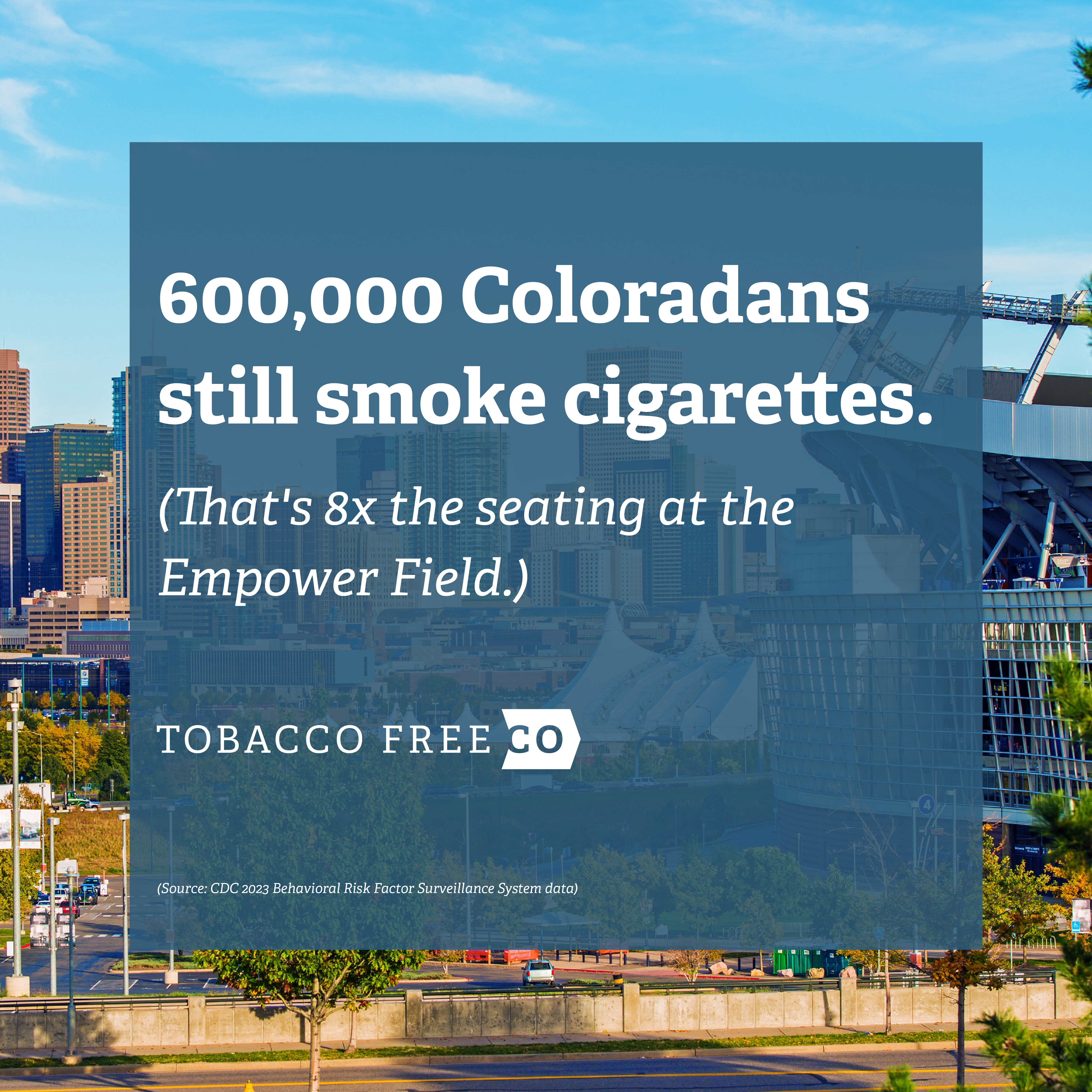
That’s why the industry lured kids to pick up smoking. They were, as one industry memo stated, “replacement smokers.” The marketing formula: Teen-focused ads, discounts for cost-sensitive teens, and fruity and menthol (i.e., minty) flavors that masked tobacco’s harshness for young smokers.
Technological advances allowed Big Tobacco to move beyond cigarettes to flavored vape and now oral nicotine products (ONPs) — and attempt to launder its dirty past.
If you aren’t familiar with ONPs, look at the signs and the displays at your local convenience store. They are discreet, cheap, and ultra-potent. A winning formula for addicting kids.
Some claim ONPs like Zyn from Philip Morris International U.S., which now has a factory in Adams County, Colorado, offer “harm reduction” for smokers, providing nicotine without the risks from burning tobacco. (It also was the pitch of Juul Labs, before that lie was exposed.)
 But this pitch ignores the harms of nicotine itself. Nicotine is a naturally occurring insecticide because it’s poison. The health risks to humans are well documented, beyond addiction.
Yet the latest tobacco industry trick is to reframe nicotine as “misunderstood,” even claiming alleged cognitive benefits.
After three decades of work in this sector, I am no longer surprised.
The Big Tobacco playbook is to lie and deny.
Deny that nicotine is addictive (until that lie ran its course).
Deny that the industry markets to kids (despite the mounting volume of evidence to the contrary, including its own internal documents).
To readers, it may seem that I’ve become one of the advocates who I once discounted as almost paranoid. I encourage you to venture out on your own fact-finding journey. You may be amazed and dismayed by what you find.
You may want to start with this short piece on ONPs and tobacco industry claims.

Make It Easy for Your Audience: Accessibility Improves Every Message and Campaign
Improve Readability and Visual Connection
Most Americans read at a sixth-grade level (source)—yet too many marketing campaigns use language that’s overly complex. If a message takes too much effort to understand, people tune out. Plain, direct language always wins.
Start with strong, clear writing:
- Use simple, everyday words.
- Keep sentences short.
- Cut out jargon and acronyms.
- Write the way people talk.
Tip: Reading your copy out loud takes time—but it works. If it sounds awkward, it probably reads that way too.
Use visuals that support the story—not distract from it.
People want to see themselves—or people like them. Choose images that feel real and add meaning. Skip anything that adds clutter or confusion. And of course avoid cheesy stock photos that look staged.
- Make It Visually Accessible: Design choices can either include or exclude people. Accessibility helps everyone, especially people with vision impairments, learning differences, or just aging eyes.
- Use high-contrast colors: Black text on a white background remains one of the most readable combinations. Avoid light gray text, bright yellow text, or text over busy images. Use a contrast checker (like WebAIM) to confirm your design meets WCAG (Web Content Accessibility Guidelines) standards.
- Pick readable fonts—and size them up: Use sans serif fonts like Arial, Helvetica, or Verdana. Keep body text at least 16 point font. For printed materials, 12-point font or larger works best.
- Avoid ALL CAPS and italics: All caps slows reading speed. Italics can blur on screen. Use bold type for emphasis instead.
- Break up the page: Add white space between lines and sections. Use headers, bullet points, and short paragraphs. This keeps readers engaged and prevents overwhelm.
Go Beyond Compliance: Design with People in Mind
Accessible content isn’t just a box to check—it’s a mindset. We build stronger campaigns when we center them around the needs of the people we’re trying to reach.
More accessibility tips:
- Add image alt text for screen readers.
- Open caption videos.
- Avoid flashing elements.
- Write descriptive link text (“Read more about accessible design” beats “Click here”).
- Test your content with real users, not just internal teams.
Accessibility Is Good Strategy
When you make your message easier to understand, you expand your reach. It brings more people in, keeps them engaged, and shows you care enough to meet them where they are.
Want help building a more accessible campaign? Let’s talk.


A New Chapter in the Heart of Denver: Our Move to The Sudler
Big news—we’ve officially moved into our new office in The Sudler building, right in the heart of Denver! We’re now just a block from the State Capitol, surrounded by energy, history, and some of the best coffee in Denver.
Why We Chose The Sudler
The Sudler is a beautifully restored mid-century building with big windows, lots of natural light, and cool design details that make it feel both modern and full of character.
It’s the kind of place that sparks creativity—something that’s really important to us.
Being downtown also helps us stay connected.
We’re close to the people and organizations we work with every day, whether that’s in public health, education, or community outreach. It puts us right where we need to be to do our best work: in the mix, face-to-face, and part of what’s happening in our city.





A Moving Experience That Meant Something
We also want to shout out the amazing team that helped us move: The Other Side Movers. This isn’t your typical moving company. They hire people who are rebuilding their lives after time in prison or recovery. And they do an incredible job.
For us, choosing them wasn’t just about getting boxes from point A to point B—it was about supporting a mission we believe in: creating opportunity, building community, and lifting people up.
Come See Us!
We’re proud of our new space and what it represents. It’s more than just an office—it’s a place where ideas can grow, partnerships can thrive, and we can stay grounded in the community we care so much about.
If you’re ever in the neighborhood, come by and say hi. We’d love to show you around.

Get Uncomfortable. Get Loud. Return to Pride’s Radical Roots.
Sponsors love rainbows until doing real work gets involved. They slap logos on floats, pump cash into parades, and post glossy allyship on June 1. Then they vanish.
This year, corporate sponsors ghosted Pride events faster than a closeted politician in an election year. Organizers announced cancellations. Cities scaled back. Brands blamed “safety concerns.” But let’s name it: These corporations folded under pressure. Far-right blowback scared them, and instead of standing with the LGBTQ+ community, they sprinted for the exit.
No explanation can excuse that.
If a company can’t show up when people face real threats, then it never stood with us in the first place. It stood with marketing. It stood with visibility, not vulnerability. And visibility without courage means nothing.
Stop Pretending Pride Needs Sponsors
Pride started as a riot. Not a brand partnership.
No one threw bricks at Stonewall for the chance to snag a Gatorade logo on a banner. They fought for survival, for dignity, for breath. Pride lived in alleyways, church basements, dance floors, clubs, and marches where no one handed out coupons. We showed up because we had each other. Not because someone handed us a branded stress ball.
And here’s where the mirror turns: some Pride organizers helped the shift to commercialization happen. Some traded people for polish. They built events that looked good on Instagram but felt hollow on the ground. They let brand money dictate the vibe. They chased clean, “family-friendly” images that erased the drag performers, trans folks, sex workers, and fierce femmes of color who built the movement.
So now, when those same brands flake out, we see the cost.
Kick Cowardice Out of the Parade
Corporations can’t lead this movement. They never did. But we can hold them accountable.
Stop calling them allies. Call them what they are—cowards.
Stop begging them back. Build something stronger.
Fill the gaps with local vendors, resource organizations, community mutual aid, and unapologetic queer joy. Fund drag shows with grassroots dollars. Pack parks and streets with families, elders, youth, and fierce-as-hell trans folks who never needed a bank logo behind them.
Queer people never relied on approval before. We don’t need it now.
Bring Pride Back to the Street
Let’s end the illusion: Rainbow capitalism won’t save us.
Community will.
We can’t let sponsors define our visibility. We can’t let glossy campaigns erase the mess, the grief, the joy, and the power that make Pride real. This moment calls for more than just celebration. It demands reckoning. And resurrection.
Let’s build Pride that scares cowards again.
Let’s build Pride that honors its roots—loud, sweaty, righteous, and bold.

Tune In, Not Out: Hearing Testing Is Easier Than Ever and It Could Help Your Overall Health
Apple’s earbuds came out with the iPod in 2001, but became iconic in the 2003 “silhouettes” ads—dancing shadows against bright backgrounds with white headphone cords. The message was clear: these little headphones connect you to music you love.
Twenty years later, we don’t have the cords anymore, but people can’t live without them.
The devices that once helped people ignore the world around them can now actually help us experience our surroundings better.
Noise canceling shuts out background noise when you need to focus, and ‘transparency’ modes amplify outside noise to make it sound like you aren’t wearing headphones at all.
It’s now normal to wear earbuds all the time. People don’t judge you for having “speakers stuck in your ears” anymore. In fact, someone wearing earbuds might hear you better than someone without them.
Apple recently received FDA approval for its new “Hearing Aid” feature for AirPods Pro 2. Delivered as a free software update, it helps to amplify noise for those with mild to moderate hearing impairment. Additionally, it offers the ability for users to take a validated hearing loss test and receive instant results, all from their home.
Reducing the barrier to entry for this first step of the process makes it more approachable and means more people might take a test earlier in life.
Importantly, the hearing test and hearing aid work together to respond to each person’s hearing needs. They customize the sound to reduce stress from straining to hear, whether you’re talking to people in person, listening to media, or making phone calls.
Taking care of your hearing is a key part of staying healthy as you age. When people can’t hear well and start avoiding social situations, they have a higher risk of developing Alzheimer’s disease. Most people don’t think about hearing health until they notice problems, but proactive protection can make a big difference.
When we talk openly about hearing loss, it’s easier for everyone to get help and prevent damage. Taking my first hearing test made me nervous—but doing it at home without an appointment made it much easier. Now I can share my experience with others and encourage them to try it. I also have a starting point to track my hearing in the future.
We need to start talking about simple actions like this that can change our lives later on. Tell your family, especially older relatives, about protecting or enhancing their hearing.
Eliminate the stigma and normalize the discussion.
If you already have these AirPods, take the hearing test. If you don’t have them, think about getting a hearing test – they’re easily accessible at ENT offices, audiology clinics, and even wholesale stores like Costco and Sam’s Club.
Or, use this technological advancement as an excuse to get a new pair of earbuds.


Being the Change: A Weekend Neighborhood Cleanup
For months, I’d walk through my neighborhood, noticing the litter that collected along the sidewalks and in front of people’s homes. Candy wrappers, plastic bottles and cans, the occasional stray grocery bag—it was always there, and I always found myself wondering, Why doesn’t someone clean this up?
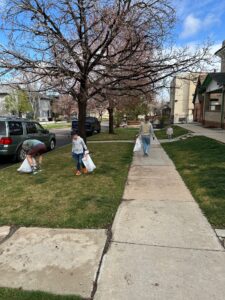 This weekend, I decided that someone could be me. And not just me—my niece, nephew, sister and husband joined in, turning what could have been a chore into something surprisingly fun and meaningful.
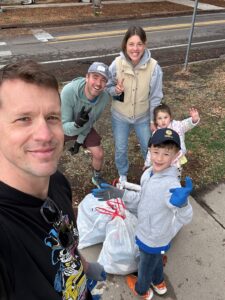 Armed with gloves, trash bags, and a sense of purpose, we spent a couple of hours picking up litter. It was simple, but the impact felt big. The streets looked better, of course, but more than that, it was a lesson in action. My niece and nephew got to see firsthand how small efforts add up, how being a good neighbor isn’t just about waving hello but about taking care of the place we all share.
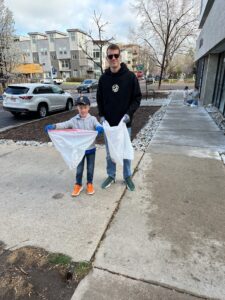 Beyond cleaning up the trash, we were also helping to create a new social norm for our community. When people see others taking pride in a clean neighborhood, it sets an example. It makes it more likely that others will step up too—or at the very least, think twice before littering in the first place. Change starts small, but when enough people see it happening, it becomes the new normal.
It’s easy to feel overwhelmed by problems bigger than us—climate change, pollution, all the chaos in the world. But this was one thing we could control. And in doing it, we felt just a little more hopeful, a little more empowered.
As we worked, a few neighbors stopped to say thank you. One even mentioned they might bring their own kids out to help next time. That’s the thing about small acts of change—they ripple outward. Maybe next time, there’ll be even more of us.
So if you’ve ever walked past a mess and thought, Someone should do something about that—maybe that someone is you. You might be surprised by how good it feels.

Break Barriers with Transcreation+: Adapt, Connect, Succeed
Words and images hold power, especially when they reach people in ways that make sense to them.
Too often, messaging and marketing get lost in translation—literally and figuratively. A word-for-word swap might capture meaning, but does it capture connection? Do the images connect across cultures? Do they hit home?
That’s where transcreation comes in. Instead of just translating, transcreation reshapes messaging to match cultural context, emotional nuance, and audience expectations.
When we think about culture and community, we need to understand values and lived experiences. The goal is to create a full experience—concepts, images, and language all working together.
Ensure Creative Matches the Audience
Translation is a word-by-word literal change to another language. Transcreation ensures impact.
- Translation: Converts words from one language to another. Additionally, interpretation takes spoken word to another language.
- Transcreation: Merriam-Webster defines transcreation as “The process of adapting a message from one language to another while maintaining its intent, style, tone, and context.”
Introducing Transcreation+
Transcreation+ expands the concept beyond translation to encompass all forms of marketing and communication to all types of audiences. It’s about adapting not just words, but also visuals, tone, and storytelling structures to ensure every message lands the right way with the right people – even if you’re an English speaker trying to reach a specific English-speaking audience, or a Spanish speaker trying to reach a specific Spanish-speaking audience, etc.
Because communication isn’t just about words, it’s about context, values, and cultural nuance.
Adapt Words, Images, and Concepts
Words don’t exist in a vacuum. Different audiences respond to different styles of communication and storytelling approaches.
- A middle-aged Spanish-speaking man might prefer a formal, respectful tone with traditional imagery.
- A bilingual Spanish-speaking teen might connect more with Spanglish, emojis, and dynamic visuals.
Transcreation+ isn’t just about translating between languages. It’s about adjusting how we communicate — verbally and visually — across different cultural and social groups.
Shape Stories That Resonate
Whether communicating in English, Spanish, or another language, Transcreation+ ensures messaging resonates—not just in words, but in the way they connect.
That means:
- Using images that reflect the audience and their experiences.
- Choosing words that feel natural and inviting.
- Structuring campaigns with concepts that align with cultural values.
Because when words, images, and ideas connect—change happens.
Invest Where it Counts
A one-size-fits-all campaign might seem like the most budget-friendly option, but it often falls flat—failing to connect with key audiences. Transcreation+ is a more complex approach, and it may require a larger budget.
Adapting messaging, visuals, and storytelling for multiple audiences takes time, research, and resources. But investing in the right strategy upfront prevents wasted spend on ineffective outreach. Instead of asking, “Can we afford this?” consider: “Can we afford not to?” Because real impact comes from messaging that truly resonates—and that’s worth the investment

Tumblr's New Politics-Free Position and Attempted Comeback
For a while, Tumblr seemed like a ghost town.
After its heyday in the early 2010s, the platform faded into the background as Instagram, Twitter (now X), and TikTok took center stage.
But lately, Tumblr has been creeping back into cultural conversation. Not as the chaotic free-for-all it once was, but as something better—or at least, something different.
They seem to be rebranding as a space safe from politics and toxic-masculinity – with new TV ads to boot. You can see info about their campaign here.
Can it reclaim its place as an internet haven, or is it just a relic of a bygone era? If the internet feels exhausting, Tumblr might be your refuge—or maybe not.
What Made Tumblr, Tumblr
In its prime, Tumblr felt like the Wild West of the internet.
People used it to build micro-communities around everything from niche aesthetic vibes to full-blown fandom empires.
Unlike other platforms, where clout and engagement metrics rule, Tumblr thrived on anonymity. You could be anyone, post anything (sometimes to a fault), and disappear into your curated world of memes, art, and hyper-specific obsessions.
Some of the things that made Tumblr unique:
- No Algorithms – Your feed showed posts in chronological order, not whatever the algorithm decided you should see.
- Micro-Communities – Whether you loved gothic architecture, vintage anime clips, or surreal memes, there was a corner for you.
- Creative Expression – Writing, art, and GIFs thrived without pressure for likes or shares.
For me, Tumblr was all about Superwholock— Frankenstein’s monster of fandoms combining Supernatural, Doctor Who, and Sherlock. That corner of the site lived on inside jokes, fan fiction, and GIFs moving at light speed.
I had around 5,000 followers, though most of what I did was reblogging content that aligned with my specific interests. My partner, on the other hand, was deep in “stoner Tumblr,” which was exactly what it sounds like.
The variety of subcultures made Tumblr feel endless—there was a place for everyone.
For others, like SE2 Associate (and self-described recovered Tumblr fanatic) Mikey Talley, it was a vision board before Pinterest, a space to curate dream outfits from fashion magazines, capture aesthetics and scenic escapes, and craft aspirational collages.
It became a hub for discovering underground music, fresh perspectives, and inspiring quotes while connecting with like-minded people across the globe. More than just a collection of images, it was a personal sanctuary—a little corner of the internet where creativity, exploration, and self-expression flourished.
The Vine Connection and Tumblr’s Influence
People forget how much Tumblr shaped internet culture. Many of the viral trends that defined early social media either started or thrived there. The now-defunct Vine owes a lot to Tumblr; many of its biggest moments first gained traction through reblogs before hitting wider audiences.
Some ways Tumblr influenced internet culture:
- Absurdist Humor – Nonsensical memes and inside jokes ran wild.
- Remixing Content – Users reworked and built on each other’s creations.
- Fan Culture – Fandoms grew deep roots, creating lore and traditions still seen today.
Why Tumblr Feels Right Again—Or Does It?
In a digital landscape dominated by Meta’s ad-choked feeds and X’s toxic free-for-all, Tumblr’s weirdness feels like a relief. But does it still have a place?
Some arguments for its renewed relevance include:
- No Pressure to Perform – There’s no race for engagement or clout.
- No Algorithm Manipulation – You see what you follow, nothing more.
- No Endless Ads – Unlike other platforms, Tumblr hasn’t turned into an ad-filled wasteland.
I’ve been tempted to dust off my old account, clean up the chaos, and get back into it.
Tumblr has always been silly, fun, and surprisingly pure in its weirdness. Maybe that’s exactly what the internet needs right now. Or maybe it’s just a nostalgic relic from a different era of the internet.
What do you think? Is Tumblr making a comeback, or is it just trying? Let’s talk about it.

DEI and the Bottom Line: How Inclusion Drives Marketing ROI
Diversity, Equity, and Inclusion (DEI) isn’t just a trendy buzzword—it’s a critical driver of business success. Yet, many companies today are backtracking on their commitments because of the current political climate.
This regression doesn’t just harm marginalized communities; it undercuts the very foundation of modern marketing strategies.
Let’s break this down: DEI delivers results. It builds trust, fosters loyalty, and creates genuine connections. Ignoring it means leaving money—and humanity—on the table.
Define DEI with Clarity
Diversity means representing a mix of identities, backgrounds, and experiences. Equity ensures everyone receives fair treatment, access, and opportunities. Inclusion means creating spaces where all people feel valued and welcomed.
Together, these principles form a powerful framework that fuels innovation and growth.
However, DEI is more than policies and training sessions. It demands integration into every facet of a company, especially marketing.
When brands prioritize representation and equity, they connect with audiences who see themselves reflected in campaigns.
Use DEI to Build Emotional Connections
People crave connection. They want brands to understand their stories, struggles, and victories. Representation creates that bond.
For a young transgender individual, seeing someone like them in an ad isn’t just a marketing move—it’s a lifeline.
For a Black professional, spotting their identity celebrated in a campaign validates their experience.
When brands embrace DEI authentically, they build emotional connections that foster loyalty. This commitment translates directly to the bottom line. Inclusive marketing doesn’t just feel good—it works.
Back It Up with Results
DEI efforts boost revenue. McKinsey’s study on diversity in leadership found companies in the top quartile for racial and ethnic diversity outperform competitors by 36% in profitability. Firms with diverse teams generate more innovative ideas, appeal to broader markets, and maintain stronger reputations.
Take Procter & Gamble’s “The Talk,” a campaign addressing conversations Black parents have with their children about racism. It won accolades for its honest storytelling and drove consumer trust.
Representation creates relatability, which translates into consumer action.
Respond to Today’s Needs
In today’s fractured world, connection matters more than ever. Consumers demand authenticity and accountability.
Performative gestures—like slapping a rainbow logo on a product in June—no longer suffice. People want meaningful action. Brands must move beyond surface-level commitments and demonstrate real investment in DEI values. Regression in DEI initiatives threatens to erode the progress made. Brands that retreat risk alienating vast segments of their audience.
Conversely, companies doubling down on DEI efforts stand out as leaders. They demonstrate courage, empathy, and a commitment to equity—traits that build unshakable loyalty.
Make DEI Your Marketing Advantage
Brands must integrate DEI into their core strategies. Start by listening to marginalized communities and amplifying their voices. Build campaigns rooted in authentic stories. Take actions that reflect your values. Measure your impact, refine your approach, and prioritize transparency.
The cost of ignoring DEI is far greater than the investment needed to embrace it. Companies that lean into inclusion reap the rewards of loyalty, innovation, and long-term growth. More importantly, they contribute to a world where everyone feels seen, valued, and respected.
So, let’s ask ourselves: What kind of impact do we want our marketing to make? Let’s ensure our brands are more than businesses. Let’s make them forces for equity and connection—because when DEI wins, everyone wins.

Communications Lessons from 2024 and a Vision for 2025
As 2024 draws to a close, the marketing and communications world finds itself in a fascinating moment of transition. This year brought rapid technological advancements, shifting audience expectations, and putting an even greater demand for authenticity in a crowded media landscape.
At SE2, we’ve been navigating the challenges and opportunities that defined 2024 and exploring the trends that will shape the future.
2024: A Crisis in Confidence for Communicators
The most important shift in 2024 wasn’t just a new platform or technology—it was a change in audience expectations. “Audiences became increasingly skeptical and selective, seeking messages that resonate with their values,” said RJ Johnson, SE2’s content producer. With shrinking attention spans and heightened skepticism of traditional marketing tactics, authenticity emerged as a vital currency for building trust.
Video formats—especially short-form—cemented their dominance. As Public Relations and Community Outreach Specialist Elizabet Garcia noted, “Instagram and TikTok amplified the power of short videos. They’re the perfect length to deliver big messages without losing focus.”
At the same time, alternative channels like podcasts gained momentum, with political figures and brands alike exploring new ways to connect directly with these audiences.
AI wasn’t just a buzzword—it became a tool. “AI isn’t the enemy or the savior,” said Principal Eric Anderson. “It allows us to automate mundane tasks and elevate our focus on things only humans can do.”
Principal Susan Morrisey observed that AI matured from a novelty to a practical resource, reshaping workflows without replacing the core of good communication: human creativity.
2025: Authenticity Takes Center Stage
Looking ahead, authenticity will remain the bedrock of effective communication. “Audiences crave narratives grounded in genuine experiences—not polished campaigns,” shared RJ Johnson.
Real stories rooted in shared values will cut through the noise, fostering trust in a divided and cluttered media landscape.
AI will continue to grow in prominence, but its role will evolve. “People are becoming more attuned to recognizing how AI is used,” observed Mikhail Talley, associate. “They’ll place greater value on what AI can’t replicate: authentic human emotion.”
To stand out, brands must pair AI-driven efficiency with deeply human storytelling.
At the same time, face-to-face connections will reclaim importance. “In-person interactions build trust in ways AI and digital tools cannot,” said Eric Anderson. This trend highlights the need for human-centered strategies that go beyond screens, from meaningful community engagement to real-world collaborations.
And as misinformation and disinformation loom large, regulator shifts could redefine the boundaries of communication. “Emerging regulations like COPPA 2.0 could drastically impact how advertisers engage with young people,” said Jack Cohen, associate. COPPA 2.0 refers to proposed updates to the Children’s Online Privacy Protection Act (COPPA) aimed at strengthening online privacy protections for children, addressing emerging technologies, and expanding regulations to better safeguard minors’ data in the digital age.
Navigating these changes will require agility and a deep understanding of evolving platforms.
Bridge 2024 to 2025 and Beyond
The world of communications never stops evolving, and 2024 underscored the importance of adaptability. As we look to 2025, our focus remains on fostering connections, telling real stories, and meeting audiences where they are—whether through AI-enhanced strategies, video platforms, or in-person interactions.
At SE2, we’re committed to navigating the challenges ahead with creativity, resilience, and an unwavering dedication to the communities we serve. As Mikhail Talley summed up, “In an increasingly divided world, the most important thing is to focus on the common values that connect us all.”

Power Your Creativity: 4 Resources Every Designer Should Know and 1 Bonus Tip
Every designer has go-to resources that spark creativity and help bring ideas to life. For me, SE2’s graphic designer, the key is balancing discovery with the right digital tools. Browsing top rebrands, unique color combinations, and storytelling campaigns sharpens my design eye and keeps me inspired.
Here’s a look at my creative toolkit:
 1. Behance
Behance showcases design solutions from freelancers and agencies worldwide. It’s my first stop for inspiration—whether I’m seeking visuals or practical resources like free mockups and fonts. It’s a global gallery of creativity.
 2. TypeWolf
When selecting fonts, TypeWolf helps me find the perfect type pairing. From classic choices to the latest in typography, it offers examples that capture the character and tone of any project.
 3. Envato Elements
Envato Elements provides everything from illustrations to high-quality stock photos. Our SE2 subscription covers a huge range of licensed materials, making it easy to find what I need to bring a concept to life.
 4. Mr. Mockup
Mockups help present designs in real-world settings. Mr. Mockup offers a variety of templates that give clients a vivid preview of the final result, enhancing their connection to the project.
Connect with Other Creatives
In-person events, like those by Creative Mornings, create opportunities to meet other creatives, exchange ideas, and discover even more resources.
These tools keep my work sharp and inspired. They make the creative process more dynamic and connect me to a community of designers who enrich my work every day. Whether through digital platforms or in-person networking, staying inspired is all about finding—and sharing—the right resources.


Meet Elizabet Garcia: A New Voice for Community-Centered Advocacy at SE2
SE2 is excited to introduce Elizabet Garcia (she/her), a dedicated advocate for community-centered change and a powerful new voice on our team. With a career rooted in amplifying underrepresented voices and fostering lasting impact, Elizabet brings a passion for equity and inclusivity that aligns seamlessly with SE2’s mission. Her experience spans leading strategic campaigns and building connections that empower communities, making her a perfect addition as SE2 continues driving meaningful change across Colorado and beyond. Get to know her through these three questions.

What made you want to focus your career on making change for good through causes and issues?
I’ve always been driven by the idea of creating meaningful, positive change, which has shaped my career focus on advocacy and public service. From leading comprehensive communications strategies with the American Federation of State, County, and Municipal Employees to founding Verbo LLC, where I advised on inclusive community outreach initiatives, my work centers on connecting people to causes that matter. I find fulfillment in amplifying the voices of historically marginalized groups and developing messages that engage diverse communities. Working on campaigns that promote equity and representation fuels my passion for making an impact that lasts and resonates.
Each project, whether addressing urgent political issues like affordable housing, creating community-centered messaging in places all around Colorado, or helping underrepresented voices be heard, has reinforced my understanding that genuine change comes from within communities. My goal has always been to not only address the immediate issues but also to inspire lasting engagement and build pathways for sustainable change.
What do you like to do when you’re not working?
When I’m not working, I stay actively involved in my community as a volunteer on the Colorado Consumer Health Initiative Board of Directors, where I contribute to supporting the work they do in the health equity and advocacy space. I also love spending my downtime traveling to new places, swimming, and getting lost in a good book. Above all, I genuinely value the time I spend with family and friends, whether we’re eating together, exploring new places, or simply catching up.
Where did you grow up and how did your early experiences help shape who you are today?
I grew up in Greeley, Colo., a community with diverse cultural backgrounds that deeply influenced my values and career direction. Growing up in a bilingual household, I was naturally immersed in the diversity of languages and stories that make up our community. This environment sparked my passion for communication and community outreach as I saw how effectively bridging cultural divides can empower people and amplify underrepresented voices.
From a young age, I became involved in civic activities, which taught me the power of collective action and the importance of advocacy. These early experiences, along with the mentorship I received in local organizations such as the Colorado Latino Leadership, Advocacy & Research Organization or CLLARO, shaped my commitment to supporting communities in need. Today, in my work, I draw on these experiences to create impactful messaging and foster relationships that advance positive change.

Move Beyond Demographics: Communicate with Core Beliefs in Mind
How can shifting our focus from demographics to understanding values and motivations foster more meaningful conversations, even when discussing challenging topics?
Perhaps never has this topic been timelier.
More in Common’s session on Speaking to Values and Identities at The Communications Network’s ComNet24 last month challenged me to rethink how I approach and communicate perspectives outside my own.
In our professional and personal lives, we often categorize people by race, sex/gender, age, or political affiliation. From these labels, we make snap assumptions and conclusions about how someone might think, act, or navigate the world, which in turn shapes how we communicate with them.
However, research from More in Common encourages us to look deeper — that real understanding goes beyond surface labels. Every person is different, why are we still only focusing on small parts of what makes someone human?
More in Common’s Hidden Tribes Study reveals that America’s divides stem from deeply held ideals rather than just race, politics, or socioeconomics. By focusing on values, motivations, and worldviews—referred to as “core beliefs”—we can connect more authentically.
Core beliefs influence how individuals perceive the world and respond to social and political issues, providing a more nuanced perspective. Traditional demographic labels play a role in a person’s core beliefs, but they don’t tell the whole story. We can create communication that resonates authentically with each person’s lived experience better when considering their upbringing, current reality, and aspirations for the future.
The study identifies five key dimensions that shape worldviews:
- Tribalism and group identification
- Fear and perception of threat
- Parenting style and authoritarian disposition
- Moral foundations
- Personal agency and responsibility
These dimensions helped group Americans into seven “hidden tribes,” ranging from Progressive Activists to Devoted Conservatives. In the middle lies the Exhausted Majority—a group of ideologically flexible individuals, frustrated with the current state of the world but not strictly aligned with either “side”. This majority in the middle may offer the most room to create change, if we can identify, understand and leverage their core values.
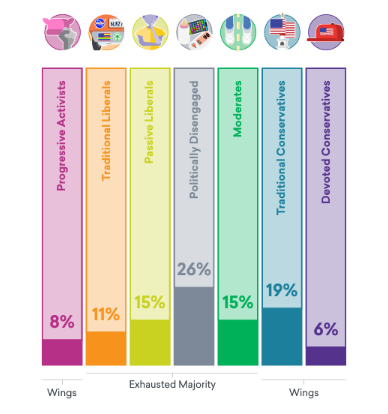 More In Common’s Hidden Tribes
>>> Discover more on the Hidden Tribe profiles <<
>>Take the quiz to find your “Hidden Tribe”<<
From ‘Who’ to ‘Why:’ Rethinking How We Understand and Engage Audiences
To communicate more effectively, we need to shift our mindset from focusing solely on “who” our audience is to understanding “why” they think the way they do.
For example, consider what values drive their beliefs about community and responsibility instead of assuming their stance on an initiative based on their race, age, or income. Are they motivated by a sense of fairness? Safety? Freedom? And how do these factors shape their views?
Asking questions like these can create authentic communication that resonates with a person’s deeper concerns and priorities.
Therefore, effective communication requires engaging with those who don’t share our views to better understand their core values, and bridge divides. If we only surround ourselves with like-minded individuals, we limit our understanding of others, making it challenging to connect with people who have different perspectives and experiences, people who could also potentially benefit from our work.
And when we misunderstand or overlook core values, we risk mischaracterizing entire groups, leading to shallow communication or reinforcing divides. This creates what More in Common calls a “perception gap,” where we assume there is more division than actually exists, perpetuating stereotypes and further emphasizing disconnections.
For instance, assuming that “traditional” values imply resistance to change can overlook potential motivations like stability or a desire for community.
While focusing on values can potentially help bridge differences, it’s important to recognize its limits. When people hold very rigid or extreme views, emphasizing shared values might not just fall flat—it can be a non-starter, especially if those values clash outright with the core message.
Values as a Bridge: Calling People In
Starting with values can transform how we communicate and invite people into conversations that matter. A values-based approach creates opportunities to call people in—building dialogues that lead to sustained connections and change.
People are complex, and so are their experiences. Whether crafting a campaign message or navigating a tough conversation, consider starting with values to foster understanding.
By acknowledging the motivations that drive people, we can communicate in more genuine and impactful ways. In a world where it’s easy to talk right past each other, this kind of intentional, values-driven approach may be exactly what’s needed to bridge divides, build real connections and drive change towards a collaborative vision for the future.


Cut the Fluff: Lessons in Smart Brevity from ComNet 24
Making complex stories scannable for busy readers? Easier said than done.
The training on Smart Brevity at The Communications Network’s ComNet 24 in Kansas City, led by Axios, reshaped my approach to content.
This piece? It’s me putting that training to work—trimming down, focusing on what’s relevant, and trying to keep you reading.
Key Lessons I’m Using Right Here:
- Shorter is stronger.
Axios laid out the facts: Only 5% of people finish an 800-word article. Aim for half that length. It’s not about cutting words; it’s about cutting fluff. This blog? Around 400 words max, so every sentence here earns its place.
- Hook them with what’s new.
You’ll notice we skipped a big intro here. That’s on purpose. Readers—especially busy communications pros—want to know what’s new right away.
- Be a “word surgeon.”
Words have weight. At ComNet, we practiced paring paragraphs down to a word or two. It’s about removing filler, and that’s why I’ve kept each lesson short here—you’re getting only what matters.
- Think story, not facts.
People remember stories, not fact after fact. Even in brevity, storytelling should guide us. This blog aims to share not just tips but tell the story, however brief, of how Smart Brevity changed how I think about my writing.
- Be human, not robotic.
Smart Brevity isn’t just stripping language down; it’s about clarity. Writing as if I’m speaking directly to you keeps it natural, conversational, and clear. Read it out loud—if it doesn’t sound right, refine it until it does.
Practical Tips Applied:
- Audience first. I’m writing with you in mind—one of SE2’s key audience members looking for actionable insights.
- Scannable structure. Notice the bold headers, bullet points, and the most important words first? This format lets you quickly decide whether to dive deeper or move on.
- Precise headline. Headlines should be 10 words or fewer. No clickbait. And yes, emojis boost engagement by 6%—which is why I added one here.
Why It Matters
Smart Brevity isn’t just a technique; it shows respect for your reader’s time. Making every word work double-duty requires us to put our audience first. As communicators, the challenge is clear: Write so they stay.

Leadership in Action: Alvina Vasquez on Political Engagement and Networking
SE2’s newest Principal, Alvina Vasquez brings a wealth of experience and passion for community outreach. She reflects on her journey of professional growth, shares advice on how to make a meaningful impact in today’s political climate, and offers insights on building a strong, supportive network. Whether you’re looking to engage with your community or elevate your career, Alvina’s perspective offers real, actionable advice to help you succeed.
Q: Since joining SE2, what ways have you felt challenged/grown in?
A: I didn’t invent community outreach, but I’ve dedicated my career to professionalizing it. This approach is new to many, and one of the biggest opportunities I’ve encountered is inspiring others to see its significance. It’s immensely rewarding to communicate the importance of building strong relationships and to demonstrate how our efforts create positive, lasting impacts in our communities.
Q: In our current political climate, what advice do you have for folks to get involved and make a difference, outside of just voting? How can people get together? Especially post-election?
A: The easiest way to get started in working in and advancing political messages is meeting people where they are at, listening to their pain points and finding common ground. Hosting themed gatherings to bring awareness to issues that matter is a great way to help. Also not just voting but telling people that you are voting. Social pressure is a great tool to make others make time to vote. Colorado has the safest and most accessible voting process in the country, help a friend out on how to get registered and how to vote.
Q: What’s your advice for building up your network and connections?
A: My advice for building a network is to meet in person, make yourself valuable to others by asking them how you can help them succeed, and do it if it’s within your skill set. We are all trying our best to do our best work, and if you can help others feel good about themselves and the work that they do, your network will grow, and you will also be trusted and sought out.

Change That Lasts: Lessons from SE2’s CEO
In a rapidly changing world, SE2’s Principal and CEO Susan Morrisey sees “change for good” as both a responsibility and a privilege. Reflecting on her team’s legacy, she shares insights on creating lasting impact, connecting authentically with audiences, and the progress and persistent challenges women face in executive roles. Her guidance emphasizes the power of amplifying real voices, embracing community-driven change, and advancing meaningful conversations in every project.
Q: What is the “change for good” SE2 has had a part in that you’re most proud of?
A: If I look for the throughline of our impact over the past 25 years, it’s been generating energy and enthusiasm around issues and stories that might have gone unnoticed. Whether we’re working to change policy, public opinion, or personal behavior, these are the issues that have real impact on people’s lives. Moving forward, our challenge is to support community conversations and priorities – not the other way around. That’s how we get to meaningful, sustainable change.
Q: What’s your biggest piece of advice for copywriting/storytelling?
A: Our role as storytellers is to simply amplify the real, authentic stories people want to tell. Often, we come into it with our idea of what makes a compelling story driving the narrative. If we listen, rather than direct, the results can be surprising and moving.
Q: As a woman in business, especially in an executive role, what challenges do you feel women still today face? What challenges have improved or gotten worse?
A: I think it depends on where women are “in business”. In many areas – including government, nonprofit, and corporate settings – women’s power and influence has continued to grow. But there continues to be a barrier for many top executive roles. I look forward to a time when women aren’t only appreciated for the “soft skills” we bring to the table but are judged fairly for and in positions of power.

How to Create Memorable In-Person Events that Foster Connection: 3 Takeaways from An Expert (Plus Lessons I Learned from My Drag Show)
Creating memorable in-person events is a challenge and an opportunity in a post-pandemic world buzzing with virtual options. Recently, we gathered for an insightful training session led by Val Nosler-Beck, founder of Upstream and the Steady Network. Her wealth of experience in event planning, particularly in the political realm, gave us valuable tips to elevate our events.
Here’s what we learned, along with my own journey in event planning and how these insights apply to SE2 and the broader marketing landscape.
It’s All About the Experience
The landscape of event planning has changed dramatically. As audiences have grown accustomed to attending events from the comfort of their homes, they now seek in-person experiences that offer genuine value for their time.
Gone are the days of generic galas and dull dinners. Instead, people crave vibrant gatherings that engage and excite.
Organizers must be creative in building for each event. There is no one way to reach out; it’s best to use multiple platforms to reach the desired event participants. Going beyond emails and event pages, it is important to leverage personal connections—direct messages, phone calls, and even involving the venues themselves in outreach. This personal touch not only boosts attendance but also fosters a sense of community before the event begins.
One key takeaway—which has always been important—is the need for meticulous planning. As soon as you know an event is on the horizon, start organizing. Avoid or minimize days of emergencies and bumps in the road by establishing the event team’s clear roles and responsibilities. This clarity leads to a smoother process and allows for effective collaboration. In addition to defining roles, it’s crucial to set internal deadlines and regular check-ins throughout the planning process. These checkpoints help you assess progress, decide which elements to move forward with, and identify what may need to be adjusted or cut. As the event day approaches, make time to meet with your team and conduct thorough checks on the status of tasks. This will catch any oversights. To improve the process and take advantage of learning opportunities, gather your team within a day to discuss what worked, what didn’t, and how to improve for next time, fuels growth and enhances future planning efforts.
Lessons from my Journey with Event Planning
I’m RJ Johnson, a content producer at SE2 with over six years of experience in event planning. My journey began in college and took a vibrant turn as I embraced drag, became my drag king persona, George Not-Strait, and began to produce shows. Alongside my partner, who is also a drag performer, we launched StageFluid, a monthly open-stage drag show, in March 2022.
StageFluid began as a space for performers of all levels, inspired by the inclusive spirit of the “Rise of Kings” show that we both loved, which ended during COVID when the venue closed and the troupe producing it disbanded. Initially hosted at a smaller venue, we faced turnout and venue challenges. However, our event transformed into a beloved community gathering after moving to the Mercury Cafe in July 2023. We regularly pack the venue with 100 hundred attendees, fostering a lively atmosphere filled with creativity and talent.
StageFluid began as a space for performers of all levels, inspired by the inclusive spirit of the “Rise of Kings” show that we both loved, which ended during COVID when the venue closed and the troupe producing it disbanded. Initially hosted at a smaller venue, we faced turnout and venue challenges. However, our event transformed into a beloved community gathering after moving to the Mercury Cafe in July 2023. We regularly pack the venue with 100 hundred attendees, fostering a lively atmosphere filled with creativity and talent.
At StageFluid, we pride ourselves on creating an inclusive environment. There is no theme, allowing performers the freedom to express themselves in whatever way resonates with them. Performers can explore various roles—emcees, stagehands, DJs—gaining valuable experience that enhances their skills and confidence. We prioritize creating a safe space where everyone feels welcome, no matter their experience level.
We cater to two key audiences: performers and attendees. For our performers, we offer a welcoming space to express themselves freely, regardless of experience level. They can try new roles, explore creativity, and develop skills enhancing their drag careers. Many performers who have graced our stage have gone on to start their own shows, contributing to a thriving performer ecosystem.
Additionally, we foster collaboration within the drag community. We recommend other venues and events to our performers, creating a network that supports everyone involved. In turn, we also welcome other producers who invite us to participate in their shows, reinforcing a sense of unity and collaboration among creators.
For our audience, we provide great entertainment and a chance to engage with and support the community. The more people who attend and have a fantastic experience, the more likely they are to return and invite others. This ripple effect cultivates interest in trying to drag and join the community.
Accessibility is paramount for us. We keep StageFluid free to attend, ensuring that anyone can enjoy the show without a cover fee. We heavily utilize Facebook for outreach, as we know that many drag performers and supporters are active on that platform. We actively engage with our community, inviting everyone to become a part of this celebration of creativity.

To promote our shows, we encourage our cast to invite friends and family and provide them with a toolkit of promotional materials to share across social media. I boost our event on Meta about $40 a month and share it in relevant groups to attract new attendees. Our approach to outreach emphasizes personal connections; I often send DMs or texts to invite people directly, making them feel valued.
Feedback is essential to our growth. At each show, we announce the next event, fostering anticipation. We listen to our community’s suggestions, ensuring that we evolve and meet their desires. This engagement cultivates a loyal audience eager to return month after month.
Our event has put into practice many of the practices Val brought up in her training; we just had to learn them the hard way. Some of our big takeaways have been that a venue can make or break an event, personal invites go way further than simply posting or sharing an event, and knowing your audience is critical to success. We have created a safe and fun experience for both our performers and our audience, which has led to tremendous interest and loyal attendees who come back month after month.
Transferring These Insights to Marketing and Communications Space
The lessons from event planning extend well beyond the logistics of execution—they’re about creating lasting impact and fostering genuine connection. Here are three key takeaways that can be applied to the marketing and communications space:
- Make It an Experience: People want something memorable, whether it’s an event or a marketing campaign. Beyond just delivering information—focus on creating an engaging experience that resonates with your audience and provides rdistinct value. Experiences stick with people and give them a reason to invest their time and attention.
- Know Your Audience and Invite Them Personally: Effective outreach starts with understanding your audience and tailoring your approach to meet them where they are. Personal connections make all the difference; whether direct messages, calls, or targeted outreach, inviting people individually makes them feel seen and valued. In marketing, this is how you create loyal customers who feel connected to your brand or mission.
- Always Reflect Post-Event: Consider what worked and what didn’t after every event or campaign. Immediate post-event or post-campaign analysis is critical for continuous improvement. Through these reflections, you can fine-tune your approach, ensuring future success and growth.
These principles—creating a memorable experience, fostering personal connections, and always reflecting— apply to all forms of engagement. In a crowded marketplace, making your interactions stand out, connecting with people personally, and constantly evolving is critical to building solid, lasting relationships that drive success.

Brandon Zelasko on Growth, Technology, and How to Drive Change
Brandon Zelasko, Principal at SE2, combines a love for data and creativity to drive impactful work that changes lives. In this Q&A, Brandon shares insights into his personal growth at SE2, the future of AI in communications, and the campaigns he’s passionate about. From mentoring others to bridging the urban-rural divide, Brandon’s perspective showcases the powerful role of strategic communications in addressing today’s most pressing issues.
Q: What is the biggest way you’ve felt you’ve grown since your first role at SE2 to now?
A: The biggest way I’ve grown at SE2 is through learning how to better support and mentor others in their career journeys, something I’m still working on but find really rewarding. I’ve also started to step back from being in the weeds of the work, creating more space for others to lead. As a result, I have a wider perspective on how the issues we work on are interconnected, which has helped me apply lessons and strategies from one project to others across the agency.
Q: What new technology are you most excited about as a communications/marketing professional?
A: I’m excited about the potential of AI and how it’s going to shape the work we do at our agency in the coming years. I see AI enhancing the value we provide to clients by allowing us to work more efficiently, analyze data with greater precision, and create more personalized, targeted campaigns. While it won’t replace the human insight and creativity that are at the core of what we do, it will give us new tools to optimize our efforts and deliver even better results for the people we serve.
Q: What sort of work/issues would you love to see SE2 tackle more often?
A: I am excited to work on more workforce and alternative learning pathway campaigns, especially as the world continues to evolve and the traditional ways of learning no longer keep pace. We need professional education that helps people stay competitive so they don’t fall behind, ensuring that families and communities thrive. This shift is also key to creating more opportunities for economic growth in rural areas, helping to bridge the urban-rural divide and empower these communities to thrive in today’s economy. I would also be excited to work on more harm reduction public health campaigns because they meet people where they are, offering practical strategies to minimize the negative health, social, and economic consequences of risky behaviors. These campaigns improve public health by focusing on safety, reducing stigma, and encouraging individuals to take incremental steps toward healthier behaviors—without necessarily pressuring them to stop altogether.

Three Big Insights from SE2’s Eric Anderson: Change, Connection, and Fun
SE2’s Principal Eric Anderson has been with the company since the beginning. He is an ex-journalist chancing new communications challenges. Get some of his fresh perspectives and get to know him a little better through these three questions.
Q: In what ways has SE2 shifted in the 25+ years of change-making marketing and communications?
A: From the start we committed to focus exclusively on pressing public issues – not products — and that’s remained a constant. Most of the shifts since then have been evolutionary.
When we started, we still relied on the “sneaker net” (i.e., sharing files between computers by carrying floppy disks). Faxed and hand-delivered media releases were the norm. But the the foundations of success, regardless of the technology, are the same. For example:
- Strong messages are everything.
- Meaningful relationships matter.
- Pay attention to the forest and the trees.
- Find the courage to make bold strokes.
Along with technological advances, we’ve seen the science of behavior change and the best practices for building successful movements become clearer over the years. It’s our job to stay on top of those developments as we innovate.
Q: How do you suggest bringing people together to create change in this polarized election season and beyond?
A: From the start, SE2 existed in a sort of empty space between ideological extremes. I had friends and SE2 colleagues who were politically diverse. When we spent a lot of time together, we learned that we had a lot in common.
Unfortunately, these days fewer opportunities exist in society to interact in person and find this common ground. Social media sniping may provide a dopamine rush, but it can become an addiction that just pushes us further to our corners.
The best advice I have is that we all take the time to get to know people around us, even if that pushes us out of our comfort zones. And we need to engage in person whenever we can!
Q: What’s one way you suggest making work more fun?
A: We’ve always been committed to having fun doing serious work. That means creating a community that offers opportunities for everyone to take part and be themselves. This is less about staff outings, though those can be fun, and more about finding joy in everyday activities.

Principal Brandon Zelasko on How to Rebuild Trust: LGBTQ+ Blood Donations
Brandon Zelasko’s latest article in Health Affairs sheds light on a critical issue that has impacted the LGBTQ+ community for nearly four decades: the exclusion of gay men from blood donation. A recent FDA policy change marks a significant milestone, but as Brandon points out, the work is far from over. His personal connection to the cause, coupled with years of advocacy, underscores why rebuilding trust, educating the public, and demonstrating impact are essential next steps.
For anyone interested in the intersection of health equity and LGBTQ+ rights, this is a must-read.
[nectar_btn size=”jumbo” open_new_tab=”true” button_style=”regular” button_color_2=”Accent-Color” icon_family=”default_arrow” text=”Read A New Era Begins for Blood Donation by Gay Men” url=”https://www.healthaffairs.org/content/forefront/new-era-begins-blood-donation-gay-men”]
Dive into some of Brandon’s other essential content on blood donation and LGBT issues.
[nectar_btn size=”large” open_new_tab=”true” button_style=”regular” button_color_2=”Accent-Color” icon_family=”none” text=”Gay Men May Be Allowed to Donate Blood FDA Blood Donation Rules” url=”https://www.9news.com/article/news/local/lgbtq/gay-men-may-be-allowed-to-donate-blood-fda-blood-donation-rules/73-dd286518-3ef9-418c-bb9c-8eeab1411029″]
[nectar_btn size=”large” open_new_tab=”true” button_style=”regular” button_color_2=”Accent-Color” icon_family=”none” text=”Coming Clean on Blood Donation and Gays” url=”https://www.denverpost.com/2013/12/27/coming-clean-on-blood-donation-and-gays/”]
New Perspectives Highlight How to Use Positive Social Norms: Key Takeaways from SE2 Presentation with Montana Institute
Developing a positive community norms campaign can be challenging when you’re looking for new ways to communicate about evolving and critical issues like fentanyl and teen opioid misuse.
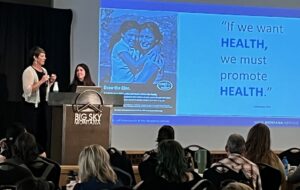
In July, I was honored to co-present at the Montana Summer Institute with the brilliant Sara Thompson, the Montana Institute’s director of communications and training. The summer event, which lasted four days in beautiful Big Sky, was attended by over 300 public health professionals from around the country, all seeking to learn more about using positive community norms to change behavior.
Highlighting positive community norms, also called social norms, can drive positive behavior change while discouraging risky behaviors.
Our presentation, The Question is the Answer, focused on asking new questions and finding new norms in the data to continue to promote the health and positives that already exist in the community.
Here are some of the key takeaways from the presentation and the approaches SE2 has used on a variety of issues, from youth prevention to childhood immunization, in behavior change campaigns across the nation.
- Identify the story you want to tell – what relevant positive norms exist in your community?
- What data is available to you? Are there any surveys that have been done recently, like a state survey?
- Based on the data available, what do you know? What hypothesis could be tested? What new questions could uncover new norms?
- What kinds of messages can you test that would highlight different norms?
- Descriptive norms, “what most people do,” describe what people actually do in a community or social circle. (Example: Most teens have never used fentanyl.)
- Injunctive norms, “what most people think or believe they should do or feel,” describe people’s attitude toward a protective behavior in a community or social circle. (Example: Most teens would support a friend who was trying to quit.)
- Bystander norm messaging says if most people perceive their peers support being active bystanders (in other words, taking action to protect others) then they may be more likely to personally support a peer.
- How are you reaching your intended audience in message testing? Can you partner with local organizations, like school districts, nonprofits, or community centers to distribute a survey?
- Finally, what new norms are appearing in your data?
A key issue is how to promote positive community norms without stigmatizing those who are outside the norm. On the issue of opioids, for example, stigma can be fatal by causing people to use opioids alone, which means no one is there to help if they overdose. Stigma can also deter people from seeking treatment.
One solution we discussed to avoid unintentional stigma was promoting positive bystander behavior. Try using bystander behavior like “x out of x teens support their friends in quitting x,” “x percent of teens would try and stop a friend from using x,” or “most teens would carry naloxone to protect a friend from overdose.” This creates a positive norm without stigmatizing those who have used or are using.
 Positive community norms campaigns can help discourage unhealthy behaviors like substance use or violence, and encourage people to change their behavior by correcting misperceptions about what is normal or typical in a group. These campaigns can also promote positive behaviors, attitudes, and the health and hope that already exists in a community.
For more than 25 years, the Montana Institute has been a leader on this topic, and we’re grateful for our long-time collaboration with the fantastic team there. Their insights have helped inform various prevention campaigns over the years, and we remain committed to sharing and educating people about the positive behaviors and attitudes that can save and change lives.


Why Are Men Presumed More Qualified Than Women in the Business World?
Yesterday the political world was shaken when President Biden stepped aside and decided to suspend his campaign to run for a second term. In his announcement he did not specify who he would support as a candidate. Political commentators spent nearly an hour speculating on whether he would back the natural and logical choice of the Vice President.
He later announced his support for Vice President Kamala Harris. The first Indian and African American woman to run for the high office. Questions of her experience and her qualifications quickly spread across the internet.
This reaction unfortunately is very normal, from the ground floor to the top floor, from large business to small business, women are presumed unqualified while men are presumed qualified. It seems asinine to question whether the woman who has been the Vice President for the past three and half years would not be qualified over someone who has NOT been the Vice President for the past three and half years.
In today’s progressive society, one would expect that gender equality has made significant strides, especially in the business world. However, an enduring bias remains, tipping the scales in favor of men when it comes to perceived qualifications. This bias isn’t just an issue of fairness; it has real-world implications on hiring practices, career advancement, and workplace dynamics.
How Bias Manifests in the Workplace
Hiring Practices
Studies have shown that identical resumes with male names receive more callbacks than those with female names. Even in industries where women have a strong presence, such as human resources, men are often preferred for leadership roles.
 Performance Evaluations
Men and women can perform the same task with similar outcomes, yet men are more likely to be rated higher in performance evaluations. This disparity often results in more promotions and greater earning potential for men.
Leadership Roles
Women make up nearly half of the workforce but occupy a much smaller percentage of executive positions. The “glass ceiling” is still very much in place, limiting the upward mobility of women in the corporate ladder.
The Impact of This Bias On Women
The presumption of male superiority affects women’s career prospects, earning power, and overall job satisfaction. Women may feel the need to work twice as hard to prove their worth, leading to burnout and job dissatisfaction.
On Organizations
Companies miss out on the diverse perspectives and innovative ideas that women bring to the table. A lack of gender diversity can result in a homogenous corporate culture, which stifles creativity and innovation.
On Society
When women are not given equal opportunities, society at large suffers. Gender equality in the workplace is not just a women’s issue; it’s a societal one. Ensuring that women are given equal opportunities benefits everyone by fostering a more just and equitable society.
Steps Toward Change
Awareness and Education
Organizations need to recognize and address the biases that exist within their culture. This starts with educating employees and management about unconscious biases and how they impact decision-making.
Mentorship and Sponsorship
Creating mentorship and sponsorship programs can help women advance in their careers. Having a mentor or sponsor who believes in their potential can make a significant difference in a woman’s career trajectory.
Policy Changes
Implementing policies that promote gender equality, such as flexible working hours, parental leave, and diversity hiring initiatives, can help level the playing field.
Accountability
Companies should hold themselves accountable by setting diversity and inclusion goals and regularly measuring their progress. Transparency in reporting these metrics can also drive change.
Conclusion
The presumption that men are more qualified than women in the business world is a deeply ingrained bias that requires concerted efforts to overcome. By acknowledging the problem and taking proactive steps, we can create a more equitable workplace where everyone has the opportunity to succeed.
Are you ready to take action? Join the conversation and be part of the change. Sign up for our newsletter to stay updated on the latest insights and strategies for promoting gender equality in the workplace.

Unleash the Power of Twitch for Marketing to Youth
In the ever-evolving digital marketing landscape, staying ahead of the curve is crucial, especially when engaging with youth. One platform that has been gaining significant traction is Twitch, a powerhouse in the world of live streaming and interactive content.
Let’s delve into what Twitch is, who uses it, and the potential pros and cons of marketing on this platform.
What is Twitch?
Twitch is a live streaming platform primarily focused on video games, but it has expanded to include diverse content, including music, art, cooking, and even talk shows. At its core, Twitch allows users to broadcast themselves playing video games or engaging in various activities. Viewers and streamers can interact via chat in real-time.
Who is the Audience?
The Twitch audience is predominantly comprised of young people, particularly millennials and Generation Z. Gen Z has grown up watching other people do everything, which has led to the popularity of platforms like Twitch and, earlier, YouTube. Gen Z is also passionate about gaming, entertainment, and connecting with like-minded individuals.
Marketing on Twitch: Pros and Cons
Pros:
- Highly Engaged Audience: Twitch boasts a highly engaged user base, with viewers spending hours watching their favorite streamers and interacting with the community. This presents a unique opportunity for marketers to capture the attention of an attentive audience.
- Authenticity: Unlike traditional advertising, marketing on Twitch often feels more authentic and genuine. Streamers have a close relationship with their audience, making sponsored content feel more like a recommendation from a friend rather than a blatant advertisement.
- Targeted Advertising: Twitch offers robust targeting options, allowing marketers to tailor their campaigns to specific demographics, interests, and gaming preferences. This precision targeting ensures that your message reaches the right audience.
Cons:
- Saturation: With Twitch’s increasing popularity, the platform has become saturated with content and advertisements. Standing out amid the noise can be challenging, requiring marketers to develop creative and innovative strategies to capture attention.
- Ad Aversion: Many Twitch users are ad-savvy and may have ad-blocking software, making it difficult to reach them through typical methods. Marketers must find alternative approaches, such as influencer partnerships and sponsored content.
- Community Backlash: While authenticity is a significant advantage of marketing on Twitch, it also comes with risks. If a sponsored campaign feels forced or insincere, it can lead to backlash from the community, damaging the sponsor’s reputation and credibility.
Another platform worth mentioning alongside Twitch is Discord. Originally popularized as a communication tool for gamers, Discord has evolved into a versatile platform for building communities around shared interests. Its integration with Twitch allows for seamless interaction between streamers and their audience, enhancing community engagement. Utilizing Discord in conjunction with Twitch can amplify marketing efforts by fostering deeper connections and creating a more immersive brand experience. By tapping into the synergistic potential of these platforms, brands can effectively engage with and grow their youthful audience base.
Leveraging Twitch for marketing to youth offers a dynamic and engaging way to connect with a tech-savvy, entertainment-focused audience. The platform’s unique combination of live interaction and diverse content streams provides an unparalleled opportunity for brands to showcase their authenticity and resonate with younger demographics. However, marketers must navigate the challenges of a saturated platform and the discerning nature of its users by employing creative, genuine, and targeted strategies.

Embracing Pronouns Builds Inclusive Workplaces and Improves Marketing
In recent years, pronouns have become a focal point in discussions surrounding diversity, equity, and inclusion in the workplace. While the topic may spark controversy or confusion for some, the importance of respecting and acknowledging individuals’ pronouns cannot be overstated. I am a nonbinary individual who uses they/them pronouns. I’ve experienced highly supportive workplaces and environments and other professional environments where I was met with scorn when trying to advocate for myself and others.
You probably already know what pronouns are, but let’s explore why inclusive workplaces where people share and respect pronouns are essential for fostering a culture of respect, understanding, and belonging. If you’re new to pronouns, check out this great resource to learn more.
Pronouns: More Than Just Words
Pronouns are a fundamental aspect of identity, reflecting how individuals wish to be addressed and referenced. While traditional pronouns such as he/him and she/her are widely recognized, it’s essential to acknowledge that pronoun preferences can vary widely among individuals.
Some may identify with they/them pronouns, while others may use neo pronouns (newly created pronouns that vary by the person). The English language requires pronouns when speaking about someone or to someone. Everyone has them, and you probably use them more than you think.
The Power of Pronoun Sharing
Sharing one’s pronouns – whether in meetings, email signatures, introductions, or virtual meeting names – is a simple yet powerful gesture that promotes inclusivity and respect.
By normalizing pronoun sharing, individuals create a safer and more supportive environment for their trans, nonbinary, and gender-nonconforming colleagues to do the same. It also helps prevent assumptions and misgendering, fostering a culture of awareness and understanding.
It’s a simple step that can be normalized through practice. If you haven’t already, update your email signature, LinkedIn profile, Instagram account, etc. Doing something this small can make a big difference. For a colleague, client, or someone in your personal life, it’s a big indicator that you’re on their side.
Embracing Diversity in Pronouns
Recognizing that pronoun preferences can be fluid and may change from day to day or situation to situation is essential. Some individuals may use multiple sets of pronouns or experiment with different pronouns as they explore their gender identity. Some folks even use any and all pronouns – meaning you can use any pronoun for them or perhaps they like if when you switch it up. Asking for and respecting someone’s pronouns demonstrates a commitment to creating an inclusive and supportive environment where all identities are valued and respected. If you don’t know – ask.
Mistakes Happen: It’s about Effort
Navigating pronouns may seem daunting at first. It’s okay to make mistakes as long as there’s a genuine effort to learn and improve. If unsure about someone’s pronouns, asking for clarification politely is perfectly acceptable. Checking in with colleagues and using the correct pronouns shows respect and consideration for their identity, fostering trust and rapport within the workplace.
If you make a mistake, just quickly correct yourself – don’t make a show of apologizing and saying how hard it is. Try to shift your perception of the person instead of just memorizing words to use. I promise it’ll help.
Beyond Pronouns: Gender-Inclusive Language
In addition to pronouns, it’s crucial to use gender-inclusive language that avoids assumptions about gender identity. Phrases like “ladies and gentlemen” or “men and women” can inadvertently exclude individuals who don’t identify as binary. Instead, opt for inclusive alternatives like “everyone,” “folks,” or “colleagues” to create a welcoming and affirming environment for all.
Creating Safe, Inclusive Environments
Ultimately, embracing pronouns and fostering gender inclusivity in language are integral to creating safe, inclusive workplaces where all employees feel valued, respected, and empowered to bring their authentic selves to work. By prioritizing pronoun sharing, respecting individual identities, and cultivating a culture of openness and understanding, organizations can drive positive change and lead by example in the journey toward greater diversity and inclusion.
The Power of Gender-Neutral Language in Marketing
In marketing efforts, the importance of gender-neutral language and inclusive pronouns cannot be overstated. By embracing they/them pronouns and other gender-inclusive terms, organizations demonstrate their commitment to diversity, equity, and inclusion. Inclusive language resonates with a broader audience and fosters a sense of belonging and acceptance among audiences. As organizations strive to connect with diverse demographics, integrating gender-neutral language into marketing materials sends a powerful message of inclusivity and respect, ultimately strengthening loyalty and trust.

Navigating Pride Month Marketing: Dos and Don'ts for Authentic Engagement
Pride Month is a time of celebration, reflection, and advocacy for the LGBTQIA+ community, and for businesses, it presents an opportunity to show support and solidarity. However, creating effective and authentic pride-themed marketing campaigns requires sensitivity, awareness, and a commitment to inclusivity.
The time is over of simply slapping a rainbow on materials and attending a pride parade; LGBTQIA+ audiences want to see more from companies and marketing. Here are some dos and don’ts to ensure that your marketing efforts resonate with LGBTQIA+ audiences and uphold the values of pride, not just during Pride Month but year-round.
Do:
- Use real, authentic voices and stories:
-
- Center your marketing campaigns around real experiences and narratives from the LGBTQIA+ community. Authenticity breeds connection and fosters trust.
- Spotlight the actions your company is taking to support inclusive values:
- Showcase the tangible steps your company is taking to support LGBTQIA+ inclusion, whether through policies, initiatives, or partnerships.
- Make your messages about the community, not your product or service:
- Focus on celebrating and uplifting the LGBTQIA+ community rather than using pride-themed marketing as a sales pitch. Show genuine support and solidarity without commodifying the LGBTQIA+ experience.
- Do your research:
- Educate yourself and your team about LGBTQIA+ history, terminology, and current issues. Understanding the nuances of the community will help you create more informed and respectful marketing campaigns.
- Represent diverse voices and don’t just focus on one part:
- Ensure that your marketing materials reflect the diversity within the LGBTQIA+ community, including people of different genders, sexual orientations, races, ages, abilities, and backgrounds.
- Stand your ground and keep your values:
- Stay true to your company’s inclusivity, equality, and diversity values, even in the face of potential backlash or criticism. Authenticity and integrity should guide your marketing efforts.
- Support your LGBTQIA+ employees year-round:
- Create a workplace culture that supports and uplifts LGBTQIA+ employees beyond Pride Month. Offer resources, training, and support networks to foster inclusivity and belonging.
- Participate in “rainbow capitalism” thoughtfully:
- If your company sponsors pride events or markets pride-themed products, ensure that it’s done with genuine support and contribution to the LGBTQIA+ community rather than just profiting from it.
- Know the history of pride:
- Understand the origins of Pride Month and its significance as a commemoration of LGBTQIA+ rights and activism. Respect the legacy of those who fought for equality and continue to advocate for progress.
- Donate and amplify:
- Support LGBTQIA+ organizations and causes through charitable donations. Use your platform and resources to uplift and amplify the voices of marginalized communities.
Don’t:
- Only support this demographic during Pride month:
- Authentic support for the LGBTQIA+ community extends beyond Pride Month. Make a commitment to ongoing advocacy and allyship throughout the year.
- Just update your logo for a month:
- Superficial gestures like changing your logo to a rainbow version without substantive action will come across as performative and insincere.
- Prioritize profits over people:
- Avoid exploiting Pride Month for profit or using LGBTQIA+ imagery as a marketing tactic without genuine support for the community’s rights and well-being.
- Stereotype or tokenize:
- Resist the urge to rely on stereotypes or token representations of LGBTQIA+ individuals in your marketing materials. Respect the complexity and diversity of LGBTQIA+ experiences.
- Virtue signal with flat-lined statements:
- Empty statements of support without meaningful action behind them can ring hollow and alienate LGBTQIA+ audiences.
- Be performative:
- Authenticity is key. Ensure that your support for the LGBTQIA+ community is genuine and rooted in a commitment to equality and inclusion.
- Stay silent:
- Silence in the face of LGBTQIA+ rights issues or discrimination sends a message of indifference or complicity. Use your platform to speak out against injustice and advocate for positive change.
By adhering to these dos and don’ts, businesses can create meaningful and impactful Pride Month marketing campaigns that resonate with LGBTQIA+ audiences and contribute to a more inclusive and equitable society. Let’s celebrate Pride Month with authenticity, respect, and a commitment to positive change.

AI's Risks and Opportunities: How Creatives Should/Shouldn't Use it in Their Work
AI is a powerful tool that can help everyone work smarter, more creatively, and more efficiently. It also creates significant risk if we don’t handle it with care. Check out this short guide from SE2’s Eric Anderson and Creative Law Network‘s Dave Ratner on how creatives should and should not use it in their work.

Alvina Talks Shift: Breaking Barriers: Women's Journeys in the Professional World
SE2’s newest principal, Alvina Vasquez, interviewed SE2 Principal Susan Morrisey in another episode of her podcast, Alvina Talks Shift. They reflected on the challenges they faced, such as harassment and being pigeonholed, both as women and as a Latina in business. Alvina shared her journey from the male-dominated broadcasting industry to working in a women-dominated environment. Susan talked about balancing work and parenting. The women also contemplated the significance of Women’s History Month and stressed the importance of reflecting on its implications in their own lives and experiences.
Begin Transcript:
Alvina Vasquez:
Let’s talk about creating a life and country we are proud of together. Welcome to Alvina Talks Shift. I am your host, Alvina Vasquez.
This is part two of an amazing interview we had last week with Susan Morrisey. We connected after the first episode, and I said that I didn’t think we got to discuss everything that we needed to. Susan has some questions for me too, so let’s kick it off.
Susan, welcome back.
Susan Morrisey:
Thank you. I’m so excited to be working with you every day and I do have some questions for you.
In our first episode together, we talked about what it was like for me coming up in the working world. Now I want to hear what’s it been like for you, coming up as a woman and a Latina in business. What kinds of barriers or obstacles did you encounter?
AV:
I started in broadcasting, which was very male dominated. That’s why the issue of workplace harassment and hostile work environments was so ingrained in me – because that’s what the broadcasting world was like. Very male dominated, very macho. People could say whatever they wanted to you. I mean, I had men telling me they were having dreams about me, very gross stuff that. I just had to deal with it and move on. There wasn’t an HR department where you could go because they were very small stations. There was no one you could complain to.
I feel like women now have so much more voice than they used to. We had to cover up because we didn’t want to be harassed at work. But then I moved into the advocacy world and worked with women almost exclusively. So, it was super interesting to make that switch.
Just like with any leader, you have good ones and bad ones, no matter which gender they are or how they identify. I think it’s given me resiliency and the opportunity to decide, what are the things that are worth fighting for? What are the things I’m going to pick at and what are the things that I just need to let go and move on? And just set those expectations for myself.
I’ve been thinking a lot about leadership. Of course, I was the owner of my company before I became an owner of SE2. But I was thinking about it this weekend because last week I was really sick and really tired, and I was like, okay, I think I need to take some time off. It was because I was wrestling a bit with what I think an owner of a company should be like and act like – and wondering whether I’m living up to that. I feel like that was kind of setting me back, so I needed the weekend to reset and get myself to a place where I am confident in what I’m doing. Stuff was just piling on and I thought, ugh, I just need a breath.
Every new environment gives us new challenges, and we have to know when it’s time to take a break and just reset, so that we can refocus on what needs to get done.
SM:
Absolutely. And, by the way, you are doing just fine, the way you’re acting as an owner of a business. You don’t need to worry about that. There’s no imposter in how you’re perceived, whatsoever.
So, that gives me some insight into some shared experiences that you and I had in terms of coming up as women in business. What’s different, however, is that I was a white woman coming up in business and you’re a Latina. Can you reflect on that experience and how it might have been different for you?
AV:
Yeah, I get pigeonholed a lot – like, I’m only good at Latino stuff, at Latino outreach. That’s why working with the governor’s campaign as the political director for all constituencies was so important to me. It got me out of a box and into other rooms and talking to different people.
Also, I’m a third-generation Latino, so may not know exactly the experiences of an immigrant family. Sometimes, I might not be the right person or have the right experiences. But I know how to engage with those audiences and those constituencies. I’ve learned, over time, how to relate to them and understand and be open to listening to their experiences. But just because I’m Latina doesn’t mean I know the immigrant experience.
I don’t know if we’re given the grace to have multiple life experiences and have multiple generations. We’re kind of like put in a box, like, oh, Latino, immigrant, Spanish speaker. And then there’s the issue of whether you speak Spanish well enough, whether you get enough credit for speaking Spanish. When I went through the Latino Leadership Institute, they talked about language justice in a different way. When my parents moved here, they were told never speak Spanish at home because my brother was stuttering. In fact, what he was doing was translating. So, it was a reverse racism. We lost our language and I had to relearn it. New immigrants come here and they’re like, oh, you don’t know how to speak Spanish, so you get judged on that. It kind of puts you in a weird place. I identify with white community and middle-class family – that stuff. But I also understand how the impacts of all this racism from the past has impacted me, my future and my kids as well.
SM:
Speaking of kids, how is Romero?
AV:
Oh my god, he’s so much fun. What’s interesting about a toddler is that you kind of see their brain expand every day. Every day there’s a new word or you see him make sense of something that didn’t make sense yesterday. It’s pretty amazing to see that experience.
SM:
You’re going through a period right now that’s also similar to what I went through. My kids are in their mid-20s now. Being a working mom, trying to work and, in your case, own a business and be out in the community and having a toddler – that’s a heavy load. How do you balance all that?
AV:
I mean, you don’t. You’re good at some things one day, then other days you’re good at something else. But I’m glad you brought that up because I wanted to talk about when I came to the office last year, when we were still talking and negotiating about the ownership and I had to bring the baby with me. I was on my way to the airport and so I didn’t have anywhere to take him. He just had to come with me. And you said something in that meeting; something like, how amazing is it that you’re a business owner selling your business and your toddler’s here with you.
SM:
Hey, I remember trying to coach my kids’ soccer – being in the field coaching little, little kids – while also getting calls about bills that clients were working on at the Capitol. And I just had to do both. I knew I had to have that moment where I was, you know, being a good mom by taking my turn at coaching soccer. But I also had to keep those other plates spinning.
So, he is welcome anytime that you need to combine those two roles of yours. Because I get it. Been there, done that!
AV:
It’s so exciting because that’s the legacy he’ll have now. Oh my God, I’m getting emotional. That’s the legacy he’s going to have because you all invested in me and I invested in that business. So, I think that’s really exciting. And, you know, he’s adopted, so who knows what the outcomes could’ve been in his life. It could have been anything. And so, thank you for your support.
SM:
Something tells me that his outcomes are going to be good, with you as a mom, as a working mom.
AV:
He’s a good networker. He is always shaking hands. He knows how to work a room.
SM:
Those experiences of combining parenting with working, I think they only add to who you are and how effective you are. It’s tough, I’m not going to lie. It’s tough to keep all the plates spinning, but ultimately it’s a good mix.
AV:
Changing subjects, now that I’m on the SE2 team, what do you think is the future of our work and what we’ve talked about in terms of developing community relationships?
SM:
Doing this kind of work has really changed. I think the way that agencies like ours used to work with communities is that we would come to them pretty late in the process and say, Hey, we’ve developed this campaign. Can you push this out in your community? You know, can you take our work and share it with your community? And that has really shifted. Now we’re making sure that we’re doing research directly with them. We’re testing messages and creative directly with them. We’re getting their input on a strategic level and on a creative level for the campaigns that we’re creating. We can’t just go to them with an ask. It has to be a mutually beneficial dynamic.
And that’s where you come in, to help us stay focused on continuing that evolution and making sure that we’re working with communities early, often, and in an authentic way. Not to check a box, but to really make sure that we’re really hearing their voices and incorporating their perspectives and stories into the work we’re doing.
AV:
So, we’re going to wrap up here in a minute, but this is Women’s History Month, and I made a comment on my Facebook that everybody loved, because I was like, I’m celebrating me. I have this whole support network of people, but I’m the one who made changes. I’m the one who took chances and I’m the one who got these things done. So, when people do these big celebrations, like women’s day, blah, blah, blah, what do you think about that? Is it good? Is it worth it?
SM:
I think the celebration month or day is only meaningful if you reflect on its application in your own life and in your own experience. I don’t know that those days really achieve anything if you don’t take a take a minute to think about it. You know that saying, Think globally, act locally. I think it’s the same thing. Recognize the global celebration going on but think about how to give meaning to it in our own experiences and circles of influence.
AV:
Well, thank you Susan, for another amazing episode of Alvina Talks Shift. We’re going to have lots of conversations. I love our chats. I know we’re the two women partners, but every time I walk away from a conversation with you, I’ve learned something. And I just feel safe, I feel like you’ve got my back. So, thank you for that, Susan. And thank you for joining me on this episode.
SM:
Absolutely. Thanks for having me.
AV:
Thank you for listening to Alvina Talks Shift. Please like, share, and subscribe and as always, engage, empower, evolve. If you like this episode, or if you want more content like this, go to alvinatalksshift.com or wherever you listen to podcasts.

Alvina Talks Shift: Women's Rights, Policy Battles, and Mentorship with Susan Morrisey
SE2’s newest principal, Alvina Vasquez, interviewed SE2 Principal Susan Morrisey in her latest podcast, Alvina Talks Shift. Susan shared her experiences working with the late Congresswoman Pat Schroeder, a champion for the rights of women and families, and reflected on the sometimes-lengthy battles for policy change. She also discussed the importance of commitment to long-term advocacy, challenges and misconceptions faced by women in political and business spaces, and the significant impact of mentorship in her own career.
Begin Transcript:
Alvina Vasquez:
Let’s talk about creating a life and country we’re proud of together. I’m your host, Alvina Vasquez. Welcome to Alvina Talks Shift.
Today I have a very special guest, Susan Morrisey. We’ve been working together for around three years, but now are partners since I sold my business to SE2.
I’m so excited to have you on, Susan, because I feel that you and I have similar backgrounds in the political and nonprofit space. So, I want to explore that a little with you today and where you think the future is for communications, marketing, and PR.
But first, I want to tap into your experience of working with the late Pat Schroeder, who was given credit for mentoring a lot of young people when she was in Congress. That was a time when very high-profile things were happening that really changed the trajectory of women in the workplace. Like the case involving Clarence Thomas: We learned about hostile work environments and all these new terms that changed how women were interacting and interfacing in professional settings.
Susan Morrisey:
Yes, it was an interesting time for women and in my own career. There were a lot of high-profile issues affecting women and families. Pat had been working on the Family and Medical Leave Act at that point for many years, and it finally passed – groundbreaking legislation that made sure that people didn’t have to choose between going to work and taking care of important family needs, like the serious illness or death of a loved one, or the birth or adoption of a child.
So, there were some pivotal as well as some negative things happening with respect to women. Sexual assaults in the military became a very high-profile issue. As you mentioned, Clarence Thomas and the treatment of Anita Hill when she testified before Congress, and the Violence Against Women Act. Pat was that champion who was unafraid to take on some of these issues, whether it was defending women or working to advance the rights of women, including taking care of their families. She never shied away from these issues and was a champion until the end.
AV:
And just to highlight how long these fights take, in Colorado paid family leave was only passed in 2020, just four years ago. That expands the rights for workers to take time off for, like you said, death, family illness, adoption in addition to having a child or even taking on family children. So that’s how long it takes to win some of these battles.
SM:
Yes, and I think advocates, including those who are working on behalf of women and family issues, have to be committed to the long haul. When I think about some of the women I was fortunate to work with on these issues when I was working with Schroeder, many of them are still doing that same work today. Childcare has taken on a whole new level of importance in the collective conversation now, especially since COVID happened, and there’s just much more attention being given to that issue. But I remember working with Anna Jo Haynes, who was a fierce and relentless advocate for quality childcare 40 years ago. So, these things do take a long time and you might be looking for incremental change at a policy level year after year. You just have to stay committed to the fight.
AV:
It’s interesting that you bring up Anna Jo, because she is a huge influential person in our community. I think she’s credited with so many big wins for children and education. So, I’m glad you brought that up because it makes me think about the impact of that generation of women leaders, and how we can take those stories to younger women so that they can carry on the torch.
SM:
Yes, I have a daughter who just turned 27, so I get to interact with the young feminists of today – and they do use the word “feminist”. For some time that term carried sort of a negative connotation. But young women today do care about important issues, whether they’re issues that affect women specifically or not. Issues like abortion rights are very important to young women and they may not have fully appreciated, 10 years ago in their lives, the magnitude of some policy decisions being made – in Congress, at the state capitol, or in the courts. As they come into adulthood, however, I think they really get it.
What I would tell young women today that are thinking about how they can become involved in community issues is that you have to stay committed to that long game. Their lives change so dramatically, from the time they go from being children to teens to young adults. The idea of working on an issue for years might seem daunting to young people, in a world where everything around them, in the media and their own lives, changes so quickly. But it can take years or even decades to really change an issue. So, staying committed over the long term – being unafraid to say what you mean and mean what you say, and not being afraid to be called a feminist or somebody who is loud and really using their voice – that’s what our voices are for.
AV:
Speaking of longevity, you’ve been with SE2 for 25 years, right? You all have been around changing lives for 25 years! What made you switch from working on policy issues to being more on the marketing/ communication side of things?
SM:
Well, you’re right: We have been doing this work for 25 years. I’ve been with SE2 for about 23 years, and it really was a seamless transition for me. Working for Pat Schroeder, I got to understand the power and influence that communications can have on important issues. So, I was just able to move pretty seamlessly into the work that we’re doing today because the common thread is talking about important issues. However you’re doing that, whether it’s through media, or through in the work that you do, Alvina, with community outreach – if you’re doing something that you really care about, that transition seems easy. It may not have seemed easy at the time, but when I look back, it really was easy because I was doing something that I loved.
AV:
What were some of the challenges or differences between working in the political space and the business space, especially as a woman?
SM:
There are many more women in policy work and politics today than when we were younger, so that has been interesting to watch. What is the same is that women who really use their voice and are unapologetic about saying and standing up for what they believe are still called “shrill” or even the B word. Women even today are still called those things if they’re very fierce. So, while there are more women in that space, some of the criticisms continue to be the same.
I do think there is a balance that you have to strike when you are a woman in business – between bringing those skills and attributes that are really a natural to women, like hearing a room and mediating differences, with digging in and really advocating for what you believe and being tough. Because in many respects, the business world continues to be a man’s world, and in my experience, men are not necessarily going to wait for you to advocate for what you believe. You have to get out there and do it yourself.
AV:
So, in our conversations, you’ve mentioned to me that you were part of a cohort that provided support to business leaders like yourself. Let’s talk about mentorship and how mentorship never ends. I’ve talked about this with other folks as well and think that at all levels of our career, we should always be looking around for those kinds of support. When have you done that during your career and what was most impactful about those experiences?
SM:
One of the most important mentors I ever had was my mother. Before she passed away five years ago, my mom had her own business. She was a consultant, and I did everything in her office growing up and as a teenager. I traveled with her and would see her just being a woman in business. So, being around other women in business, I think, is important. Whether you call it an official mentorship or not, I learned so much from watching. It was a mentorship that I didn’t really ask for, but inadvertently received and it had probably the most profound influence on my life as a woman in business. But I’ve had other important mentors that are men. I have learned a great deal from our partner, Eric Anderson, who I’ve worked with now for almost 25 years, and have gained so much from those relationships with male mentors as well.
AV:
It’s almost like when you’re in these spaces, you just have to absorb what’s happening around you and just be aware of decisions that people are making, listen to how they’re interacting with the client, and just pick up on those little things. Also, recognizing we’re not perfect and we’re all just trying to do our best, at the end of the day.
What do you do when you have a bad day or if something goes wrong? How do you recover from that?
SM:
Well, I want to come back to that in a second. But before I forget it, I want to follow up on something you said in terms of the little things that you pick up by just being with someone, observing them as they do their work. I think a real, very significant change occurred with COVID and everything that is still with us in the business world post-COVID. I believe young people in business today are at a disadvantage because they’re not working in an office with people who have been doing their work longer than them. Not being able to collaborate and work around people in person, I believe, is impacting people in business today. I don’t know if we’ve fully seen the effects of that.
And then back to your question about what I do when I am having a bad day. I am not going to lie: I have had many bad days in my career – days where I had to go get in my car and drive around because I thought I was going to cry at work. I’ve had those experiences. Sometimes just a change of location helps. And talking things through with others, whether it’s coworkers or other people, not even coworkers, can help me get through some tough experiences.
And lastly, the thing that I think is just the greatest gift to all of us is that we live in Colorado. So, just getting outside: It does wonders when you’re having a bad moment. Go for a walk. It’ll change your outlook on the day.
AV:
Yeah, I feel like we should all take our jobs and ourselves seriously, but never so seriously that the rest of the day is going wrong because we’re unable to recover. We’re obviously all trying our best. If we fail at something, in the big scheme of things it’s not going to have a huge impact. And we can make somebody else’s day better by just moving through it.
I had a speech coach that told me I cry a lot. I’m a crier. She said, “If you ever are crying in a speech, just keep talking. That’s the only way for the crying to go away.” I feel like that’s a good lesson for life: Just keep going, keep talking, and try to get through it until it goes to the back of your mind and you’re able to recover and get back to doing whatever you need it to get done that day.
SM:
Absolutely. Whatever terrible thing happened today, whether it was your responsibility or not, in the scheme of things, you’re right: It’s not going to be a big deal when you look back on it.
AV:
I feel like it’s like the rear-view mirror thing. Things in the rear might look closer than they appear, but those things are way back. Just move on.
Well, we’re running out of time, but I wanted to talk a little bit about what do you do for fun. I see you in the office a lot and we’ve done business meetings together, but I want to know more about you. What do you do when you’re just having a day off?
SM:
I have a horse, and it is the thing that just makes me so happy. I get outdoors a lot and try to be active, whether it’s walking or skiing or going up to the mountains. Whatever I can do to be outside is energizing for me.
AV:
Well, Susan, I really appreciate it this time. Thank you so much for taking a chance – for bringing me into the fold and making me a part of SE2. It’s a huge opportunity and I’m so excited about all the things that we can do together.
I remember the first time we talked on the phone: I hung up and said to a coworker of mine, “This is going to be a big deal.” I am so glad this came to fruition and now I’m part of the SE2 team.
SM:
Yes, absolutely. You are bringing a whole new perspective and vitality and network to the work that we do, and I’m so excited.
AV:
Thank you, Susan.
Now concludes another great episode of Alvina Talks Shift. Thank you for watching. Please like, share, and subscribe. And, as always, engage, empower, and evolve.
If you like this episode or if you want more content like this, go to alvinatalksshift.com or wherever you listen to podcasts.

Beyond Happy Hours: Rethinking Alcohol-Centric Work Cultures
Drinking has long been woven into the fabric of our lives, from corporate events to networking gatherings. Whether it’s the Friday happy hour or the celebratory toast at a company event, alcohol often serves as the social thread that facilitates networking and team bonding. However, with the continued decline in alcohol consumption among younger generations, it’s essential to consider the needs and desires of those who choose not to drink.
The pervasive presence of alcohol in professional environments can pose challenges for individuals who choose not to drink for personal, religious, or health reasons. Moreover, it can create an exclusionary atmosphere that marginalizes those who do not partake in alcohol-related activities. It’s essential for companies to reevaluate their reliance on alcohol as the primary means of socialization and consider alternative approaches that promote inclusivity and well-being.
One way to redefine alcohol-centric work cultures is by expanding the range of social activities offered within the workplace. Instead of defaulting to happy hours or after-work drinks, companies can organize a variety of events that cater to diverse interests and preferences. This could include wellness workshops, team-building exercises, volunteer opportunities, or cultural outings, providing employees with meaningful ways to connect outside of the traditional drinking scene.
Promoting a culture of respect for individual choices is important in creating an inclusive work environment. This entails fostering an atmosphere where employees feel empowered to make decisions that align with their values and lifestyle preferences, without fear of judgment or ostracization. By cultivating a culture of inclusivity and acceptance, companies can foster a sense of belonging and camaraderie among their teams, regardless of their alcohol consumption habits.
In recent years, there has been a notable shift towards more inclusive and mindful approaches to workplace socialization. Companies are increasingly recognizing the importance of prioritizing employee well-being and creating environments that support diverse needs and preferences. This includes implementing policies that provide alternatives to alcohol-centered social events and promoting a culture of moderation and responsibility for alcohol consumption.
Creating inclusive spaces for socializing and team building is not about removing alcohol use entirely but rather acknowledging and respecting the choices of individuals who decide not to drink. From offering diverse non-alcoholic options to promoting organizing events that go beyond alcohol, industries can play an important role in creating a culture of understanding, respect and support.
Rethinking alcohol-centric work cultures requires a shift in mindset and behavior. By expanding the range of social activities, promoting a culture of respect and inclusivity, and prioritizing employee well-being, companies can create workplaces where everyone feels valued and supported, regardless of their relationship with alcohol. Ultimately, it’s about fostering a culture of connection and belonging that extends beyond the confines of traditional drinking norms.


The Power of Collaboration: A Journey from Grassroots Advocacy to Strategic Partnerships
As I reflect on my journey from founding my public relations firm to joining forces with SE2, a Denver-based agency focused on creating positive change, I am struck by the transformative power of collaboration. What started as a dream to build a successful business has evolved into a commitment to make a meaningful impact on communities, particularly for Latina entrepreneurs like myself.
The landscape for Latina-owned businesses is both promising and challenging. On one hand, we see incredible growth and resilience, with millions of businesses generating substantial revenue across the United States. Yet, accessing capital and navigating the complexities of scaling a business remain significant hurdles. It’s a journey filled with highs and lows, victories and setbacks, but through it all, one thing remains clear: the importance of advocating for change, winning strategic battles, implementing policies, and advocating once again.
My own experience mirrors this cycle. Selling my business was not something I had envisioned, but it opened doors to new opportunities and possibilities. It taught me the importance of thinking big, staying open to new opportunities, investing in my network, and prioritizing education and research. These lessons have guided me as I navigate the ever-changing landscape of entrepreneurship.
But the journey doesn’t end with individual success. It extends to the broader community, where issues like access to resources, representation, and systemic barriers continue to ignite my passion. I believe in making a genuine impact on people’s lives by challenging existing systems and bridging gaps in support and resources. It’s about creating real alternatives that meet the needs of individuals and families, particularly those who have been marginalized or overlooked.
Joining forces with SE2 has been a natural evolution of this commitment. Together, we share a vision of creating Perpetual Movements: Change for Good®. We recognize the power of collaboration in driving positive change on pressing public issues, from health and education to economic empowerment and environmental sustainability. By integrating our talents, expertise, and networks, we can amplify our impact and reach new heights of success.
 Central to this collaboration is a deep commitment to community engagement. Effective movements require pushing power out to diverse community leaders and organizations, leveraging their credibility and trust to drive meaningful change. As someone with deep roots in Colorado and extensive experience in community engagement and political strategy, I am excited to expand our network and elevate our commitment to serving diverse communities.
Looking ahead, I am energized by the possibilities that lie ahead. Whether it’s through my work with SE2, hosting my podcast, or serving on organizational boards, I am dedicated to making a difference in the lives of others. The journey from grassroots advocacy to strategic partnerships is a cycle of growth, learning, and transformation. And together, we can create a brighter, more equitable future for all.
As SE2 celebrates its 25th anniversary, I am proud to be part of this journey and excited to see where it takes us next. Together, we can build on our legacy of positive change and continue to make a lasting impact on communities across Colorado and beyond.

Colorado Counties Collaborate on an Awareness Campaign to Dispel Stigma and Promote Recovery from Addiction
“Recovery starts when stigma ends.”
That’s the message of a new local public awareness campaign created to dispel stigma around addiction, including opioid use disorder, and to inspire the community to rise together to meet the challenge of this devastating epidemic.
The bilingual campaign, a collaborative effort of Chaffee, Custer, Fremont and Park counties, directs the community to information and resources available at EndStigmaStartRecovery.org and ParaElEstigma.org.
The campaign notes that one in six Americans has a substance use disorder. It states: “Whatever the substance, these are our neighbors, friends and family members. They deserve compassion, support, and evidence-based treatment to recover and thrive. We all can play an important role.”
The campaign features original portraits of four Coloradans who are in recovery from substance use disorder. Their nuanced portraits and the words they chose to describe themselves – dad, mother, grandfather, son, adventurer, advocate, runner, community member – illustrate their multifaceted identities.
The campaign uses digital ads, billboards, posters, drink coasters, and pocket cards to spread the word around the region.
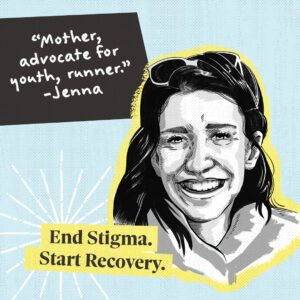 The four counties are organized as the Region 15 Opioid Abatement Council, one of 19 regions established by the Colorado Department of Law to distribute opioid settlement funds for substance use disorder treatment, recovery, harm reduction, law enforcement, and prevention/education programs.
The Colorado Department of Law has sued pharmaceutical manufacturers and distributors and is on track to receive over $750 million in opioid settlement funds.
“Many people unintentionally became addicted to opioids, which were aggressively and misleadingly marketed by drug companies,” said Andrea Carlstrom, director of Chaffee County Public Health. “People with opioid use disorder or other types of substance use disorder need support and evidence-based treatment to recover and thrive. This campaign aims to inspire more people to start their recovery journey.”
“Our community can and must rise to meet the growing threat of fentanyl, which has caused a surge in overdoses,” said Patrick Fiore, substance abuse coordinator with the Custer County Public Health Agency.
“Effective treatment for opioid use disorder requires that we prevent overdoses. That entails making naloxone, known by the brand name Narcan, widely available, learning how to use it, and keeping it nearby.”
“Openly and candidly discussing these issues with friends and loved ones is an essential step toward recovery,” said Paula Buser, director of Fremont County Public Health and Environment. “This campaign is designed to spark those discussions across our community and among local families.”
“People recover from addiction, going on to live long, healthy, and rewarding lives,” said Lynn Ramey, director of the Park County Public Health Agency.
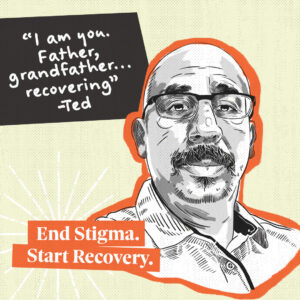
“Recovering from an opioid use disorder or dependence on another substance requires more than just willpower. Evidence-based treatment works.”
The campaign was created by SE2, a Colorado-based behavior change marketing agency. The portraits were drawn for SE2 by Javier Robles, a Colorado illustrator.
“We’re grateful for the vision of these health leaders at the four counties and for the courage of the local folks in recovery who agreed to be featured in the campaign,” said SE2 Co-Founder Eric Anderson. “Our team has been touched personally by this issue and we’re honored to be able to highlight how we all have a role to play in addressing it.”

How We Can Keep Pace with Change through Reskilling, Upskilling, and Next-Skilling
In the ever-evolving landscape of work, just one thing is guaranteed: change.
With automation, artificial intelligence, and digital transformation reshaping industries, the demand for a skilled and adaptable workforce has never been higher.
As we navigate this shifting terrain, reskilling, upskilling, and next-skilling emerge as crucial pillars in supporting workers to stay competitive, fostering diverse workplaces, and spurring economic development.
So we don’t further marginalize low-wage workers — who have the most to lose as workforce needs evolve — businesses, government agencies, and nonprofits must invest in these opportunities.
A Seismic Shift
The Fourth Industrial Revolution is upon us, marked by technological advancements radically transforming how we work.
According to the World Economic Forum, by 2025, 85 million jobs may be displaced by automation, while 97 million new roles may emerge, underscoring the urgent need for a workforce that can adapt and thrive in this dynamic environment.
It’s safe to assume none of us is immune.
Reskilling, Upskilling, Next-Skilling: What’s the Difference?
Staying competitive and adaptable goes beyond traditional education. There are three key strategies that individuals and organizations can employ to navigate the shifting landscape of work effectively:
- Reskilling involves learning new skills to transition to a different role or industry. It’s about equipping workers with the abilities needed for jobs that are in demand.
- Upskilling focuses on enhancing existing skills to keep pace with technological advancements within one’s current role or industry.
- Next-Skilling anticipates future skills requirements and prepares individuals for upcoming job roles, often leveraging emerging technologies and trends.
Robust reskilling, upskilling, and next-skilling initiatives hold tremendous promise in empowering diverse communities, addressing systemic inequities, and fostering inclusive economic growth. Historically marginalized groups, such as women, people of color, and individuals from lower-income backgrounds, frequently encounter formidable barriers when seeking access to education and employment opportunities. These barriers, ranging from financial constraints to discriminatory hiring practices, perpetuate cycles of inequality and hinder social mobility.
However, by implementing tailored training programs and support mechanisms, we can begin to dismantle these barriers and forge pathways for all individuals to excel in the workforce.
For example, targeted mentorship programs, like Next 100 Colorado, can provide invaluable guidance and support to women and people of color aspiring to enter traditionally white male-dominated fields, empowering them to break through glass ceilings and pursue fulfilling careers.
Additionally, initiatives that offer financial assistance, such as scholarships or subsidized training courses, can help alleviate the financial burdens that often deter individuals from underserved communities from pursuing further education and skill development.
Investing in reskilling, upskilling, and next-skilling initiatives is not just a matter of economic necessity; it is a moral imperative. We can build a more just, equitable, and prosperous society for all by prioritizing diversity, equity, and inclusion in our workforce development efforts. Through collective action and commitment to empowering marginalized communities, we can unlock the full potential of every individual and create a future where everyone can thrive.
An Economic Development Imperative
A skilled workforce also serves as the bedrock of economic growth, catalyzing innovation, productivity, and competitiveness in today’s rapidly evolving global economy. As industries undergo digital transformation and technological advancements reshape the nature of work, the demand for specialized skills continues to escalate.
When workers possess the expertise and proficiency required to excel in high-demand roles, they not only contribute to the success of their respective organizations but also drive broader economic development.
Investing in reskilling and upskilling programs has far-reaching implications for regional economic development.
Companies seeking to establish operations are drawn to regions with a talented and adaptable workforce capable of meeting evolving industry demands. By prioritizing investments in workforce development initiatives, governments and local authorities can position their communities as attractive destinations for businesses looking to set up shop. This, in turn, generates job opportunities, stimulates economic activity, and fosters a vibrant ecosystem of innovation and entrepreneurship.
But don’t just take my word for it. Review the research:
- Individual benefits. Individuals who continuously upskill and reskill are better equipped to adapt to evolving job requirements and technological advancements. Research by the World Economic Forum found that individuals who invest in lifelong learning and skills development are more resilient to job displacement and are less likely to experience periods of unemployment.
- Business benefits. A study by the Society for Human Resource Management found that companies with high employee turnover incur significant costs associated with recruitment, onboarding, and training new hires. By investing in upskilling and reskilling programs, businesses can reduce turnover rates and minimize these costs. The Center for American Progress estimates that the cost of replacing an employee can range from 16% to 213% of their annual salary, depending on the level of the position and the industry.
- Community benefits. National Employment Law Project research also shows that higher-wage jobs often have positive spillover effects on other sectors of the economy, creating multiplier effects that amplify economic growth and lead to job creation in industries such as retail and food services, as workers have more purchasing power to support local businesses.
Government and Private Sector Collaboration
Realizing the full potential of reskilling, upskilling, and next-skilling requires a concerted effort from both the public and private sectors. Governments play a vital role in setting policies, allocating funding, and creating frameworks that support lifelong learning and skills development.
Here in Colorado, the drivers of these changes are the Colorado Department of Labor and Employment’s Office of the Future of Work and the Colorado Workforce Development Council. This includes investing in education systems, incentivizing businesses to provide training opportunities, and fostering partnerships with industry stakeholders.
At the same time, private businesses must take proactive steps to prioritize employee development and invest in the future workforce. At SE2, we do this providing financial support to team members who seek to grow their skills, talents, and expertise.
As an alumnus, I am an energetic proponent of community colleges. Programs like Workforce Resilience Program, Career Advance, and Care Forward Colorado from the Colorado Community College System are making reskilling, upskilling and next-skilling more accessible to workers.
Finally, nonprofit organizations are leading the change. This includes a personal favorite, ActivateWork, which helps employers solve talent gaps by finding promising candidates who aspire to work in tech and preparing them to excel in new careers. It also includes former SE2 clients The Center for Workforce Education and Employment, Mi Casa Resource Center and Worklife Partnership.
A Call to Action for All of Us
As we stand on the cusp of a new era of work, reskilling, upskilling, and next-skilling represent powerful tools for navigating the challenges and seizing the opportunities that lie ahead.
By embracing lifelong learning, fostering diversity, and investing in our workforce, we can build a future where every one has the opportunity to thrive, and our economies are more resilient and inclusive than ever before.
It’s time to harness the transformative potential of skills development and pave the way for a brighter tomorrow.

Three Questions with Alvina Vasquez, SE2’s Newest Principal and a Veteran Engagement Strategist
Q: What issues in our community ignite your inner fire, and how do you channel that passion into impactful action?
Alvina Vasquez: I strongly believe that making a genuine impact on people’s lives is more than just addressing specific issues. It’s about providing individuals and families with a real alternative to the societal systems that may not meet their needs.
There are countless tools and resources available to support individuals and families, but many people don’t take advantage of them because they don’t think they apply to their situation. I enjoy finding areas where we can improve and bridge those gaps. Supporting our community leaders and services is crucial, but it’s equally important to challenge the system and ensure we serve individuals and families in Colorado and beyond to the best of our ability.
Q: What excites you about joining forces to tackle community challenges? What unique blend of perspectives do you imagine creating together?
Alvina: Joining forces with a larger team and utilizing the right tools can significantly enhance your abilities. As a natural team player, I thrive on collaborating with others. When I first experienced working with SE2 in 2021, I immediately recognized its unique qualities. We share the same values and a deep passion for making a positive impact on the world.
My goal is to gain a deeper understanding of how major government projects are initiated and ensure that the services provided are truly beneficial. I aspire to be a catalyst within the SE2 team, expanding our network of stakeholders, strengthening our grassroots outreach, and consistently delivering creative, thoughtful, and impactful work that leaves a lasting influence on our country.
Q: When the clock strikes free time, what passion projects captivate your energy?
Alvina: I love hosting my podcast, Alvina Talks Shift.
With my background in broadcast media, radio has always been a passion of mine. So, I took the leap last year and started my own podcast.
The show dives into the shifts that occur in our lives, both ones we can control and ones we can’t. We cover everything from personal stories and transformations to important political and policy changes that affect our communities. It’s been so much fun!

A quarter century ago, Eric Sondermann helped plant the seeds of SE2 today
In the mid-1990s I was adrift.
A child and sibling of newspaper reporters, all I had ever wanted to do was become one too.
And then, after a half dozen years of journalism in Washington, Hong Kong and Denver, I hit a wall.
My gut, literally a knot in my stomach, told me I was done with newspapers.
But I had no idea what was next. I realized journalism wasn’t how I’d make my mark on the world, but I didn’t know what else I could do.
So, I called Eric Sondermann.
I met Sondermann when I was a political reporter. I came to appreciate his straightforward, spin-free commentary.
Sondermann was (and remains) a political iconoclast.
He grew up as a Democrat but increasingly felt uncomfortable with that party’s orthodoxy. He found common cause with free-market Republicans but had no use for right-wing social dogma.
I was a political and policy junkie, but I, too, didn’t feel completely comfortable in one camp or the other. As a political reporter, I had effortlessly moved back and forth across the aisle – finding thoughtful voices among both Democrats and Republicans – and I didn’t see why I should have to choose sides.
I also was impressed that, back in the day when most political consultants happily cashed checks from Big Tobacco, Sondermann worked only on the scrappy and underfunded side of anti-tobacco rebels. (We continue to fight the tobacco industry today.)
I was hungry and ready to learn, and Sondermann let me learn by his side, initially as a sort of apprentice and then quickly as a business partner, when we co-founded SE2 25 years ago.
Although Sondermann stepped away from the agency in 2014, we carry lessons I learned from him.
Here are three:
- The customer is not always right. Always tell clients the truth, even when they don’t want to hear it.
- Focus on the bold strokes. While it’s easy to become preoccupied with tasks and to-do lists, we must focus on the big strategies that will make a lasting impact.
- Stick to your values. It’s easy to chase the money or go with the flow, but all we have in the end is our reputation and credibility.
Sondermann remains engaged in the community and as insightful as always in his commentary, which includes a regular column in Colorado Politics and the Gazette newspapers and the Colorado Inside Out panel on PBS12.
He’s a voracious reader and deep thinker who loves ideas. I don’t always agree with him, but I appreciate the intellectual rigor in his takes on current events.
Thanks, Eric Sondermann, for helping to set me – and SE2 – on the journey that we continue today. You’ve helped us all make a positive impact on some of the most pressing issues of our time.

PowerMap Ltd. and Alvina Vasquez join SE2, elevating the agency’s capacity to create positive change through communications, marketing and community engagement
DENVER — Alvina Vasquez and her company PowerMap Ltd. have become part of SE2, combining expertise and experience as the Denver-based agency looks forward to its next 25 years of creating positive change around pressing public issues.
Vasquez has joined Susan Morrisey, Brandon Zelasko, and Eric Anderson as a principal and shareholder of SE2, a 16-person integrated marketing and communications agency focused exclusively on pressing public issues.
Vasquez founded PowerMap Ltd. in 2019 with the mission to make Colorado “a place where every person can succeed and every community can thrive.” That mission aligns with SE2’s focus on creating Perpetual Movements: Change for Good®.
“Alvina and SE2 have collaborated for years on impactful campaigns to support healthy and successful communities. She’s established herself as a visionary leader in the field. We know that we will drive even more positive change by fully integrating our talents and expertise,” said Morrisey, SE2’s CEO.
“Our shared expertise in communications, policy, media and marketing is enhanced by Alvina’s proven leadership on community engagement, which will continue to become a growing element of SE2’s strategy for creating positive change,” Morrisey added.
“I am absolutely thrilled to join the team at SE2,” Vasquez said. “This incredible opportunity allows me to build on the impactful work I’ve been fortunate enough to do for my amazing clients for the past five years. It is a true honor to be recognized and valued, and to have the chance to become a leader in an organization that shares my commitment to informing and supporting communities across the state and beyond.”
“Our shared community engagement philosophy recognizes that effective movements require pushing power out to diverse community leaders and organizations. They know their audiences best and bring their credibility and trust to important causes. Key to this success is effectively engaging with ethnically and racially diverse communities, and Alvina will further elevate our commitment to and expertise in this area,” Zelasko added.
Vasquez is a tested and respected community leader and political strategist. In 2018, she served as political director on Jared Polis’s gubernatorial campaign, where she was responsible for building a statewide network of influential leaders and supporters that helped power Polis to his first term as Colorado governor. She also served as senior vice president in the Colorado office of Strategies 360, a public affairs firm, where she led coalition-building and messaging efforts on a variety of local and national initiatives.
“Alvina’s deep roots in Colorado ensure that she can connect with communities across the state, from frontier to rural to suburban to urban, with a wide network of established contacts in every corner of Colorado,” Anderson said. “We also will apply her proven community engagement strategies far beyond Colorado’s borders.”
Vasquez also brings to the table more than 20 years of experience in Spanish-language and general-market broadcasting, working with many of Colorado’s leading editors and reporters, with whom she maintains close ties.
Vasquez has been recognized as one of Denver’s 40 Under 40. She serves on various organizational boards focused on education, equality, and civic engagement. She is a trustee at Western Colorado University and a fellow at the Latino Leadership Institute Executive Program at the Daniels College of Business.
Since its inception in 1998, SE2 has focused exclusively on creating positive change on important public issues in Colorado and nationally. This includes health, the environment, education, housing, early childhood, substance use, economic empowerment, energy, and other pressing issues.
As SE2 marks its 25th anniversary, this announcement reflects the next step in a measured and sustained growth strategy that aims to expand and enhance the services SE2 offers existing and new clients to broaden its positive impact and build on its legacy.

A Generational Turning Point: The Juul Settlement's Promise of a Nicotine-Free Future
In the ongoing effort to address the epidemic of youth vaping, the recent settlement six states plus the District of Columbia secured against Juul presents a groundbreaking opportunity to secure the future health and well-being of an entire generation.
Using this $460 million-plus settlement to advance youth prevention isn’t just an investment; it’s a chance to avoid a new generation of nicotine-addicted adults.
Youth vaping is more than just a trend; it’s a public health crisis. Research shows that nicotine, regardless of how it’s derived or delivered, harms developing brains. We also know that teens become addicted to nicotine through vaping and often end up smoking regular cigarettes.
Big Vape, the Netflix four-part documentary series based on the book by the same name, vividly describes how Juul marketed its highly addictive devices to teens, causing an epidemic of underage use.
The legal settlement with Juul offers an unprecedented opportunity. By investing the funds into comprehensive and evidence-based prevention campaigns, we can start rewriting this grim narrative.
Prevention is, without a doubt, the most cost-effective and impactful way to address this issue. Every dollar directed towards campaigns aimed at dissuading young people from vaping has the potential to save countless more in future healthcare expenses. In fact, a body of research shows that there is a positive return on every dollar invested in prevention campaigns – with some analyses showing as much as $18 saved for every $1 spent.
The Juul settlement provides an infusion of resources that can be channeled into comprehensive educational programs and community outreach. These campaigns will provide youth with the knowledge they need to make informed decisions to support their health.
These investments offer a profound return on the broader societal scale. A generation of healthier, addiction-free individuals is better able to live happy, productive lives and contribute to our communities. By curbing youth vaping now, we pave the way for a stronger, more prosperous future. And as research indicates, nicotine addiction can pave the way for other addiction later in life. This underscores the importance of preventing addiction early on, not only as a morally sound choice but also to mitigate societal impacts in the future.
Yet, the significance of these prevention campaigns extends far beyond the immediate health and economic benefits. It is intertwined with the crucial aspect of youth connection.
Adolescents often turn to unhealthy behaviors like vaping when they lack a sense of belonging, purpose, or connection. By directing settlement funds into youth engagement and support programs, we not only address the symptoms but the root causes of a wide range of unhealthy or risky behaviors.
Youth connection initiatives not only create a sense of belonging but also provide opportunities for skill-building, resilience, and personal growth. When our young people are connected to trusted adults and peers, they are happier and healthier. By nurturing their sense of purpose, we create an environment where the choice to vape becomes less enticing and less likely.
Our communities and schools can become hubs of connection, where young people can explore their interests, passions, and futures while avoiding substances that would only get in the way of their dreams. When we connect our youth with mentors, positive role models, and resources, we offer them alternatives that will enrich their lives rather than endanger them.
The Juul settlement dollars offer an unprecedented chance to rewrite the story of our youth, to prevent lifetimes of nicotine addiction.
This is not just a financial investment; it’s a moral one. It’s an investment in the health, well-being, and potential of our nation’s youth. We cannot afford to let this opportunity pass us by. It’s a chance to save a generation, and we must seize it. Their future depe

Empathy is a Marketing Essential: Understanding Agricultural Communities and Beyond
Empathy and understanding are two of the most important qualities we can bring to marketing and life. When we take the time to connect with others on a deeper level, we can build stronger relationships, create more meaningful experiences, and ultimately achieve greater success.
Learning from the Colorado Farm Bureau


Rural Americans face stereotypes, prejudices, unique dynamics, and challenges like any community or group. SE2 has worked in these communities, spreading the word on mental health, ending stigma against addiction, and more. But to deepen our understanding, we brought in two experts from the Colorado Farm Bureau, Becca Edlund and Taylor (Lobato) Szilagyi.
Taylor, a former SE2 employee who grew up on a ranch in Center in the San Luis Valley, now holds the top staff position at the Colorado Farm Bureau.
Becca presented on the Colorado Agricultural Addiction and Mental Health Program.
As the largest agriculture association in Colorado, the Farm Bureau advocates for policy, offers leadership development, and supports farmers and ranchers living in the state.
I grew up on a cattle ranch, and I learned from the presentation that the vast majority of farms and ranches in Colorado are family-owned, like my family’s is.
Understanding Rural Coloradans
Farmers and ranchers face unique dynamics.
- They are family-oriented and community-motivated.
- Children face the stress of carrying on their parent’s legacies. They are often under scrutiny by their community, resulting in a fishbowl effect. Everyone knows everyone, and expectations are high.
- Money is often a hot topic.
- The average earnings for a family farm is $36,000 a year, which puts them below the national poverty line.
- In addition, they are at the mercy of volatile commodity prices (the prices at which raw materials or basic foodstuffs are bought and sold, such as the cost of cattle or fruit).
- They may have massive debt from purchasing equipment or even have to leverage their land and property to get operating loans. The legacy of debt falls not only on the adults but also on their children.
- Success is highly uncertain when your only paycheck comes once a year.
- Livelihoods depend on weather, water, health, and even public policy.
- Flooding, droughts, and diseases can kill crops and livestock.
- Who is in public office can change a farmer’s life.
- Unfortunately, insurance options are minimal, so if you lose your stock or something takes a turn for the worse, you’re often out the money.
- Creating prize-winning and profitable genetics (meaning a prize bull for breeding or a specific strain of corn) can take generations, and a single instance could destroy it.
- Work is hard and seasonal. Many workers travel with the season.
Bringing Much-Needed Resources
The suicide rate amongst farmers and ranchers is three and a half times higher than in the general population.
Rural and agricultural settings can be isolating and lonely, so when COVID-19 began in 2020, the program Becca described was created.
The Colorado Farm Bureau asked farmers what they needed and how to meet that need regarding mental health and addiction. The program offers farmers and ranchers six free mental health counseling sessions with a rural competent counselor who has completed a three-hour specific training.
Another critical resource for farmers has been online Alcoholics Anonymous, giving easy access that’s confidential and avoids the stigma of in-person sessions. Programs like these help address accessibility while continuing to spread awareness and fight stigma.
Applying Empathy Always
My biggest takeaway from the training wasn’t about rural people in particular; it was the emphasis on simply doing your best to understand others always.
“Always consider people’s challenges and boundaries in life. Stare at people and pick beneath the surface to understand them, ask questions, and see what their barriers to entry are,” Becca said.
Empathy is essential in marketing. By putting ourselves in our audiences’ shoes, we can better understand what motivates them, their challenges, and the solutions they seek. This allows us to create more effective marketing campaigns that resonate with our audiences.
But empathy is essential not just in marketing but also in life. When we take the time to listen to others and understand their perspectives truly, we can build stronger relationships, resolve conflicts more effectively, and create a more harmonious world.
One way to cultivate empathy is by sharing personal stories and experiences. Whether we are farmers or marketers, we all face unique challenges and struggles. We can create a more profound sense of connection and understanding by sharing these stories with others.
Let’s take the time to listen to others, share our stories, and show empathy and understanding in all we do, no matter who we’re talking to or about.

Using Social Media to Support Mental Health: How Users Marshal Engagement on the R/Anxiety Subreddit
It’s no secret that social media can be toxic and exacerbate mental health issues.
But can it also offer support?
When the pandemic started, social media was an easy place to find a distraction and to keep the mind busy. Of course, when upsetting imagery saturates all of social media, this distraction suddenly only worsens things.
Having said that, I think it’s important that we acknowledge the help some forms of social media can provide us. Reddit is one of the social media sites that we can use to support our mental health.
Reddit is filled with thousands of communities, known as subreddits, tailored to attract specific fan bases and to bring people together.
I’ve found that it’s almost impossible to think of a subreddit that doesn’t already exist. Case in point: Want someone else’s opinion if you’re in the wrong? See r/AITA (Am I the Asshole?).
The subreddit r/Anxiety was a particular favorite and frequently visited site of mine. This subreddit was created in 2008 and has accumulated over 600,000 members.
When I was struggling with my anxiety it was relieving to hear of others going through the same waves and how they’ve made it through to the other side.
However, I couldn’t help but notice the hundreds of posts that never received any interaction from other community members. All of those questions and concerns left unanswered and floating in Reddit cyberspace….
I’ve spent the past nine months researching and writing my undergraduate thesis paper about what, how and why certain posts within r/Anxiety receive more engagement than others. Let’s break down what my research revealed and what we can take from it.
To measure the level of engagement of a post, you can look at upvotes and clicks but, for the purpose of my research, I used the number of replies to a post as an indicator of the level of engagement. The post that received the most engagement had 633 replies and the least had 0 replies.
To directly compare the posts with higher levels of engagement and lower levels of engagement, I pulled 999 posts from the r/Anxiety subreddit and organized them from the most replies to the least.
There are direct and indirect ways of marshaling social support.
Direct methods include:
- Defending aspects of their mental health such as their perspective and experience
- People reexamined beliefs that they held about their mental health
- Solicitation and direct requests of specific forms of social support (informational, esteem, emotional, and social presence)
Indirect methods include:
- Self-enhancement: when posters shared good news and updates on their mental health
- Other-enhancement: when poster aimed to increase the esteem of the reader through encouragement, compliments, etc.
- Highlighting positives: poster actively notes the positive qualities of their mental health
- Recruitment for help with their mental health
My data revealed that posts that used a direct support marshaling strategy, but more specifically solicited informational and social presence support, received the most engagement from the community.
In the low-engagement posts, highlighting positives was the most used form of support marshaling. Highlighting positives would look like someone updating the community about their improvements and progress.
While it seems odd that this type of post usually receives little engagement, it gives us insight into why people use the r/Anxiety subreddit. The users are not there to individually congratulate other members on their mental health progress, but instead they are there to provide actionable advice.
This doesn’t mean that there is no space on Reddit for users to share their growth. Many subreddits are tailored for more specific uses, such as sharing accomplishments.
From this research, we can better understand how Reddit users can receive the most help when posting on r/Anxiety. Given that the direct support marshaling strategies resulted in higher engagement levels, if users ask direct questions that ask for information or social presence, they’ll have a better chance of getting a response. These posts could look like: “What do I do if I missed one dose of my medication?” and “I’m feeling really lonely today, does anyone want to chat?”.
Avoiding vague and non-engaging posts such as “I have so much anxiety, this is the worst” could increase the chances of getting engagement. Perhaps it can help to imagine if you were another user reading your post; if there isn’t something concrete you can touch on or help with, you’re probably less likely to take the time to write a comment.
If you would like to read more about my research, my full thesis can be found on my LinkedIn page.
 Isabel Anderson will graduate from the University of Washington in December of 2023 with Honors from the Communication Department.
LinkedIn: https://www.linkedin.com/in/isabel-anderson-331962211/
Gmail: isabelanderson72@gmail.com


SE2 Marks 25th Year of Challenging the Status Quo to Drive Positive Change

Think for a moment about tobacco.
For the companies that profit from it, it’s quite possibly the perfect product.
Tobacco quickly makes its customers physically dependent – literally addicted to the product.
There’s only one catch: Tobacco kills about half of these customers.
To Big Tobacco, this was not a moral dilemma but a solvable problem: It would create “replacement smokers” by hooking young people.
Putting aside the question of how tobacco executives can sleep at night, this insight suddenly explains why the tobacco industry creates flavored products and youth-oriented marketing campaigns that appeal to kids.
Immoral? Yes. But decades ago, it wasn’t yet a big scandal.
Big Tobacco hired armies of advertising agencies, PR firms, and lobbyists to prop up its profits and give it mainstream legitimacy.
Back then, tobacco companies would pay generous retainers just to “park” firms. It was easy money: You didn’t have to do much besides agree not to derail its gravy train.
This coincided with the genesis of SE2. While many of our competitors happily cashed Big Tobacco checks, we chose the other path — working to stop the deadly toll of tobacco.
In 1998, we launched SE2 as a marketing and communications agency focused exclusively on important public issues like tobacco.
As we mark our 25th anniversary, we still take on the evolving threat of tobacco.
Now, we’re also addressing emerging threats like fentanyl, which grew out of predatory marketing by opioid manufacturers that seemed very familiar to those of us who had analyzed the Big Tobacco playbook.
We’re also promoting mental health for teens, strong starts for toddlers, affordable housing, health care access, education, immunization, and an array of other vital causes.
Our team steadily grew and diversified, now encompassing 15 full-time employees. We’ve occupied five different offices plus a pandemic-caused virtual phase. We’ve expanded our reach across the country.
We increasingly balanced our focus on using communications to make systems change with the principles of individual behavior change and positive social norms. Together, these three pillars create a sustained virtuous cycle that we call Perpetual Movements: Change for Good®. In this model we’ve refined over decades, each step creates momentum for the next.
We’ve had the privilege of collaborating with national experts in public health, social psychology and medicine, building their science-based strategies into our work.
Our work is also informed by the lived experiences of our staff and advisors as we elevate their voices. Their diversity encompasses age, race, ethnicity, country of origin, gender identity, sexual orientation and education. When we view challenging issues from their varying perspectives, we all see a more complete picture and can craft more comprehensive solutions.
No matter what issues we embrace, we bring a mindset we learned while taking on Big Tobacco.
We know that change requires that we challenge conventional thinking and disrupt the status quo.
That philosophy became our tagline: Challengers Creating Change®.
Over our 25th year, we’ll amplify the voices of our staff who will share how they challenge conventions to create change.

More than Ever, Authentic Community Engagement in Public Health Matters. Here’s Why
Rising vaping, alcohol abuse, food insecurity, gun violence, mental health disparities, and social isolation. Public health officials are working hard to find and communicate solutions for these pressing topics.
Because these issues disproportionately affect low-income and minority populations, public health professionals must rethink how they can effectively each these communities and create long-term positive change.
Increasingly, public health officials have turned to the most-impacted communities. After all, who best to innovate solutions than those closest to the issues?
What does authentic community engagement look like?
Authentic community engagement means more than public health entities simply surveying the community for their thoughts or allowing them to host events. It should aim to go past focus groups, or even just grants. The ideal version of these community partnerships should be community leaders and members at a shared table with officials. One way to model this could look like this:
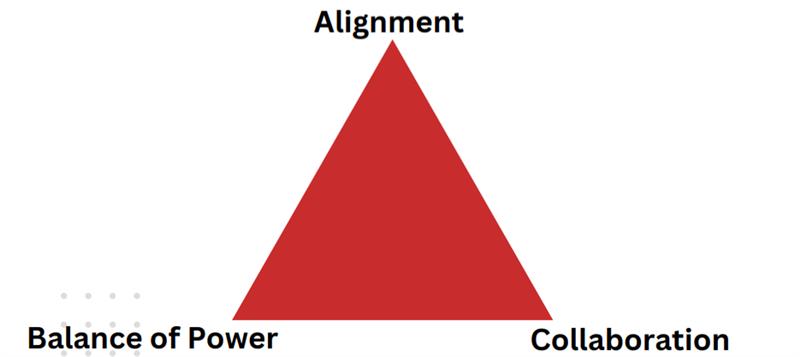 Graphic credit: Yu, E. (2022). Community engagement. American Public Health Association.
Alignment
For change to be sustained, communities’ values and behaviors must align with the solutions. Ensuring these align also ensures that a mutual investment is established to continue the work beyond any official public health partnership.
It’s also important to align with communities on what is reasonable in terms of time, resources, and interest. Asking a community with limited leadership, volunteerism, or resources to take on a more prominent place in your partnership than they can reasonably sustain would not be aligned with the work.
Balance of Power
Successful community engagement should also balance power between communities and public health officials, with the ideal moving in the direction of community members. It’s not making room for communities at the table; it’s allowing them to create their own space.
Collaboration
The goal here is moving beyond community participation to community integration — from working for the community to working with communities as equal strategic partners.
Ultimately this can be boiled down to the following quote.
“What matters to community members matters the most.”
Yu, E. (2022). Community engagement. American Public Health Association.
Recently, we engaged with a youth LGBTQIA+ organization in a partnership that aimed to move beyond promotion or grant work.
After digging into their social media and program work, we came up with specific ideas of what we thought might make sense for our campaign. But after meeting with them and listening to their priorities, our ideas seemed out of touch – because they were.
These are the leaders, the folks doing the work, day in and day out, working firsthand with LGBTQIA+ youth.
How can we engage with communities in our work?
So how do we do it? The specifics around how to engage depend greatly on the work to be done, the community, and the resources available to do it. However, there are a few things to keep in mind while doing the work:
- Reduce barriers to participation.
- Ensure strategies are aligned.
- Create a culture of accountability, healing and trust and acknowledge, confront and work against power dynamics/ structures.
- Connect authentically.
- Be a vehicle to tell their stories for positive change.
All these things have one thing in common: to release control. To truly engage with communities, we must release control over the outcome and listen to and let these communities lead.
We must also connect authentically, consistently immersing ourselves in the issues and their work, not just as it serves our needs. Attending the events and coming to the table with a base knowledge of what they are all about and the power structures that oppose them are the first steps towards building the necessary relationships for community engagement.
One of the most powerful, authentic, and successful ways we can do this in our work is through storytelling. We are storytellers who need stories. Stories about what’s going right and what may be going wrong to illustrate the issue.
Why do we engage with communities in our work?
“Do you understand what you intend to do and what you have the power to do?”
-Jessica Mulcahy, MA + Emily Yu, MBA
Yu, E. (2022). Community engagement. American Public Health Association.
More importantly, beyond the how lies the why.
Why is it important and valuable to prioritize marginalized communities in finding and implementing solutions to their public health issues? Because it challenges the status quo historically established against these groups’ autonomy. Because it makes the most sense and is just the right move. And frankly, its success can reverberate across governmental institutions.
When we ask ourselves what we have the power to do when engaging with communities affected by the issues, the answer is quite powerful to imagine. When communities are trusted with their own solutions, trust is built, health equity is enhanced, and change is sustained, creating healthier communities overall.
Recently, a campaign allowed us to meet unhoused youth at shelters statewide, asking for their experience for authentic messaging and feedback. Many of them spoke of being asked about their experiences as a step in the right direction. For some, it had been years of not feeling heard or valued by those outside of their community. Hearing their experiences firsthand provided us with knowledge that we literally wouldn’t have been able to find otherwise. And more importantly, it served as a great reminder of what is possible with this work.
Authentic community engagement is more than just something to tack onto a campaign; it means giving those who feel voiceless the opportunity to be heard.

AI Will Help Us Elevate Our Work, but Don't Expect More Free Time
When I was in elementary school in the 1970s, my teachers told us that automation would mean we would only have to work a few hours a week. In this promised utopia, we’d get to spend the rest of our time exploring our passions outside of the office or factory.
They lied.
Fast Company noted in 2019, “Today the average American works 47 hours a week, nearly a full day longer than the 40-hour workweek for which their forebears fought. Worse, 18% of full-time workers work 60-plus hours a week.”
What gives?
The promised technological innovations took place. Instead of a secretary for every executive or two, everyone started typing their own memos and scheduling themselves.
Manufacturing didn’t become completely automated, but robotics eliminated many routine tasks.
What did we do with all that free time? We elevated to work at higher levels, freed from rote tasks.
We were more creative, strategic, and productive. (And, yes, we spent a lot of time responding to email and surfing the web.)
Today some are saying that #artificialintelligence (AI) will make more of us obsolete.
But as this New York Times essay notes, for most of us it will just free us from mundane tasks that aren’t the best and highest use of our talents.
The essay’s author, Louis Hyman, writes: “Boring, repetitive tasks that I knew a computer should be able to do, but that I didn’t know how to make it do, suddenly became as easy as typing in my request.”
For those who think of AI as a threat to their job, it may become what they fear.
But for those who see AI as a booster — one that opens new horizons in their mind for new pursuits — the possibilities are limitless.
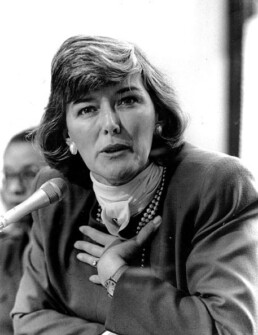
Remembering Pat Schroeder: Champion for My Family and Yours

When former Congresswoman Pat Schroeder passed away last month, Colorado and the nation lost one of our most influential champions of women’s rights. She was also a fierce advocate for the needs of American families.
Much has been written about Schroeder’s work spearheading groundbreaking legislation to support families and advance the rights of women. When she started her first term in 1973, there were just 16 women in Congress. Every voice mattered – a lot – and hers was loud and passionate.
Over the next 24 years, Schroeder sponsored legislation to protect pregnant women at work, advance equitable treatment of women in the military, and increase protections for victims of domestic violence. She was relentless in her support of the Family and Medical Leave Act, which took nearly a decade to pass.
Over many years and since her death, I have reflected on the impact Schroeder had on my life and career. I had the honor of serving as a congressional aide in her Denver district office for five years, supporting her work on women, children, and family issues.
Those were pivotal years in my life and career. I worked for Pat when I had my first child, now 28. She made sure I had the time and support I needed as a new mom and working mother.
It was also when I found my passion and commitment to working on important and pressing issues.
Through experience and observation, I learned a great deal from Pat about communications strategy and practice. She had a keen mind, a quick wit, and was a talented orator.
Staff would labor over talking points for her speeches. She would then jot a couple of bullets on a napkin, take to the podium, and talk extemporaneously for an hour, laser-focused on the most important issues and messages.
The media loved her because she always brought a compelling story, delivered with memorable quips.
She referred to then-President Ronald Reagan as the “Teflon president” to describe how it seemed no controversies stuck to him. (While the controversies didn’t stick, her description of Reagan did, and was often repeated.)
When asked how she could be a mother and serve in Congress, she replied, “I have a brain and a uterus, and I use both.”
Those of us who worked with Pat also witnessed first-hand her thoughtful attention to the issues and residents of Colorado’s first congressional district.
For more than two decades, constituents called and walked into Schroeder’s offices in Denver and Washington, D.C.
Many came to advance the priorities of their organization or movement; others came to discuss more individual, personal challenges they faced. When they didn’t know where to turn, people reached out to Schroeder because they knew she would get something done. She remembered their issues and asked after their families. Handwritten notes with her iconic “Pat” signature – a smiley face in the “P” – were common.
Pat Schroeder paved the way for generations of women leaders because she lived and worked by the values and standards set by important women and feminists of history:
Say and do what’s right.
Don’t wait for permission, don’t apologize, and don’t back down.
Keep going until the job is done.
As Pat was known to say, “You can’t wring your hands and roll up your sleeves at the same time.”
The life of the Honorable Patricia Schroeder will be celebrated on Friday, April 28 at 2 p.m. (doors open at 1:30) at History Colorado Center, 1200 Broadway, Denver. The event is free and open to the public.

What We've Learned About Youth Interests and Issues
We believe that young people have an important outlook on the world and that they experience unique issues. As we target young folks in our messaging campaigns, it’s important that we understand those issues so we can move forward and create authentic and relevant messaging.
As part of our work, we talk with young folks aged 12 to 19 to capture their opinions on the issues most affecting them and their peers. In the video below, we discuss what we’ve learned: Young folks have told us that mental health, social media, and substance use are a few of the most important issues facing them today.
Mental health
Mental health has become an increasingly important issue. Young people, Just like many of us, are concerned. They’re concerned about their peers, their communities, and their personal well-being.
Gen Z has been known to be fiery regarding advocacy. It’s no surprise that they’re working to destigmatize mental health by creating places and taking up space to talk openly about it. And they’re not just scratching the surface. They’re getting deep into it by talking about the factors that impact mental well-being, such as access and environment.
A Colorado Health Access survey reported that Coloradans with insurance are more likely to report having better mental well-being. Yet in 2019, 360,000 Coloradans went uninsured. How might that inequity affect Colorado youth?
Not only that, but young folks are feeling pressure as they navigate digital learning environments, public safety concerns and adolescence.
Social media
Young folks also told us about how the time they spend on social media impacts their lives. On average, Young folks under 18 are using it six hours per day.
Although this time could be a cause for concern for some, young folks, say no. The time they spend online helps them explore their identities, create connections, and privately explore the world. However, some young folks say they don’t know how to use social media productively. With a lack of guidelines on safety and productivity, some young folks say that they feel sucked into using social media just to use it.
While not all young people could agree on how much time is appropriate, most could agree on one thing: Spending too much time online can be risky. Seeing influencers and peers at their best and their worst all the time can spark harmful comparisons and erode one’s self-image.
Substance use
Substance use also has a unique and powerful impact on youth. We know from research, from youth experiences, and even our own upbringings that peer pressure is a normal thing for young folks to experience. But with today’s high-risk substances such as high-potency marijuana and fentanyl, experimentation can be risky or even fatal.
We know that substance use in a young person’s environment can lead to them using substances later on. According to a 2022 Rise Above Colorado survey, two out of five youth have lived in a home where an adult was using substances.
Young folks are familiar with the issue of substance use, and some of them are familiar with the issue of overdose. Young folks in Colorado are likely to know someone or know of someone who has overdosed on substances.
From these insights, we’re able to better understand and serve youth across the state of Colorado. Our understanding helps us to empower healthier and more informed young folks.


The Hazards of Building a Presence on the Shifting Sands of Social Media Platforms
Imagine setting up your office in the lobby at Twitter, Meta or TikTok headquarters.
Even if they didn’t kick you out initially, they could at any moment. And you’d have no control over your environment.
That’s essentially what we’re doing when we invest our time and resources into developing a presence on their social media platforms. We’re living in borrowed space and the landlord has nearly complete control.
They can tell us what kinds of ads we can buy (as SE2’s Jack Cohen described in Advertising Week) or pursue strategies that undermine democracy and health (see Facebook and Instagram).
They can change the rules of engagement overnight, like when Elon Musk took over Twitter. Musk’s Twitter stepped back from any commitment to promoting constructive dialogue and putting facts and science above disinformation. Twitter became antithetical to our values.
Based on his series of erratic and ill-advised actions, I decided it wasn’t a place I wanted to plant by flag, and SE2 came to the same conclusion as an organization.
When we left, we had to write off the hundreds of hours we had spent building a network there.
We had been building our network on someone else’s platform, and the new owner made it uninhabitable for us. Yet others, including journalists, say they can’t afford to leave Twitter because it remains the place for key announcements from governments and other news sources.
Alternative platforms like Mastodon and Post haven’t filled the gap — at least not yet.
Now organizations are wondering if TikTok is a secure place to build their presence and grow audiences.
Because TikTok is owned by a Chinese company, the focus has been on whether it could spy on users or use its algorithm to manipulate what news and points of view users see. This has prompted states to ban it on government computers and at universities. A congressional bill would ban TikTok across the United States.
For organizations that want to build a significant presence on TikTok, those current and potential restrictionsat raise a lot of red flags.
Yet, they also know that TikTok is a great way to reach a key demographic. TikTok is on pace to surpass 100 million users in the United States. Those users skew younger, and it’s the go-to app for Gen Z.
So organizations must balance the benefits of reaching these users where they are with the uncertainty of TikTok’s future.
It’s an increasingly common conundrum as we rely on these private platforms for public engagement. While this is the stark reality we face, we can mitigate the risk with these three steps:
- Don’t become overreliant on a single platform. Just like you wouldn’t want all your savings invested in a single tech company, spread your efforts and engagement across the relevant social media platforms. It takes more work, but it’s worth it.
- Stay alert to the changing landscape. For example, what is the practical implication of the growing number of state bans on TikTok? Are federal policymakers or regulators likely to take action that would restrict its use in a substantive way acoss the nation?
- Keep comparing your values and your organizational values to the policies and actions of the platforms. Are they furthering the goals of your campaigns or are they undermining them? Increasingly, that presents a tough balancing act.

Forward Together Is Cultivating Connections Across Colorado
Recall for a moment being a teenager. The feelings of confusion around who you are, external forces telling you who you are “supposed to be,” and anxiety about — well everything. It can be overwhelming.
Now, consider what or rather who may have helped provide a bit of clarity during this incredibly confusing period. Maybe it was your grandparents or a family friend. It may have been a teacher or a coach. Or perhaps you were able to bond with an adult at a local community organization or your boss at your first summer job. Whomever it may have been, finding community and forming connections with others can help us on our journeys more than we may think. And particularly at this critical age, it can quite literally be a lifesaver.
Forward Together, an initiative launched by the Colorado Department of Public Health and Environment and Colorado Department of Human Services in 2020, seeks to help Colorado teens feel more connected to their peers, parents and other trusted adults. Research has shown that youth who are connected to positive relationships are less likely to smoke, drink, use other substances or have feelings of depression. Using the Developmental Relationship Elements Framework as a guide, the campaign has developed messaging and resources to help teens and parents form these strong connections.
While getting the word out to Colorado youth and trusted adults on a macro level through traditional media efforts proved to be effective, the campaign strategized ways to get the campaign “on the ground” and integrated into local communities. The team reached out to youth-serving organizations statewide, asking them to share what young people in their local communities needed to form valuable connections.
The answers were as vastly diverse in project need as they were in geographic location across the state. Everything from music lessons in Fort Collins to youth-led murals in Leadville to outdoor exploration in Buena Vista was identified as “ways in” by these youth leaders to help teens in their communities form strong connections with mentors or peers. And after identifying 24 youth groups over the course of the year, Forward Together provided funding to bring these special mission-driven programs and projects to life through community-based organization sponsorships.
Here are three main takeaways we’ve had from our work:
- Allow those doing the work to continue doing the work: Young people have said that advertisers are not always trusted sources of information for them, and, essentially, they can smell a canned public service announcement from a mile away. That means that while curated Snapchat advertisements and billboards are great for spreading the word, the campaign needed to get messages into the hands of these community’s trusted messengers, the youth organizations already doing everyday work with young people to help them form strong connections with peers and mentors. As the campaign aimed even further to reach marginalized groups of youth, it became clear these youth audiences would respond most effectively to fellow members and leaders of their specific communities. Mentees from BIPOC organizations such as Convivir, Spirit of the Sun and Muslim Youth for Positive Impact (MYPI) gave feedback to support this idea, with one young person from MYPI saying, “I got to talk to someone who had similar experiences as me, and she also went to high school in America as a hijabi, something that other adults in my life can’t relate to.” And young people from LGBTQIA+ organizations such as Four Corners Rainbow Youth and Inside Out Youth Services echoed these sentiments with one young person saying, “Rainbow Youth Center has the only safe adults in my life, and I can be myself, online or in person.” Our recommendation for those wanting to reach communities on a micro level: Hand messages over to these community leaders and empower them to disperse them in whatever ways they recommend. And to take it a step even further: Integrate community leaders in the development of campaign messaging from the start. That’s the campaign’s plan for the upcoming year, as they plan on collaborating with partners on more aspects of campaign development and implementation such as messages and greater creative control.
- Let young people lead whenever possible. A Developmental Framework Element, Sharing Power with young people has been proven to be very effective in developing strong and reciprocal relationships. Grantees continued to model this in their work as they brought projects like youth-led murals and block party concerts to life. We heard time and time again, from mentors and mentees alike, that letting young people take the lead makes the difference in their engagement with their projects and relationships with their mentors. As one mentor from Full Circle of Lake County said, “Kids love being represented and heard, and our mural is a great representation of that.”
- It works. Through Forward Together’s grantee program, the campaign has been able to directly reach over 1500+ Colorado young people and help them form strong connections with peers and trusted adults in their local communities. These are young people who may have seen Forward Together messaging in advertisements or on social media but were able to feel its purpose in a deeper way through these community efforts. The long-term effects of these projects and the campaign overall will not be able to be seen for quite some time (until we are able to survey these young people as adults). However, through the testimonials from young people and mentors, we can see that getting the campaign on the ground through direct community engagement and partnering with youth organizations as trusted messengers does work and strong connections are being formed.
Over the past year, we have seen firsthand that community organizations across Colorado are affecting real change with young people and helping cultivate strong relationships. Relationships with young people matter and finding ways to create these relationships in local communities is paramount to their future and ours.
Check out the Forward Together playlist spotlighting some of these projects Colorado Stories of Connection and check out the resource guide to help a teen in your life find organizations to get connected to.

Why SE2 Won’t be Spending Our Money to Advertise on Twitter Anymore
I really, really liked Twitter.
Want to know how much?
Since signing up in 2008, I have tweeted 14,000 times.
I also have curated and regularly updated a list of more than 1,000 Colorado media accounts on Twitter.
Beyond the numbers, I have found it a great way to explore ideas, see issues through the eyes of others, debate policy (usually constructively), and monitor the news and reporting in real time.
I hesitate to try to calculate how many hours I’ve spent on Twitter.
SE2 also has spent a lot of money on Twitter — well over $100,000 — specifically to boost tweets for our own content and for our clients. This is the way to break through the algorithm and reach a wider audience.
Elon Musk’s takeover of Twitter has made us rethink all that.
As of this week, we won’t be paying Twitter anymore to boost SE2’s own tweets. This won’t impact our clients’ use of Twitter, or our availability and willingness to support them in getting their messages out through Twitter. That’s a decision they must make based on their own assessments.
Despite Musk’s promises to advertisers and users that he wouldn’t allow it to become a “hellscape”, he quickly and predictably opened the doors to new levels of toxicity.
Musk increasingly has demonstrated a disdain for any sort of accountability and he showed why his approach is so harmful when he amplified a corrosive lie over the weekend. His tweet served as a signal to many who were waiting for tacit permission to perpetuate more hate and lies.
The floodgates opened and a toxic stew poured in.
I don’t want to whitewash Twitter’s legacy; It was constantly teetering on the edge of anarchy well before Musk’s takeover. Now it seems to have fallen off the edge.
It’s ironic that SE2 furthers our positive communications and marketing initiatives by using social media platforms, yet those platforms often undermine our work’s goals.
We acknowledged this when we decided to stop spending money on Facebook a year ago.
We understand our spending amounts to just a drop in the ocean so we encourage others in the communications and marketing sector to consider how they spend their ad dollars and whether it undermines their values.
GM has already paused advertising on Twitter and some high-profile celebrities have walked away from the platform.
What are the alternatives?
LinkedIn has become a much more robust arena for ideas and, because it’s a professional networking site without anonymity, users generally behave themselves.
Feel free to follow SE2 and connect with me over there!
For now, I’ll still keep an eye on Twitter but I’ll consider The Washington Post’s suggestions for alternatives, including spending more time reading long-form news stories, subscribing to insightful newsletters and — gasp! — reading e-books.

How We Work with a Niche E-newsletter to Reach an Influential Colorado Audience
It would be a great understatement to say that journalist-run startups typically put a lot more energy into reporting than planning for financial sustainability.
While this limits their financial growth, or even long-term sustainability, many keep plugging along, producing great content along the way.
Few pull the curtain back on their finances — unless they’re nonprofits, they have no responsibility for financial transparency — and grateful readers like me are just happy to see them succeed, or at least survive.
SE2 is happy to support some of them through subscriptions. And sometimes through sponsorships. (If they’re nonprofits, donations provide us with the usual tax benefits, which helps us justify bigger investments.)
When assessing the value of a sponsorship for our public issue marketing and communications agency — or for a client — we want to know what any advertiser would ask: Will they help us reach a target audience in an impactful way?
A target audience doesn’t necessarily mean one that’s big or powerful, at least in the traditional sense, just an audience that is critical to reaching our objectives for a specific project. (A long, long time ago, we pioneered buying advertising on The Denver Post editorial page to reach that wonky audience. It worked well, but we had to convince the Post to let us do it.)
Successful media organizations usually know a lot about their audiences and are happy to tell potential advertisers.
Axios, whose ad revenue appears to be supported significantly by tech companies that want to reach its plugged-in audience, monetized this reach for a cool $525 million.
SE2 has sponsored Axios Denver emails. For those of us who focus a lot on regional issues, these influential local audiences are key.
One important group of influencers is journalists themselves. How they frame issues, who they quote and which facts they choose to share influence the broad audiences they reach.
I spend a lot of time on Twitter, and I’ve curated a free-to-follow list of more than 1,000 Colorado journalists there, so that’s one way I stay in touch with media people.
Another great way to reach Colorado journalists is through Inside the News in Colorado.
My biggest complaint about this weekly e-newsletter is that publisher/author Corey Hutchins crams too much meaty news into each edition. (Corey might want to buy a copy of the Smart Brevity handbook published by the Axios founders. Or maybe just ask an Axios scribe for one of their six copies.)
This month, our client One Chance to Grow Up, which works to limit harm to kids from marijuana, sponsored Corey’s newsletter to promote an educational campaign highlighting a State of Colorado warning on marijuana concentrates.
Too often media coverage depicts marijuana with a leaf and describes it as a harmless plant when young people, whose brains are still growing, are increasingly dabbing nearly pure THC resin. Our hope is that by exposing more journalists to the State of Colorado warning, more coverage will reflect the known risks.
It’s been great to work with Corey on this sponsorship. I’d encourage others who want to reach his uniquely influential audience to consider In the News in Colorado as a cost-effective way to connect.
Like a lot of journalists, Corey is better at reporting than promoting himself. But he’s built an audience of roughly 2,000 subscribers, and his metrics show that well over half of subscribers open his newsletter each week. In other words, he’s created something of great value.
Now he just needs to keep monetizing it so it can continue and grow — and hopefully become a model for other journalism organizations like his!

Protecting Youth From Online Threats Starts with Conversation
Recently I had the opportunity to talk with Brooke Istook, vice president/youth and communities at Thorn, a nonprofit and recent SE2 client. Thorn works to protect youth from online exploitation by educating young people and their parents and caregivers, and builds technology to defend children from sexual abuse.
We talked about how Thorn’s focus and priorities have changed since the organization was created a decade ago and what it is doing to respond to an evolving landscape in which youth are increasingly at risk.
SM: What is Thorn currently doing to educate parents and caregivers about online risks so they can better protect youth?
BI: There is a lot that parents don’t understand about the technology their kids are using to communicate because they don’t have a shared experience. Unlike their kids, most parents didn’t have to worry about their private messages or private moments being documented and shared online for all the world to see.
Today, young people are growing up online, and that includes how they experience transformational phases like puberty. In many respects, doing things like sharing nudes is considered part of normal sexual exploration in the digital age. So, we recommend that parents and other caregivers have conversations with kids early and often so that they understand the risks of sharing personal information or private images.
SM: How widespread is the problem?
BI: Kids are engaging online sooner, some as young as 9 years old. A quarter of 9- to 12-year-olds say they have had an online sexual interaction, and one in six have shared intimate images. This behavior puts kids at risk of their images being shared with others and potentially being groomed by a predator. Half of kids who have shared nudes of themselves say they shared them with someone that they only knew online, while 40% believe that the person they sent them to is an adult.
SM: What do parents and caregivers need to think about when having conversations with kids?
BI: They need to understand the role that shame plays in these conversations and approach their child with empathy and understanding. Online situations, particularly those that are sexual in nature, can be wrought with shame and groomers use that to influence and manipulate youth. Many young people are reluctant to let parents know when they have shared something online, or if someone they don’t know is communicating with them.
Parents need to be curious about digital safety and talk to their kids about healthy relationships and how to make friends and avoid risks online. They also need to let their kids know that it is never their fault if someone tricks or coerces them, and to come to them if they have any concerns about interactions they have had online.
So, the message for younger kids is don’t share private information or photos of yourself or someone else, and if anyone makes you uncomfortable you should not feel bad. It’s never your fault, and you can always come to me if you feel scared or concerned.
SM: What is Thorn doing to educate and support older youth who might be sharing nudes more frequently, even as part of a dating relationship?
BI: It’s important for older youth to be able to identify red flags so they can protect themselves — whether that’s being involved in an unhealthy relationship or being approached and groomed online by someone they don’t know. They need to understand the risks of sharing nudes with a friend, partner or someone else, because those images can be reshared without their consent. In the wrong hands, they can also be used as leverage to get them to do something they don’t want to do such as sharing more images, which we refer to as sextortion.
Parents also need to talk to their kids about not resharing photos they receive from someone and to model good behavior by avoiding victim-blaming if something happens. We know that half of kids and parents blame the person in the photo when a nude is leaked. Blaming the victim leads to the dangerous dynamic of youth staying silent when something bad happens to them out of fear of judgment. In 2017, 85% of victims of sextortion cited embarrassment as their reason for not getting help.
SM: How is Thorn partnering with tech companies to keep kids safe online?
BI: We work with industry partners and develop technologies to make reporting resources more accessible when youth need help. Often, social media platforms are the only ‘person’ that a child talks to when something is going wrong — such as when they are being asked to send nudes or other information they don’t want to share. If a child feels that something is wrong, there is a critical moment when they can decide to report the interaction to the platform. The platform needs to be able to immediately provide them with support and resources to help them.
Many platforms are moving to make these safety features easier to use — and parents should know about them. For example, Apple is rolling out a new safety feature in its messaging app that can be turned on in a child’s device. The feature detects when a nude image is about to be sent or is received and messages support and alternatives to the child. It just puts a bit of friction in the path and provides youth with an off-ramp to a difficult conversation.
These are the types of features that will help to make young people’s online worlds a bit safer, which we will continue to pursue in the coming years.
To learn more about ways parents and caregivers can support and protect youth online, visit Thorn.org.

Who Do We Trust To Deliver Credible Information?
Who do you listen to for information about social issues? Your doctor? Your favorite celebrities? Your pastor? Your mom?
According to a recent Ad Council study, most people trust close family and friends, doctors and scientists, and academic and religious leaders to find reliable information about social and societal issues. These trusted messengers are the ones who are most likely to ignite action and behavior change on social issues.
It’s important to remember that the messenger is just as important as the message we’re trying to share with the public. As a Black woman, I look for messengers who are highly knowledgeable on the issue being addressed and understand how specific issues affect the Black community.
People actively seeking out the opinion of trusted messengers are more likely to be inspired to learn more or act on a specific issue. Many people change their stance on an issue when presented with information from the people they trust.
This research also shows that social media influencers, celebrities and politicians are not highly trusted as messengers. Yet, they have a broad reach and can amplify messages from experts. These amplifiers are an integral part of a larger ecosystem consisting of layers of messengers who work together to expand reach, validate, and create trust. It’s useful for communicators to understand the roles someone might play in sharing a message:
- Amplifiers — content creators, influencers, celebrities, well-known advocates — can efficiently distribute messages from experts to target audiences and support greater awareness around an issue.
- Validators — the subject matter experts — can add credibility to the shared content.
- Persuaders — friends, family and others in close circles — are the messengers who are critical in sharing messages within their communities on a personal level. This group of messengers has a unique ability to connect with loved ones on a level that amplifiers and validators cannot reach. This group can ignite behavior change through conversations with their loved ones.
As communicators, how can we work with trusted messengers to build knowledge, shift attitudes and encourage behavior change? Here are five key things to remember:
- Find messengers who are deemed trustworthy.
- Think about audience demographics and preferences when identifying trusted messengers.
- Provide tools for trusted messengers to help them become educated on the issue.
- Equip trusted messengers with tools to understand the audiences they are trying to reach.
- Broad reach (think celebrities, social media influencers) does not equal trustworthiness.
Read the full report here.
For me, a Black millennial woman living in Colorado, I understand the importance of working with trusted messengers, especially when organizations are trying to reach specific populations. A trusted messenger that would work for the Black community may not be effective for other communities (e.g., LGBTQ+, rural, Indigenous). This also rings true across generations, so it’s important for us to remember that the person delivering a message is just as important as the message itself.

Violent Media and Our Children’s Future: How Connection can Break the Cycle
By Evyn Batie
A girl stands on a platform with two boys on her sides. She faces a group of peers who stand in a straight line facing her and she begins to sing in a language I don’t recognize.
She finishes her song and then begins to yell out commands for a game of Red Light, Green Light. It takes me longer than it should to realize what’s happening. I watch, slightly confused and then alarmed, as the boys start yelling “PEW PEW” and the line of kids running at them begins falling down “dead.”
“Absolutely not!”
My shout ends the game, for now, and I gather my students, aged 6 to 11, for a conversation about appropriate games and how their re-enactment of “Squid Game,” the series about a deadly survival game, is not one.
After a year of working as a program lead for an after-school youth program, this conversation is one I’ve grown used to. The young children’s love for horror ranges from “Five Nights At Freddy’s,” a violent survival game where the player is attacked by murderous Chuck E. Cheese-style animatronics, to creepypasta, horror-focused internet urban legends. I often wonder what this exposure to horror and violence means for their future worldview.
There are three major factors at play as we as a society watch our children grow:
- Whether violent media leads to an increase in violence
- How COVID took away children’s ability to socialize
- How social media impacts how children interact with the world
Studies have explored for years whether violent media increases violence in children. While these studies have shown that media violence doesn’t necessarily promote violence, it has been proven to increase aggressiveness. These acts of aggression, coupled with children who, due to pandemic restrictions, have been undersocialized, will likely become an increasing problem in upcoming years.
A Forbes article reminds everyone to expect changes in children’s behavior because many lost formative education years. Children who lost preschool or early elementary education to online education and COVID precautions are not as equipped to socialize with their peers in healthy or functional ways.
So now we have a group of children more prone to aggression and more likely to lack empathy. Then we add in social media.
Social media gives all of us a platform to display our thoughts and feelings and online anonymity has proven a powerful contributor to problematic behavior — even for adults.
And for children, who mimic behavior to find themselves, this platform becomes a battleground for escalating dangerous behaviors and tendencies. YouTube is often left unmonitored by parents who trust their children to search for safe content. TikTok makes trends out of destruction; topics like defacing public property become hashtags.
So how do we as a society raise children as they are in the world as it is?
Do we take their devices and demand they make some friends?
Do we track all of their behaviors?
While no one really knows the answer, I am not an advocate for simply monitoring your children’s internet history. In my experience, it just makes them sneakier.
Rather, I am an advocate for open, honest, age-appropriate conversations. The best thing you can do to help your child is to talk with them. Discover their interests, watch videos with them, ask them about the movies and shows their friends like or that they hear about at school. This openness carries over to other hard conversations in the future. This connection is how to show your child you care.
“Hey Evyn, will you draw Huggy Wuggy for me?” A seven-year-old girl approaches me, shyly, during art time. I ask her to show me a picture and we do a quick internet search. I am expecting a cutesy cartoon character. I am greeted by a furry blue monster with red lips and a mouth full of razor-sharp teeth, dripping with blood.
I tell her no and ask if we can look for different drawing ideas instead. Together.
Evyn Batie is a college senior and youth advisor for SE2. Evyn is also employed with a non-profit after-school program.

3 Steps Toward Real Progress on Climate Change Communications
I couldn’t take my eyes off the refrigerator on the roof. I was standing in front of a storm-battered home in the Lower Ninth Ward in New Orleans just seven months after Hurricane Katrina.
The once-vibrant neighborhood was practically washed away by the storm. All around me were scattered debris and empty foundations where homes used to stand. News coverage of Hurricane Katrina and its immediate aftermath — the harrowing scenes from the Superdome, pictures of people on roofs holding help signs, and other distressing imagery — motivated me to take an alternative spring break relief trip in 2007.
Rising sea levels and warming temperatures made Katrina’s storm system more powerful and catastrophic. And now, 16 years later, hurricane season starts earlier, lasts longer, and yields more extreme storms.
The same can be said for all types of natural disasters, including wildfires, droughts, heat waves, and floods. The National Centers for Environmental Information report shows that in 2021, 20 separate weather and climate disasters cost the U.S. at least $1 billion each.
Even as the number of billion-dollar disasters we experience in a year is increasing, the time between them is decreasing. The average time between these events has dropped from 82 days in the 1980s to just 18 days on average over the past five years. A community in need of national attention and support only has 18 days of the public’s attention until a new event grabs the headlines.
Climate change is a threat multiplier. It touches and intensifies every issue we face as a society. Yet coverage of climate-caused problems like natural disasters often fails to connect the dots.
Meaningful response to climate change will require focused collective action. We all have a role to play whether it’s participating in disaster relief efforts, lobbying legislators and corporations, or joining an advocacy organization like Mothers Out Front or 350.org.
How Climate Change Communication Can Get People Involved
How can communication and messaging motivate communities to get involved?
First, we need to understand our audiences so we can meet people where they are. Atmospheric scientist Dr. Katharine Hayhoe argues that there are three primary reasons we don’t treat the climate change crisis with the urgency it deserves:
- Psychological distance. We believe that climate impacts are distant in time and space and won’t affect us personally.
- Solution aversion. We feel powerless and don’t believe there’s anything we can do.
- Competing priorities. We have plenty going on in our day-to-day lives.
Using these reasons as a roadmap, we can identify ways to address the fatigue.
1. To overcome the psychological distance, tell stories.
Storytelling is the sharpest tool in a communicator’s toolbox. Stories have the power to educate, persuade, and motivate in ways that facts and statistics do not.
Climate change will affect us all. That’s a simple fact, but it doesn’t paint a complete picture. To reach audiences, we need to tailor messages that connect to their shared values and local concerns.
Telling stories about how climate change is already impacting communities can fire up areas of the brain that control emotional response, complex information processing, and long-term memory. Stories about solutions and actions can motivate people to get involved.
Furthermore, stories spread. Powerful narratives are sticky, and someone still thinking about one is likely to share it with others, reinforcing memory and contributing to changes in behavior and attitudes.
2. To solve solution aversion, leverage a hopeful tone.
Climate anxiety is both real and paralyzing. The situation feels too big and too dire, so we need to flip this narrative on its head. We have available plenty of solutions ranging from individual actions to system-wide approaches, but so many of us don’t know where to start.
There are many tangible steps we can take, and the tone in which we present them matters. If we offer hope instead of alarm and communicate that these specific actions matter and can make a difference, we can empower individuals and communities to get involved. This is the key to successful climate change communication.
3. To rise above competing priorities, join the clutter.
How can we cut through the clutter of day-to-day concerns and priorities? By becoming part of the clutter.
Messages about climate impacts and actions should be woven into all forms of media. It should be part of the movies we see, the TV we watch, the influencer content we follow, the news we consume, and, most importantly, the conversations we have. When it’s everywhere, it will start to rise above the clutter, allowing audiences to connect the dots.
We all need to step up to the plate in some shape or form and find ways to address climate change. By telling stories, leveraging a hopeful tone with specific calls to action, and making the issue omnipresent, we can motivate more people to get in the game.


New local PBS station leader champions “impact media for Colorado” while connecting with diverse audiences
Kristen Blessman in October became president and general manager of PBS12, Denver’s independent PBS station. Previously the CEO of the Colorado Women’s Chamber of Commerce, Blessman said at the time: “There is no more important time than now for public television to play a critical role in bringing our communities together.”
SE2 is proud to support PBS12, which has long served as fertile ground for vital and distinctive grassroots programing. We asked Blessman why she felt this role provided a chance to make a uniquely meaningful impact at this time.
What interested you in taking this role at PBS12 at this time?
I’ve watched in disbelief, like I know so many of you have, how we’ve become so opposed to one another in the past several years — more divided on many levels.
I grew up in a household where my mother was a Democrat and my father was a Republican. It was okay to share your feelings on both sides of an issue. But somehow as a country we’ve become so divided, not just on political beliefs but in ways I can’t even explain. I feel like so much of this is because of the types of information we have access to or choose to find. And this gap feels like it’s getting wider.
We won’t be successful as a nation, as a culture, if we’re not brought back together again. I learned in my time fighting to create diverse workforce cultures that the ones with the most diversity in thought, culture, race and gender are the ones that are most successful. Companies make more money and have more customer satisfaction when they are diverse. It makes sense if you think about it because you get to know different cultures and hear unique perspectives that you wouldn’t have thought of otherwise.
I believe that PBS12 has the opportunity to level the playing field for access to educational and impactful content, as well as to bring different and diverse voices to everyone in Colorado. Put simply, we’re impact media for Colorado. And I believe this will make us a stronger community, a stronger Colorado.
With renewed focus on the importance of local media and new outlets emerging, what is the unique role you see for PBS12?
From a macro perspective, during a time when trust in public institutions, news media and other sources of information are at an all-time low, PBS12 enjoys — and zealously guards — the trust that our local community puts in us. We’re a source for fact-based information and storytelling from:
- Around the world with PBS12.3 (DW International News) and PBS12.4 (NHK World).
- Around the nation on PBS12.1 and PBS12.2 (FNX -First Nation’s Experience).
- Around the corner with our local programming on music, public affairs, industry, well-being, arts and culture, and diverse voices.
For PBS12, we can take this information and make it hyper-local and impactful. PBS12 has a responsibility to our community as a nonprofit that receives member and community support. We provide and give access to diverse content and storytelling to all. But what’s vital is for us to be able to show how the storytelling and content make an impact in our community.
For example, one of our programming pillars at PBS12 is health and wellness. I believe PBS12 should show our members and supporters that our community is healthier as a result of that programming. We have some work to do to get there, but I believe we have the power to do so.
Finally, we know we can’t produce all the content that’s worth creating so we look to content partners, independent producers and new sources of content to curate impactful, meaningful, relevant and entertaining programs for our community.
How will you engage younger, more diverse audiences who may not be familiar with PBS and may not watch much broadcast TV?
We spend a lot of time creating original content for younger audiences and delivering that content on platforms where young people are. We recently created a 13-part series called Generation Grit that tackled hard-hitting issues impacting Gen Z, bringing together young people and subject matter experts to talk about how Gen Z looks at issues and how they approach solving them.
We’re well known for our children’s award-winning content and for many programs that are accessible to families for viewing together like Nova, American Experience, and Antiques Roadshow. We recently premiered a new children’s series, Farmer Dave & Friends, that brings the local talents of award-winning children’s musician “Farmer” Dave Ladon to Colorado for learning adventures.
We’re committed to partnerships and programs like our original program, Street level, From Moment to Movement with Tamara Banks, and future endeavors that ensure diverse content that appeals to audiences of all ages, genders, races and socioeconomic levels.
Over time we’ve built robust communities on various social media platforms and YouTube to extend our reach into nontraditional audiences. We absolutely understand the future is digital and we evaluate how we can best create content meant for distribution on those channels and how we can serve those platforms with the time and attention each deserves while representing the PBS12 brand promise.
Most important is listening to the needs of younger audiences when it comes to content. Tapping into the voices of younger generations is critical to our ongoing work. We invite everyone to have a seat at the table when it comes to sharing ideas.
While I believe PBS12 offers some of the most diverse programming representative of multiple cultures, many of this content comes from national acquisition. We are also developing a platform that enables us to partner with local talent, filmmakers and organizations that ensure our locally produced content is diverse and includes multi-cultural representation. Including local, diverse voices is a primary pillar for programming at PBS12 now and into the future.

By Embracing Electric Vehicle Adoption, Car Dealerships Can Find What Best Fits Consumers

As the climate change conversation heats up, federal and state policymakers will increasingly incentivize consumers to switch to electric vehicles. President Joe Biden’s infrastructure bill, which passed the U.S. House in November with a bipartisan vote, devotes $7.5 billion to expediting EV adoption and creating a comprehensive charging station network. Additionally, the auto industry has pledged that EVs will account for 40% to 50% of sales by 2030.
Plenty of variables will determine whether this target is feasible. However, this pledge is a signal that the automotive industry is serious about accelerating the transition away from gasoline cars. Major automakers — including Ford, General Motors, and Stellantis (formerly Fiat Chrysler) — have already set internal sales goals.
Over 61% of consumers prefer to buy from dealerships, so dealerships have an important role to play when it comes to encouraging adoption. By embracing the inevitable transition to electric, dealerships can capitalize on this trend and guide consumers to the vehicles that fit them best. Here’s how:
1. Remind legacy brands of what’s at stake.
Biden’s recently passed infrastructure bill will influence the pace at which consumers adopt electric vehicles. Additionally, a growing number of states have also called for stronger incentives for EV adoption. While combating climate change is usually the focal point of policy discussions, it’s not the only factor in play.
Though EV sales represented just 3% of all domestic new vehicle sales in the first half of 2021, global demand for electric vehicles is skyrocketing, particularly in China and Europe. It’s imperative that automakers meet the rising demand by producing more electric models and partnering with dealerships to promote sales.
2. Showcase the EV customer experience.
For many consumers, the choice between electric- and gas-powered cars ultimately boils down to criteria unrelated to performance. Americans who have never owned an EV before often assume that making the switch will require them to make other major changes, such as managing expensive in-home charging equipment or modifying routes to avoid getting stranded. For some, it just sounds like a hassle.
Dealership showroom design — and the entire EV car buying experience — should focus on alleviating these concerns. By educating prospective buyers on charging equipment and processes in the showroom, dealers can demonstrate the convenience and simplicity of owning EVs and help prospective buyers overcome perceived hurdles.
3. Incentivize EV sales.
If dealerships want to sell more EVs, they should make buying and maintaining them easier and more financially viable for customers. A recent McKinsey & Co. report highlights potential new finance and insurance products — including emergency charging services, extended warranties, and maintenance subscriptions — that could extend EV ownership opportunities to a larger segment of customers.
Modified finance and insurance products aren’t the only incentives dealerships can use to draw in new customers. Dealerships can also implement new servicing capabilities that give them an advantage over competitors. For instance, they could train technicians and other staff members to manage high-voltage systems safely and invest in the right tools to service electric vehicles.
By making small changes to operations now, dealerships can be sure they’re prepared and ahead of the game when the electric future finally arrives in full force.

Going Upstream: How a Preventative Campaign is Investing in Connections Now for Teens’ Futures

Unprecedented. Postponed. Rescheduled.
When talking with youth and parents across Colorado this year, I realized that prefixes have swelled in our vocabularies as we start to bisect life into the categories of pre- and post-pandemic.
Our communications agency — one that is focused on issues related to behavior change and social impact — conducted phone interviews in early 2021 to hear how the pandemic was affecting relationships for youth. We asked about both their friendships with their peers and their connections to parents and other trusted adults.
In these interviews, we heard the prefixes abound: youth and parents were overwhelmed, overburdened, under-resourced and — as a result — disconnected from others.
Thanks to a preventative campaign focused on teen relationships, we were poised to help.
The Forward Together campaign, an initiative launched by the Colorado Department of Public Health and Environment (CDPHE) and Colorado Department of Human Services (CDHS), launched in 2020 to help young people feel more connected – to peers, parents, and other trusted adults.
The campaign takes a preventative approach to a variety of health outcomes for young people. Research shows that youth who are connected to positive relationships are less likely to smoke, drink, vape, use marijuana, or have feelings of depression.
After hearing this year from teens and families about the relational challenges they experienced during the pandemic, we had a deepened sense of urgency and a strengthened conviction about the correlation between youth connectedness and youth health.
By investing in deeper, healthier relationships for youth today, this campaign aims to prevent negative health outcomes in the future.
Here are three things we learned in our research this year — and how we are trying to chip away at the challenges.
1 | Lean into the nuance
We heard that many young people lost contact with friends and peer acquaintances during the height of the pandemic in 2020. Most adults nationwide reported similar experiences.
But our conversations revealed that this narrowing wasn’t all negative. The friendships that youth did maintain grew deeper. In fact, youth said it often takes just one positive relationship to impact a young person for the better.
We heard from Abel, a teen who was preparing to join a gang until a mentor intervened. This mentor helped him get into boxing and, in the process, Abel found friendships that were far more genuine than what the gang offered.
We talked to Sahara, a teen who went through a gender transition during the height of the pandemic. She was relieved that the pandemic gave her a break from her old social circles and let her start anew. After connecting online with an LGBTQ+ youth organization, Sahara deepened a few friendships where she felt the most accepted.
Indeed, many youth of color and LGBTQ+ youth we talked to said that at-home learning was a welcomed reprieve from feeling unaccepted at school.
We are telling these youth stories through our campaign, and normalizing these nuanced experiences in the process.
As young people see that relationships come with their ups and downs, they are more likely to take a chance on connection — and a healthier future.
2 | Equip parents and mentors
During our interviews, we also learned that adults had to navigate unforeseen challenges during the pandemic — like becoming their child’s “teacher”, or fielding questions about social justice issues. For parents with fewer resources, issues like food and housing insecurity weighed heavily on them, and created stress in their families, too.
But overall, parents really stepped up to try to be there as best they could. They just needed the right support.
Rather than preaching a list of “shoulds” to add to parents’ already lengthy to-do lists, the Forward Together campaign is providing parents with easy, specific ideas on how to deepen their relationships with teens.
Youth who feel more connected to parents report lower levels of depressive symptoms, suicidal ideation, non-suicidal self-injury, and challenges with behavior. Youth who feel connected to parents or adults also report having higher self-esteem and more confidence maintaining a variety of hobbies and relationships in their free time.
Ultimately, we hope to equip parents and other adults who support teens with the tools they need to engage teens — and normalize that it’s a learning process for everyone.
We share tips in a variety of formats — from both experts and real parents. We share social media content that’s digestible for parents on the go. We host Facebook Live events for a deeper dive on important topics.
We’re tackling questions like, “How do I respond to my teen’s frustration and anger?” and “How do I help my teen navigate tough emotions?”
We’re also telling the stories of real parents through paid media. We heard from Estevan, the mentor who helped Abel turn his life away from gang violence. We heard from Christine, Sahara’s mom, who admitted that she didn’t always get it right when it came to supporting her child through her gender transition.
But in both cases, these adults kept trying — and that made all the difference.
3 | Progress over perfection
A theme has emerged as we have talked to and created media for both parents and youth: Growth and progress in relationships matters far more than always getting it right.
The Forward Together campaign uses a Positive Youth Development model — an approach that sees youth as full of potential rather than overwhelmed by problems that need to be solved. It also promotes the idea that adults can make significant and positive differences in young people’s lives by focusing on enhancing the positive qualities adolescents already possess.
There is growing evidence that adding these principles in youth-serving programs can be particularly effective when working with vulnerable and underserved adolescents, including those who are part of racial/ethnic minority groups.
Through the Forward Together campaign, we champion progress over perfection for all audiences, letting parents know that their effort and presence can go a long way, and encouraging teens to keep giving friendships a chance, even through discouragement.
The relational challenges we all experienced during the pandemic were felt in deeper and more acute ways by teens and the adults that support them — especially in rural and marginalized communities.
By hearing their real, nuanced stories, and normalizing the learning process for everyone, we’re helping parents and teens take small steps toward connection. And those small steps might just lead to big shifts in the future.

Drinking Increased During the Pandemic. What Happens Now?
Originally published in SWHelper.org.
During the pandemic, many people turned to alcohol as a release valve. Indeed, drinking — including day drinking and overdrinking — became somewhat of a punchline, not to mention a social norm. Think about how many times the media recommended Zoom cocktail hours as a way to connect.
In such an alcohol-friendly environment, it’s no surprise that 60% of adults in a recent research study admitted to an increase in alcohol consumption during COVID-19. What’s more, 23% of people attribute their heightened alcohol intake to stress, according to the American Psychological Association.
With numbers like this, the only real winners are beer, wine, and liquor makers and distributors. It’s time we begin to address the overconsumption of alcohol, on a societal and personal level.
Addressing Overconsumption of Alcohol
This ramped-up alcohol intake isn’t just a short-term concern. It’s worrisome for the long haul, too, if it becomes the new normal. Overdrinking has been shown to harm people’s mental, physical, and even social well-being. When it comes to physical health, you’re probably familiar with the risk alcohol poses to the liver, but did you know that alcohol is the third leading preventable cause of cancer (behind only tobacco and obesity)?
With overdrinking, it’s a time for empathy, not shaming. This past year and a half should highlight just how easy it is to slip into unhealthy habits and how difficult it can be to regain your footing afterward. After all, increased alcohol intake wasn’t the only concern during the pandemic. Many individuals struggled with weight gain, insomnia, and screen time, just to name a few areas of concern.
Whether it’s stress eating or doomscrolling, most people are struggling with moderation in one way or another. As more normal life returns, the nation faces a once-in-a-generation liminal moment that a recent Harvard Business Review article described as “an ‘in-between’ time, when perspectives shift, old certainties are challenged, and new ideas emerge.” This moment provides an opportunity to fundamentally change behavior and social norms.
The key to helping others overcome their unhealthy habits is to approach them with empathy and support, not judgment. Certainly, alcohol use disorder is a disease that may require treatment. But can you encourage anyone you know to take stock of their relationship with alcohol and consider whether they would benefit from leveling off their drinking?
Instead of demonizing all alcohol intake — an approach that is likely to be a conversation stopper — you can encourage those who drink to rethink their behavior and attitudes around alcohol. This approach requires more careful communication and messaging, but it can start a productive discussion.
In the same way, social norms have changed regarding smoking, attitudes about drinking can also change. Subtly shifting social norms could lead to more (or less) drinking over time with huge implications for Americans’ health. However, the key is providing a supportive environment with the resources necessary to help anyone who may be struggling with the overconsumption of alcohol.
How to Encourage Healthier Habits Around Drinking
Overconsumption of alcohol can be a life-threatening problem, but that doesn’t mean that anyone should get preachy about what’s best for other people. Instead, you can help others evaluate their relationship with drinking and whether they want to adjust their habits. Here are three ways to be supportive:
1. Ask more questions.
Why are people drinking more? Is it stress? Social expectations? Boredom? There are a lot of reasons people can overindulge, but you won’t know what they are until you start asking. Don’t worry: You don’t have to get confrontational. Instead, you can ask simple questions about habits. Where do they tend to drink? How much have they had in the past week? What other ways do they address boredom or stress besides drinking? These questions can serve as prompts to help people decide the implications for themselves.
2. Make people aware of the support that’s available.
One silver lining of the pandemic has been the number of telehealth services and virtual support groups that have sprung up. Although the original goal was to help people stay healthy while adhering to quarantine and social distancing restrictions, these convenient resources are here to stay. Anyone who needs a little extra help sticking with a new habit just needs a phone or computer.
Moderation Management, for example, is an online community that offers peer accountability and support through virtual meetings and forums. There’s also Cutback Coach, an app that helps users track their drinking habits and set regular goals for themselves. Both of these options are easy to access and use, which can make a big difference for people who need help doing something hard.
3. Encourage people to consider what the experts have to say.
Federal public health experts recommend no more than one drink a day for women and two drinks a day for men. However, many scientists are now saying that one drink per day is enough.
Attempts at humor about portion size aren’t helpful. A full bottle of wine is not considered a single drink, even if you can fit it into a novelty glass. The Centers for Disease Control and Prevention provides guidelines regarding what constitutes one drink. This can be a useful guide or reminder for people who might not realize that they’re drinking more than they should. That generous pour of wine or liquor or the high-alcohol IPA is not considered only one drink.
As the world moves into the post-pandemic era, it will be important to have candid, compassionate conversations about the ways people can live healthier, happier lives. When it comes to drinking, this means changing social norms to encourage moderation instead of normalizing the problem with memes about drinking too much. By working together, we can usher in a future without alcohol reliance or addiction.
Note: SAMHSA’s National Helpline 1-800-662-HELP (4357) is a free, confidential, 24/7, 365-day-a-year treatment referral and information service (in English and Spanish) for individuals and families facing mental and/or substance use disorders.

Is Cannabis Doomed to Repeat E-Cigarette Brands’ Mistakes?

In early September, the Food and Drug Administration faced a deadline. It was due to respond to applications from e-cigarette brands on whether they could remain in the U.S. market. Though the FDA had already denied applications for tens of thousands of vape products, regulators said they needed more time to decide the fate of big, tobacco industry-backed e-cigarette brands like Vuse and Juul. To stay on the market, they needed to demonstrate that their products helped adults quit smoking and didn’t appeal to underage teens who could become new nicotine addicts.
A little over a month later, the FDA recognized the first e-cigarette product to do just that: the Vuse Solo Power e-cigarette and its tobacco-flavored nicotine cartridges. The FDA’s authorization marks an important first for the industry, although the decision was sharply criticized by public health advocates. The fate of Juul, which has been condemned for driving the youth vaping epidemic, remains undecided.
Juul and other vape brands invited this scrutiny because they flouted ethical practices in marketing, causing teen e-cigarette usage to skyrocket. Even those outside of the market should follow e-cigarette regulation news. History has a funny way of repeating itself, after all. If they’re not careful, marijuana businesses could find themselves in the hot seat next.
What’s Next for Cannabis?
The legal marijuana market is having a moment. Much like e-cigarettes were on an upward trajectory five years ago, the marijuana business is booming. Increased legalization means it might be worth more than $70 billion globally in just seven years.
The question is: When will the other shoe drop? If the marijuana industry prioritizes ethical practices in marketing over short-term profits, marijuana businesses won’t have to face the same fall from grace as Juul.
Juul’s early ads were packed with young models having fun while vaping. Though executives tried to argue that their products were for adult use only, the advertising spoke for itself. On top of clearly appealing to youth in advertisements, Juul and other e-cigarette brands sold numerous sweet-flavored products, which naturally appealed to minors and nonsmokers.
It’s important to note that the FDA’s recent Vuse authorization applies only to tobacco-flavored e-cigarette cartridges. In fact, it rejected other requests for flavored products from Vuse. By allowing tobacco-flavored products only, the FDA is sending a message: These products aren’t candy; they’re tools for smoking cessation.
Practicing Ethical Marijuana Advertising
The cannabis industry’s products can be responsibly used by adults. However, the lines become blurred in the case of cannabis-infused chocolates and other candies. We’ve seen increased reports of children accidentally ingesting THC-laced products.
Marijuana businesses need to address this problem and clarify what their products are and are not used for — and stop selling products that are too easy to mistake as kid-safe. If sweet or fruity flavors are wrong for nicotine, they’re also wrong for THC vape products. If marketing that reaches and influences youth is wrong for Juul, it’s wrong for marijuana companies, too.
Visionary leaders must step up to set a high bar for this market and avoid the lessons that e-cigarette brands had to learn the hard way.

Workforce Development is Changing To Meet the 'New Normal' and Community Colleges Could be at the Forefront
Originally published in EdNewsDaily
Even before the pandemic, most executives surveyed by McKinsey identified skills shortages at their companies (with more to come), but fewer than half understand how to fill those gaps. Pandemic-bred uncertainty has only heightened the need for a nimbler workforce, including reskilling and up-skilling workers, to meet a future in which 375 million global workers might need to make significant occupational shifts by 2030.
College programs can address those gaps, but recent reporting shows an existential crisis for higher education (and community colleges specifically): Spring undergraduate enrollment fell 5.9% compared to this time last year. Community colleges were particularly hard-hit, with a double-digit enrollment decrease of 11.3% since the previous year.
Can there be a win-win-win for businesses looking for skilled talent, workers who seek more stable and well-paying jobs, and two-year colleges that need to fill their seats? Yes. And it starts with supporting workers and prospective students. Address their barriers and support them in their reskilling or upskilling journey, and the challenges businesses and two-year colleges face will start solving themselves.
Here are four ways we can create a win-win-win scenario for students, businesses, and two-year colleges:
1. More affordable solutions for degree attainment
Students are concerned with costs and crushing student loan debt, and pandemic-related individual economic pressures have exacerbated that. The good news here is that community colleges are a more affordable way to get workers and learners engaged in education. Community college systems have created specialized programs or certifications that help workers obtain the necessary skills without considering significant student loan debt later.
Additionally, the Biden administration’s American Rescue Plan stimulus package provides nearly $40 billion to higher education institutions, including community colleges, to help schools offer financial aid to support people who want to get degrees. The stimulus aimed to pump money into schools with endowments of less than $1 million, with half of the funds designated for emergency financial aid grants to cover students’ attendance costs. The key for community colleges will be communicating these scholarship opportunities to get workers back in the physical or virtual classroom.
2. Changing the narrative about higher and continuing education
In retrospect, the higher education system and “influencers” made a mistake when they pushed the narrative that the only way to a well-paying job was a four-year degree.
As we know, that’s not exactly true.
Those with an associate degree, for instance, earn an average salary of just over $46,000 per year — around $7,300 more annually than those whose education stopped after high school (which translates to an extra $293,000 over a typical 40-year career).
It’s a false choice: Get a four-year degree (and take on tons of student loan debt) to get a well-paying career, or don’t get a four-year degree and prepare yourself for an uncertain and low-paying job. This thinking alienated vulnerable students and left no room to talk about the certification, re-skilling, and up-skilling opportunities for traditional and nontraditional students.
The higher education system needs to change the narrative to elevate the value of training, certification, and two-year degrees.
3. Public-private partnerships
There is a vast delta between technical skills jobs (e.g., welding or solar energy) and people with those requisite skills. Private businesses in these industries are already developing solid partnerships with their local community colleges to expand these skills. We need to continue promoting and supporting these collaborations through strategies such as providing additional funding to bolster the programs or offering tax incentives to encourage businesses to take advantage of them.
On the topic of getting unemployed and laid-off workers back into jobs, business schools and community colleges can complement the private sector. Together, public and private entities can get people back to work while building a workforce that’s stronger than the one before COVID-19. A good example is the Colorado Community College System’s Skill Advance program, which offers customized job training grants for employers. Programs like these provide a clear win for employers (which can subsidize some of the costs of retraining staff members for the future of work) and workers (who gain skills that will keep them competitive in the workforce).
4. Holistic student support beyond just a degree
To get workers into training programs, community colleges need to entice students with more than education. They need to show how they support the “whole student” via financial support, crisis support (such as food and child care assistance), help for emotional distress (pandemic-related or otherwise), and more.
For this reason, institutions are investing in coaching and capacity-building on topics such as trauma-informed care. This coaching can be administered by education social impact organizations such as InsideTrack, which saw a 218% rise in students needing crisis support services between mid-2019 and summer 2020.
Community colleges are already a significant part of the solution in the future of work. But as the world changes at ever-faster rates and technologies such as artificial intelligence chip away at the number of available jobs, community colleges’ role in workforce development will become even more critical.
Post-pandemic, the people who lost their unskilled (or even skilled) jobs have learned the importance of re-skilling and up-skilling. Still, their challenge is access to educational solutions that work for their busy lives.

Facebook is the New Big Tobacco
The recent coverage of Facebook’s manipulative practices is hardly an anomaly. Through its 17-year history, the company has built its fortunes through exploitation, manipulation, and deceit.
Its own internal research showed that its algorithm radicalizes and polarizes many of its users. It helped foment the deadly Jan. 6 insurrection at the U.S. Capitol. It amplifies misinformation that has increased vaccine hesitancy and harmful conspiracy theories. And it has helped radical leaders to come to power by turning a blind eye to disinformation networks.
There is a precedent for this type of corporate behavior.
For decades, Big Tobacco has preyed on people through its deceitful and manipulative practices. The tobacco industry knew perfectly well, as evidenced through a trove of research exposed in the 1990s, that it was addicting kids and killing its customers. Big Tobacco put profits over people.
And just as businesses and communities had to make a choice in the 1990s – to either ignore the clear evidence that tobacco was killing people to make a profit or to take a stand against Big Tobacco – we need to make a choice today.
Back then, most of our competitors in the public affairs sector happily cashed tobacco industry checks. It was easy money but we never took it.
In fact, our roots are in the anti-tobacco movement. More than 20 years ago, CEO Susan Morrisey led the state’s tobacco prevention coalition and hired SE2 to support the nonprofit’s work. She chose SE2 based on our already strong record in the tobacco prevention movement at that time.
SE2 helps clients create meaningful, positive change. We collaborate with clients to improve teens’ mental health and wellness, and bring people together to solve today’s toughest issues.
Facebook and its Instagram platform contribute to teens’ anxiety and depression and amplify content that further divides society.
To put it bluntly: Facebook’s actions stand in direct conflict with our values and our clients’ goals. And so, we can no longer idly sit by and ignore the intentional harm that Facebook commits.
Until Facebook institutes meaningful changes that contribute to our collective good, we will no longer recommend to our clients that they spend money on its products, including paid promotion of their content on Facebook or Instagram. Furthermore, SE2 will no longer spend its own money on Facebook’s platforms. (In just the past two years, our own spending on Facebook platforms totaled over $15,000.)
Just as we turned down Big Tobacco dollars in the late-90s – joining public health’s fight to protect people against deadly products – we now choose to stop supporting Facebook.
We recognize that we’re a small fish and that the revenue Facebook loses from our decision to pull advertising dollars off its platform won’t put the tiniest dent in its earnings.
But when is it enough? For us, it’s now.
We’re asking our clients, other agencies, and advertisers to join us (and the dozens of other human rights, public health, nonprofit and private businesses) in demanding change.
Not giving Facebook our money is one small thing we can do to live our values, but, perhaps more importantly, it also brings greater public awareness and public pressure on Facebook to change and will protect us from other digital media networks that attempt the same harmful tactics.
Together we can solve our world’s biggest challenges – and Facebook is one of the main problems right now.
We welcome the opportunity to discuss and debate this decision with our clients, partners and colleagues across the industry. Do you have questions, comments or concerns? Let’s talk.
Eric Anderson | Eric [at] SE2ChangeForGood [dot] com
Susan Morrisey | Susan [at] SE2ChangeForGood [dot] com
Brandon Zelasko | Brandon [at] SE2ChangeForGood [dot] com

Why Local Governments Should Engage Youth Around Digital Campfires
By Raya Patel
In 2020, as concerns about the COVID-19 pandemic rippled worldwide, youth audiences turned to the digital campfire platform TikTok. Small communities with like-minded individuals cropped up around distinct subcultures (such as #cottagecore, #darkacademia, and #witchtok) and provided young people with an avenue for interaction even when they had to social distance and quarantine.
What are digital campfires? According to Sara Wilson’s article in the Harvard Business Review, they’re “closed, and often more private and interactive online spaces.” In other words, it’s a social media micro-community that offers a space of safety and belonging to the youth community, typically those between 12 and 24. Platforms such as TikTok, Roblox and Snapchat offer less interference from “authorities” and allow for a more private online experience where youth can bond over mutual interests.
It might seem like these examples fall under the definition of a mainstream site, but the key difference is who uses them and where they congregate. TikTok has over 1 billion monthly users, for example, but about 47% are under 30. And unlike Facebook, which acts more like a broadcasting medium for individuals, digital campfires cater to niche audiences and give youth a private space to use their voices and experiment with their identities.
It’s clear that the usefulness of digital campfires extends far beyond shared experiences and entertainment. But what state and local governments might not realize, however, is that these platforms offer an extraordinary avenue to reach and mobilize young constituents.
Using Digital Campfires to Spur Youth Engagement
If the past year has taught the government anything, it’s that current and future officials need young people on their side — and not just to win elections. Think about the COVID-19 vaccine rollout. There’s currently vaccine hesitancy among young populations because they feel invincible, are worried about side effects, or got spooked by confusing and contradictory online information. It’s clear the government hasn’t done enough to engage young audiences.
Traditionally, government communication has operated under a one-way or broadcast model. But research shows that when public servants have a conversation with young audiences, rather than talk at them, messages stick better. So, after failing to meet its July Fourth vaccination goal, the federal government changed tactics. Recently, Dr. Anthony Fauci appeared on TikTok with multiple influencers to promote vaccination among young populations.
That said, government officials need to proceed with caution. Young audiences want to feel as if their elected leaders understand their perspectives, but the last thing they want is to be “marketed to.” The lack of authorities on digital campfire platforms helps young audiences feel safe enough to be authentic. If officials invade their spaces, they might not listen (at best) or may abandon their digital campfires (at worst). Many youth perceive the government as overarching, which is why officials should tap young people to do outreach on their behalf. After all, youth want to hear from other youth.
Putting Youth in the Driver’s Seat
By all accounts, Dr. Fauci was able to reach millions of people on TikTok, but the White House made an even smarter move when it began building a community corps of young people to build vaccine confidence among their peers. Seeing an official talk about COVID-19 vaccines might not influence a hesitant teen, but being able to ask friends or community members about their experiences getting inoculated could personally encourage them to follow suit.
State or local agencies that want to promote their government initiatives need to put younger officials to good use. When it comes to government, many young people are more apt to listen to individuals who fall into their age groups and understand where they’re coming from.
U.S. Rep. Alexandria Ocasio-Cortez is a perfect example of this. She’s been able to connect with young voters because she’s willing to get on their level. In November 2020, for example, she live-streamed herself playing “Among Us” on Twitch to an audience of 400,000 viewers. Ocasio-Cortez is a federal official, but that doesn’t mean state and local representatives can’t do something similar on a smaller scale with digital campfires to achieve their own goals. And who knows: Getting on the same campfire can appeal to their own inner youth, providing a win-win for both parties.
A Final Note
The youth audience is not a monolith, and treating them as such will put government officials in hot water. So before exploring the inner aspects of digital campfires, officials need to understand who they’re trying to reach and the specific messaging that will resonate with them. A target audience between 12 and 16 years of age is very different from an audience within the 18- to 24-year-old range. Adjust messaging accordingly.
No one knows how successful these vaccine campaigns will be, but one lesson is clear: The government needs to meet teens in the online spaces they spend most of their time. More young Americans are politically engaged than ever, and state and local governments can capitalize on this trend by using digital campfires to create safe spaces online.
Raya Patel is a youth advisor at Denver-based SE2, a collective of creatives, challengers, and change-makers on a mission to make an impact at the heart of today’s most important issues.

Want a Bigger Impact with Your Public Health Campaign? Partner with Other State Agencies that Share Your Goals
Excerpted from original story on GovLoop — a publication that serves a community of more than 300,000 government leaders by helping them to foster collaboration, learn from each other, solve problems and advance in their government careers.
####
Across the country, state-run agencies create programs and resources to advance their missions — whether those are public health, higher education, child care, transportation or something else. Their goals typically center on supporting the health, happiness, prosperity and well-being of their states and residents.
During this process, clarity of purpose and collaboration are essential, as they seek to impact the same audiences from issue to issue: their states’ residents. However, cross-collaboration between departments can be elusive. It is inefficient and frustrating when the actions of one department or agency greatly impact the others. The solution comes in working to advance shared objectives across departments and programs, helping to achieve greater collective impact.
Colorado’s Department of Human Services (CDHS) and Department of Public Health and Environment (CDPHE) are collaborating on a public health behavior change campaign that seeks to address the upstream factors that influence young people’s decisions to engage in healthy behaviors. The effort focuses on building stronger relationships among youth and between youth, their parents, and other adults in the community.
Visit GovLoop to see three strategies CDHS and CDPHE used to create a smooth process that helped to launch one of the most ambitious intra-agency public health campaigns in our state’s history, called Forward Together.

Diapers are a Basic Need that Too Many Colorado Families Can’t Afford
One in every three Colorado families with babies and toddlers need help meeting their diaper needs.
This is an issue with far-reaching impacts – the lack of access to clean diapers negatively impacts babies’ health and the ability of their caregivers to work and provide for their families.
That’s why we’re celebrating the fact that SB 21-027, Emergency Supplies for Colorado Babies and Families, has gotten the final OK from the Colorado legislature and $4 million for diaper assistance over the next two years. The vote of approval in the Senate was 19-13, and now the bill is headed for Governor Jared Polis’s desk.
SE2 is proud to support SB 21-027and we congratulate the bill’s sponsors, as well as the community-based partners that will be instrumental in getting diapers to families that need them. These partners include WeeCycle based in Aurora, The Nappie Project based in Loveland and others. An amendment was also added for a grant program to support food pantries and food banks.
SB 21-027 is a cost-effective solution to the urgent and ongoing need for diapers, which was made more visible by the economic strain of the pandemic on low-income families.
The funding from SB 21-027 will go to statewide community-based organizations, including WeeCycle and The Nappie Project, that are experienced with diaper distribution. These organizations buy diapers at a significantly reduced cost and have broad experience getting diapers to Colorado families that need them.
SE2 believes that we all have a role to play in giving the next generations of Coloradans a strong start, and that’s why we are proud to work on this project.
As parents ourselves and passionate supporters of access and opportunity for all Colorado families, we invite you to learn more about SB 21-027 and the positive impacts this legislation would have on our state’s most vulnerable children and families.

Journalism’s Financial Realities Can’t Snuff Out Sparks of Hope
The author’s dad, Jim Anderson.
As a teen, I watched the contractions of the once-legendary United Press International wire service, where my dad stuck it out as a reporter with the dedication of the Titanic band.
UPI’s decline was precipitated by the death of afternoon newspapers, which were killed by the evening network news. Towns with only a morning paper needed just one wire service and AP dominated.
The monopoly morning newspapers and network evening news had a long successful run before the Internet changed everything and they faced their own reckoning.
UPI’s downward spiral was a story of both media trends and mismanagement by executives far above my dad’s pay grade.
Wage concessions meant my dad’s top union salary of $35,000 was cut by a third. In 1984, the year I graduated high school with journalism dreams, UPI entered its first bankruptcy.
Failing to heed the warning signs, I threw myself into my college newspaper and, after unpaid journalism internships, got a job making $300 a week (before taxes) at a little underfunded D.C. operation called States News Service. Before its demise, it provided virtual Washington bureaus for local newspapers.
I made my way out West in 1990 to the then-struggling Denver Post. Its management had botched a transition from afternoon to morning paper so it was getting its ass kicked by the Rocky Mountain News in one of the nation’s last newspaper wars.
At my job interview, the city editor noted, “We may not be around in six months.” He also pointed out that one of my strengths as a job candidate was that I was starting on the bottom of the union wage scale.
Even in the shadows of these financial challenges, reporters kept delivering quality journalism day after day.
But my father offered me this sage early-career advice: “Journalism has been a wonderful career for me but it is not a growth industry.”
I pivoted to a career in marketing and communications around public issues.
In that role, I helped manage communications around the closing of the Rocky Mountain News in 2009.
I watched the printing presses produce the last edition. The talented Rocky Mountain News staff kept producing important journalism till the bitter end. A photographer took photos of the first of the final copies coming off the presses, sending the images back to the newsroom for its last late edition.
With its path to profitability seemingly clear, The Denver Post brass spoke of big investments to expand news operations.
We all have seen how that has turned out. A new private equity owner took over and focused relentlessly on margins, not journalism. Dedicated reporters were furloughed. The sleek Denver Post downtown edifice was emptied of journalists.
But my belief in the enduring value of journalism remains undaunted by the often brutal economic realities.
Over the past couple of weeks, I had the opportunity to work on a promising project, helping to tell the story of how a team of local and national visionaries — including experts in journalism, philanthropy, and finance — collaborated to keep two dozen Denver-area weeklies and monthlies in local hands.
They developed a model that will leverage foundation dollars to help finance the deal while balancing profitability with quality journalism.
Instead of recklessly cutting costs while alienating readers, creating a death spiral, this mission-driven company will embrace a long-term, sustainable model to grow a loyal audience. (More details are available at ColoradoNewsConservancy.com.)
It’s an inspiration and, I hope, a harbinger of things to come.
As it turns out, my family still has skin in the game.
This fall my daughter starts college as a freshman journalism major.

Building Trust in the Covid-19 Vaccine Among People of Color
This article was originally published on Route Fifty, a national publication that connects state and local government leaders
The darkest days of the pandemic are hopefully behind us now that coronavirus vaccines are being distributed to millions of Americans. The long-awaited promise of protection provides much-needed hope to an exhausted public.
But we’re not yet at the finish line. While state and local governments are working to combat distrust in vaccines through education campaigns, not all concerns can be easily addressed, particularly among communities of color.
Unfortunately, decades of skepticism—largely the result of a long history of racist policies—have made people of color less likely to obtain the Covid-19 vaccine. For example, the Pew Research Center found that while 61% of white survey respondents would “definitely or probably” get vaccinated, only 42% of African Americans would.
That apprehension is understandable given the many examples of past medical abuses perpetrated against people of color. The most well-known example is the Tuskegee experiment, where for 40 years Black men were lied to about receiving medical care for syphilis while in fact, they were being observed to document the effects of the disease when left untreated. Less well-known is the story of medical abuses against Native Americans, including the sterilizations of Native women without their consent. More recently, Latina immigrants have reported medical abuse while in custody of the U.S. Immigration and Customs Enforcement.
After violations like these, rebuilding trust takes a lot of work. And accepting any vaccine requires trust from the recipient. That’s why state and local governments need to focus a large share of their efforts on communicating with people of color.
Three Golden Rules
When it comes to public health campaigns, it’s important to identify best practices and replicate them. Creativity is always important to making marketing campaigns stand out, but creativity has to build on a foundation of proven strategies. Being creative just for the sake of being different isn’t a formula for success. The primary focus should be on connecting with audiences in a relevant and impactful way that acknowledges language and cultural differences and respects the lived experiences of the people we’re trying to reach.
While campaigns must reflect the unique traits of the communities they serve, they also can tap into these best practices that hold true across communities:
1. Pass the mic. Give the platform to people of color to speak and connect directly to their communities. Health care providers of color can be especially trustworthy and influential, but the more people, the better. Public health and health care organizations have also highlighted people of color who are stepping up to say they’re getting the vaccine and recommending that others do as well. This sends a powerful message.
The Colorado Department of Public Health and Environment is conducting a Covid-19 vaccine campaign that highlights health care providers of color discussing why they got the vaccine and how it can help the state move closer to recovery. Similar initiatives around the country are leveraging similar strategies.
Dr. Anthony Fauci, director of the National Institute of Allergy and Infectious Diseases and chief medical advisor to President Joe Biden, has highlighted the key role that Dr. Kizzmekia Corbett, a Black scientist, played in the development of one of the Covid-19 vaccines. Showcasing her valuable work in the National Institutes of Health’s efforts with pharmaceutical company Moderna can help alleviate the trepidation and hesitancy that many African Americans feel around getting vaccinated.
2. Acknowledge the elephant in the room. There’s no way to run from the uncomfortable truths of the past, so it’s better for state and local governments to recognize the roots of distrust among people of color and address their concerns directly. This is something the first American vaccine recipient, Sandra Lindsay, a Black nurse and the director of critical care nursing at the Long Island Jewish Medical Center, did when she explained she volunteered to “inspire people who look like me, who are skeptical in general about taking vaccines.”
3. Educate and collaborate. It’s critical to provide updated information and to make it accessible to your audience. That includes monitoring media coverage and social media for misinformation and addressing frequently mentioned issues head-on.
Accessibility also requires you to consider the mediums for outreach—for example, text messaging to reach adults in low socioeconomic conditions and call lines for seniors who may prefer talking to a live person about their questions and concerns.
Grassroots efforts to ensure vaccine access to people of color have sprung up in communities across the nation. Because many minority populations are at an elevated risk of contracting and dying from the coronavirus, partnering with the diverse nonprofits in disproportionately affected neighborhoods can help state and local governments learn the complexities around vaccination distrust and help heal old wounds. Organizations representing people of color should lead these efforts.
There is still a lot of work to be done regarding the Covid-19 vaccination, its distribution and its public perception—particularly in communities of color. Like all effective communications, success starts and ends with trust.

Lessons for Today from the Colorado Resiliency Framework
After the tragic and disruptive 2012 wildfires and 2013 floods, the State of Colorado recognized the need to be more proactive in preparing for unprecedented events.
Enter the Colorado Resiliency Framework
In response, it established the Colorado Resiliency Office and released Colorado’s Resiliency Framework in 2015 — the first of its kind in the nation.
The Framework helps the state to uncover issues, improve conditions and better protect against future events and vulnerabilities. And while the Framework arose from the need to tackle many of the climate-related struggles that lie ahead, insights and lessons are applicable to the other challenges we face as a state — like a pandemic.
Key areas of focus in the 2015 Framework include:
- Maintaining Colorado’s economic success, supporting the workforce, and increasing the ability of the state and local economies to rebound from immediate stress or shock.
- Addressing the health and well-being of all community members.
- Supporting housing supply and stability.
- Supporting infrastructure maintenance and improvements.
With a 2020 update, the Colorado Resiliency Framework has evolved to include addressing social inequities and unique community needs, and pursuing economic diversity and vibrancy.

Using the Framework to Guide our Recovery
Together, the key sectors and themes highlight the interconnectedness of the challenges we face. The framework makes it clear that to solve these problems and become more resilient as a state, we must work across sectors, industries and communities.
Collaboration is in Colorado’s DNA. It helped us get to the thriving Colorado that worked for some people pre-pandemic, and it will get us back to a thriving Colorado that works for all people post-pandemic.
As we think of life beyond the pandemic, the Framework — and its collaborative and interconnected way of thinking — reminds us that nonprofit, business, and public entities all have a role to play.
And the new federal stimulus package, set to deliver billions of dollars to Colorado, provides the resources to help make that happen.
Strategies may include:
- Cross-sector and/or public-private collaborations that work at the intersection of these complex issues.
- Promoting programs that suffered during the pandemic to protect and support Colorado’s most vulnerable populations.
- Engaging all Colorado communities to understand their needs so that we can support resiliency within all populations.
- Creating innovative and inclusive approaches to encourage continued improvement and advancement of Colorado communities.
To move Colorado forward to a more resilient tomorrow, we must remember that we can only get there together. An opportunity exists for us to collaborate and cultivate new strategies. Let’s continue to work together, find new ways to support Coloradans, and make positive change within our communities.
Read the full 2020 Colorado Resiliency Framework.


When Things Pile Up, We Will Shovel Out Together
When Things Pile Up,
We Will Shovel Out Together
Reflecting on 2020
Although 2020 piled on many challenges, the SE2 team remains grateful.
For work that challenged us to tackle important and impactful issues.
For positive changes made in our communities and our world.
For the fun we had along the way, as we followed every tangent and explored every fox hole in pursuit of the best creative solutions.
For our values of working with purpose, curiosity and resourcefulness, results and performance, and innovation and growth — guiding us through it all.
Most of all, we are grateful for our amazing community of staff, clients, and partners. Thank you for making this a year when grit and tenacity gave way to resilience and growth.
Here’s to a bright 2021. And shoveling out together.
Out of our gratitude, SE2 has committed year-end financial gifts to Colorado Public Radio and Food Bank of the Rockies to support local news and fight hunger. Join us in giving to their work in our communities:

The Role of Higher Education in the Future of Work
Economists are predicting that the employment rate may not go back to pre-COVID levels until the end of this decade, and that as many as 40 percent of the jobs lost during COVID will never come back.
Which has us thinking a lot about the role that higher education can play in getting people back to work and preparing them today for the jobs of the future.
Does this historic crisis present an opportunity to retool our workforce for tomorrow?
SE2 CEO Susan Morrisey sat down with leaders in the higher education field to gain insights on what getting students back to learning looks like – and what higher education can do now to help prepare people for the future of work post-COVID. Hear from:
- Dave Jarrat, senior vice president of strategic engagement, InsideTrack
- Joe Garcia, chancellor, Colorado Community College System
Watch the video below:
Additional insights from Joe Garcia, chancellor, Colorado Community College System (CCCS):
- “Students are really concerned with costs and crushing student loan debt. That concern has been exacerbated by the individual economic pressures caused by the fallout of COVID-19. The good news is that community colleges, like those that are part of the Colorado Community College System, are a more affordable way to get workers and learners engaged in education, and we have created specialized programs that get workers the skills they need without taking on significant student loan debt.”
- “On the topic of getting people back to work, business and community colleges are great partners to the private sector. Together, we can get people back to work, all while making our workers and workforce stronger than we were before COVID-19. For example, through our Colorado First and Existing Industry Customized Job Training Programs, we grant $4M per year to employers to train and reskill their workers and grow their Colorado-based workforce. Programs like these are a win for employers who can subsidize some of the costs of retraining workers for the future of work. And they are a win for workers who gain skills that will keep them competitive in the workforce.”
- “In terms of the future of work, American workers are staying in the workforce longer than ever. Additionally, any business owner knows that the rate of change in their industry is accelerating. Combined, these trends underscore the need for employers and policymakers to prepare for the future of work now. Community colleges can be great partners in helping you figure out where to start. Continued investment in, and incentives for developing our workforce are critical to meeting the future workforce demands, because the reality that most jobs of the future will require a post-secondary credential. And now is the time to work together to lay the foundation upon which our future economic success depends.”
Insights from Dave Jarrat, senior vice president of strategic engagement, InsideTrack:
- “In terms of getting students back into the classroom, there is a tremendous amount of uncertainty that requires constant backup planning. Additionally, many higher-ed administrators are worried about the existential thread that this poses particularly for those institutions whose value proposition depends on robust residential experience.”
- “We’re also seeing a lot of concern about the mental and emotional impact on students and faculty. Institutions are investing in coaching and capacity building – on topics like trauma-informed care – to better support staff and students. This support is essential to getting students back to learning.”
- “According to the Bureau of Labor Statistics, the American worker will have an average of 12 jobs over their adult lifetime. This means that workers need to constantly learn new skills to stay competitive. The future of work will require adaptability and resilience – not only for workers, but for employers as well. The future of work is constant reskilling and upskilling.”
- “We believe that by empowering students through coaching we can help them achieve the education that they need to be successful in their career. Through this coaching, we’re supporting colleges, employers and others in building a culture of student and employee success where education and work are continuously intertwined, which is so critically important as we look forward to the future of work.”