
Using Social Media to Support Mental Health: How Users Marshal Engagement on the R/Anxiety Subreddit
It’s no secret that social media can be toxic and exacerbate mental health issues.
But can it also offer support?
When the pandemic started, social media was an easy place to find a distraction and to keep the mind busy. Of course, when upsetting imagery saturates all of social media, this distraction suddenly only worsens things.
Having said that, I think it’s important that we acknowledge the help some forms of social media can provide us. Reddit is one of the social media sites that we can use to support our mental health.
Reddit is filled with thousands of communities, known as subreddits, tailored to attract specific fan bases and to bring people together.
I’ve found that it’s almost impossible to think of a subreddit that doesn’t already exist. Case in point: Want someone else’s opinion if you’re in the wrong? See r/AITA (Am I the Asshole?).
The subreddit r/Anxiety was a particular favorite and frequently visited site of mine. This subreddit was created in 2008 and has accumulated over 600,000 members.
When I was struggling with my anxiety it was relieving to hear of others going through the same waves and how they’ve made it through to the other side.
However, I couldn’t help but notice the hundreds of posts that never received any interaction from other community members. All of those questions and concerns left unanswered and floating in Reddit cyberspace….
I’ve spent the past nine months researching and writing my undergraduate thesis paper about what, how and why certain posts within r/Anxiety receive more engagement than others. Let’s break down what my research revealed and what we can take from it.
To measure the level of engagement of a post, you can look at upvotes and clicks but, for the purpose of my research, I used the number of replies to a post as an indicator of the level of engagement. The post that received the most engagement had 633 replies and the least had 0 replies.
To directly compare the posts with higher levels of engagement and lower levels of engagement, I pulled 999 posts from the r/Anxiety subreddit and organized them from the most replies to the least.
There are direct and indirect ways of marshaling social support.
Direct methods include:
- Defending aspects of their mental health such as their perspective and experience
- People reexamined beliefs that they held about their mental health
- Solicitation and direct requests of specific forms of social support (informational, esteem, emotional, and social presence)
Indirect methods include:
- Self-enhancement: when posters shared good news and updates on their mental health
- Other-enhancement: when poster aimed to increase the esteem of the reader through encouragement, compliments, etc.
- Highlighting positives: poster actively notes the positive qualities of their mental health
- Recruitment for help with their mental health
My data revealed that posts that used a direct support marshaling strategy, but more specifically solicited informational and social presence support, received the most engagement from the community.
In the low-engagement posts, highlighting positives was the most used form of support marshaling. Highlighting positives would look like someone updating the community about their improvements and progress.
While it seems odd that this type of post usually receives little engagement, it gives us insight into why people use the r/Anxiety subreddit. The users are not there to individually congratulate other members on their mental health progress, but instead they are there to provide actionable advice.
This doesn’t mean that there is no space on Reddit for users to share their growth. Many subreddits are tailored for more specific uses, such as sharing accomplishments.
From this research, we can better understand how Reddit users can receive the most help when posting on r/Anxiety. Given that the direct support marshaling strategies resulted in higher engagement levels, if users ask direct questions that ask for information or social presence, they’ll have a better chance of getting a response. These posts could look like: “What do I do if I missed one dose of my medication?” and “I’m feeling really lonely today, does anyone want to chat?”.
Avoiding vague and non-engaging posts such as “I have so much anxiety, this is the worst” could increase the chances of getting engagement. Perhaps it can help to imagine if you were another user reading your post; if there isn’t something concrete you can touch on or help with, you’re probably less likely to take the time to write a comment.
If you would like to read more about my research, my full thesis can be found on my LinkedIn page.
 Isabel Anderson will graduate from the University of Washington in December of 2023 with Honors from the Communication Department.
LinkedIn: https://www.linkedin.com/in/isabel-anderson-331962211/
Gmail: isabelanderson72@gmail.com


More than Ever, Authentic Community Engagement in Public Health Matters. Here’s Why
Rising vaping, alcohol abuse, food insecurity, gun violence, mental health disparities, and social isolation. Public health officials are working hard to find and communicate solutions for these pressing topics.
Because these issues disproportionately affect low-income and minority populations, public health professionals must rethink how they can effectively each these communities and create long-term positive change.
Increasingly, public health officials have turned to the most-impacted communities. After all, who best to innovate solutions than those closest to the issues?
What does authentic community engagement look like?
Authentic community engagement means more than public health entities simply surveying the community for their thoughts or allowing them to host events. It should aim to go past focus groups, or even just grants. The ideal version of these community partnerships should be community leaders and members at a shared table with officials. One way to model this could look like this:
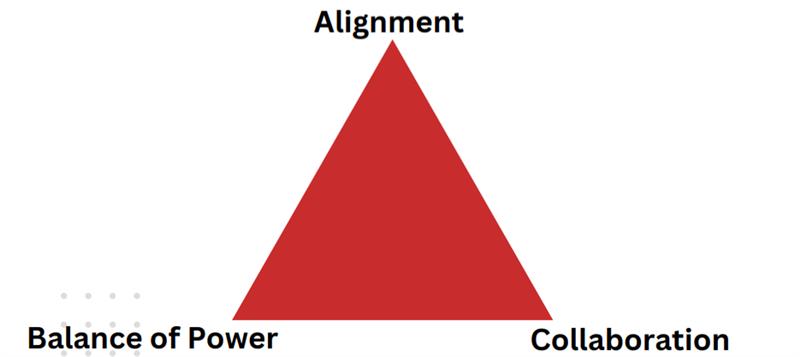 Graphic credit: Yu, E. (2022). Community engagement. American Public Health Association.
Alignment
For change to be sustained, communities’ values and behaviors must align with the solutions. Ensuring these align also ensures that a mutual investment is established to continue the work beyond any official public health partnership.
It’s also important to align with communities on what is reasonable in terms of time, resources, and interest. Asking a community with limited leadership, volunteerism, or resources to take on a more prominent place in your partnership than they can reasonably sustain would not be aligned with the work.
Balance of Power
Successful community engagement should also balance power between communities and public health officials, with the ideal moving in the direction of community members. It’s not making room for communities at the table; it’s allowing them to create their own space.
Collaboration
The goal here is moving beyond community participation to community integration — from working for the community to working with communities as equal strategic partners.
Ultimately this can be boiled down to the following quote.
“What matters to community members matters the most.”
Yu, E. (2022). Community engagement. American Public Health Association.
Recently, we engaged with a youth LGBTQIA+ organization in a partnership that aimed to move beyond promotion or grant work.
After digging into their social media and program work, we came up with specific ideas of what we thought might make sense for our campaign. But after meeting with them and listening to their priorities, our ideas seemed out of touch – because they were.
These are the leaders, the folks doing the work, day in and day out, working firsthand with LGBTQIA+ youth.
How can we engage with communities in our work?
So how do we do it? The specifics around how to engage depend greatly on the work to be done, the community, and the resources available to do it. However, there are a few things to keep in mind while doing the work:
- Reduce barriers to participation.
- Ensure strategies are aligned.
- Create a culture of accountability, healing and trust and acknowledge, confront and work against power dynamics/ structures.
- Connect authentically.
- Be a vehicle to tell their stories for positive change.
All these things have one thing in common: to release control. To truly engage with communities, we must release control over the outcome and listen to and let these communities lead.
We must also connect authentically, consistently immersing ourselves in the issues and their work, not just as it serves our needs. Attending the events and coming to the table with a base knowledge of what they are all about and the power structures that oppose them are the first steps towards building the necessary relationships for community engagement.
One of the most powerful, authentic, and successful ways we can do this in our work is through storytelling. We are storytellers who need stories. Stories about what’s going right and what may be going wrong to illustrate the issue.
Why do we engage with communities in our work?
“Do you understand what you intend to do and what you have the power to do?”
-Jessica Mulcahy, MA + Emily Yu, MBA
Yu, E. (2022). Community engagement. American Public Health Association.
More importantly, beyond the how lies the why.
Why is it important and valuable to prioritize marginalized communities in finding and implementing solutions to their public health issues? Because it challenges the status quo historically established against these groups’ autonomy. Because it makes the most sense and is just the right move. And frankly, its success can reverberate across governmental institutions.
When we ask ourselves what we have the power to do when engaging with communities affected by the issues, the answer is quite powerful to imagine. When communities are trusted with their own solutions, trust is built, health equity is enhanced, and change is sustained, creating healthier communities overall.
Recently, a campaign allowed us to meet unhoused youth at shelters statewide, asking for their experience for authentic messaging and feedback. Many of them spoke of being asked about their experiences as a step in the right direction. For some, it had been years of not feeling heard or valued by those outside of their community. Hearing their experiences firsthand provided us with knowledge that we literally wouldn’t have been able to find otherwise. And more importantly, it served as a great reminder of what is possible with this work.
Authentic community engagement is more than just something to tack onto a campaign; it means giving those who feel voiceless the opportunity to be heard.