
Anatomy of Ethical Storytelling: How We Tell Stories That Heal, Not Harm
At SE2, we believe storytelling is one of the most powerful tools we have to shape opinions, influence policy, and connect with communities. That’s why we’re proud to share our “Anatomy of Ethical Storytelling” poster at ComNet25 in Denver this month—a visual guide that reflects our commitment to telling stories that heal, not harm.
We created this piece to challenge communicators to think critically about the impact of their narratives. Too often, stories are shaped by the agenda of the storyteller rather than the lived experiences of the people at the heart of them. When that happens, storytelling can unintentionally reinforce stereotypes, retraumatize communities, and miss opportunities for truth and transformation.
So what’s the alternative? Ethical storytelling. For us, that means listening deeply, respecting lived experiences, and elevating community voices. It’s not just about visibility—it’s about influence, resistance, and connection.
To bring this concept to life, we used the metaphor of the human body. Each part represents a principle we believe is essential to ethical storytelling:
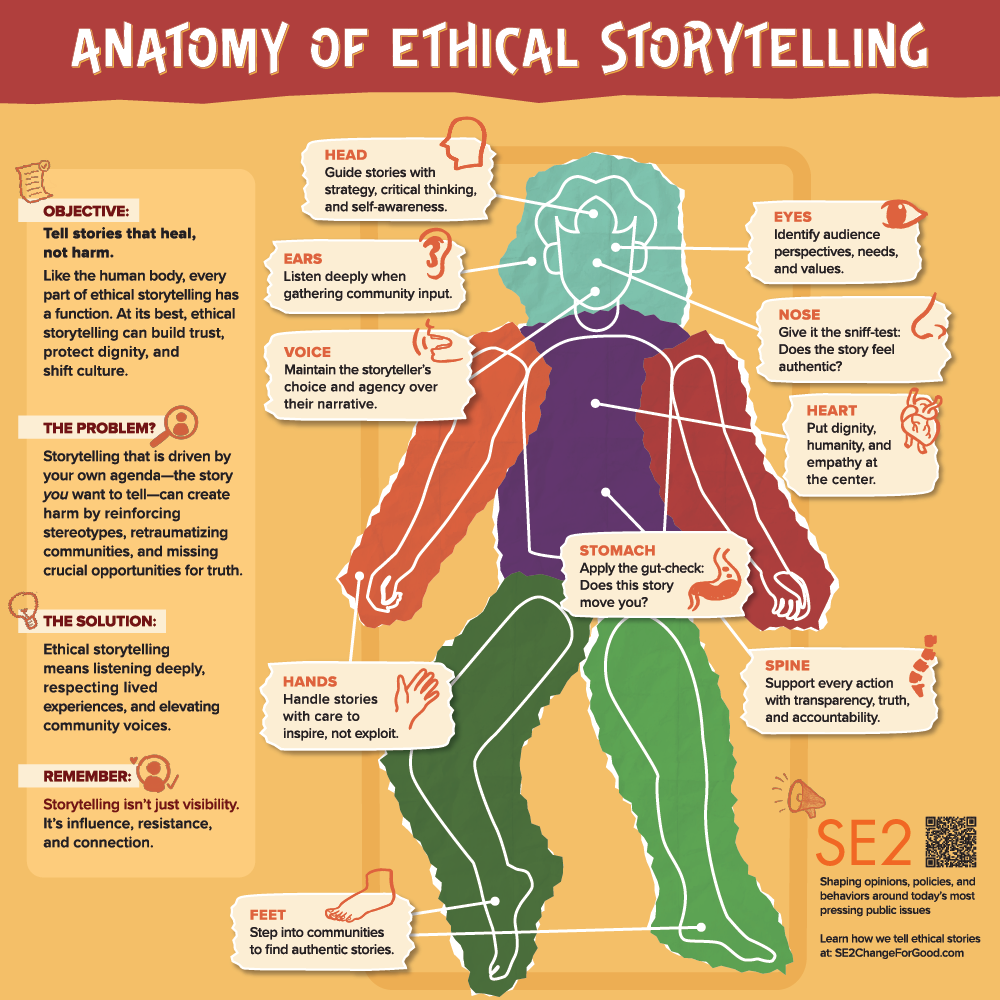
- Head – Strategy, critical thinking, and self-awareness guide the narrative.
- Eyes – We consider audience perspectives, needs, and values.
- Ears – We listen deeply to community input.
- Nose – We apply the “sniff test”: Does the story feel authentic?
- Voice – We ensure storytellers maintain agency over their own narratives.
- Heart – We center dignity, humanity, and empathy.
- Stomach – We use the “gut check”: Does the story move us?
- Hands – We handle stories with care to inspire, not exploit.
- Spine – We support storytelling with transparency, truth, and accountability.
- Feet – We step into communities to find authentic stories.
This framework isn’t just theoretical—it’s how we work every day. Whether we’re crafting a campaign, producing a video, or writing a feature, we strive to honor the people whose stories we tell. Download a PDF version of the Ethical Storytelling Framework here.
If you’re at ComNet25, come see the poster in person and let’s talk about how we can all do better by the stories we share. And if you’re curious to learn more, check out our other blogs.
Let’s keep storytelling human.


PowerMapping: Why We Must Double Down on Human Interaction in the AI Age
In recent years, the landscape of communication has undergone a seismic shift, driven by the rise of artificial intelligence (AI) and a notable decline in trust towards legacy news media. As AI technologies become increasingly capable of generating content, the implications for communications professionals are profound and multifaceted.
The Rise of AI in Content Creation
AI has transformed how we produce and consume information. Tools like natural language processing and machine learning enable AI to create articles, reports, and even creative writing with remarkable efficiency and accuracy. This democratization of content creation means that anyone with access to AI can generate high-quality material, blurring the lines between professional journalism and amateur content.
Benefits of AI in Communication
Speed and Efficiency: AI can analyze vast amounts of data and produce content in seconds, allowing for real-time reporting and updates.
Personalization: AI algorithms can tailor content to individual preferences, enhancing user engagement and satisfaction.
Cost-Effectiveness: Organizations can reduce costs associated with content production, reallocating resources to other critical areas.
However, this rapid advancement also raises concerns about quality, authenticity, and the potential for misinformation.
Declining Trust in Legacy Media
As AI-generated content becomes more prevalent, trust in traditional news outlets has waned. Factors contributing to this decline include:
Perceived Bias: Many consumers believe that legacy media outlets have inherent biases, leading to skepticism about their reporting.
Misinformation: The rise of fake news and sensationalism has eroded public confidence in the accuracy of information disseminated by established media.
Alternative Sources: Social media and independent platforms provide alternative narratives, often bypassing traditional gatekeepers and allowing for a wider range of voices.
The above distillation of the challenges facing communicators in today’s rapidly evolving landscape was written in seconds by the free-to-use Microsoft Copilot based on my one-paragraph prompt. I didn’t make a single edit. (It went on, but you get the idea.)
Besides hitting the mark, this AI-generated copy highlights that the talented people at our communications and marketing agency shouldn’t be spending our time creating things that AI can do nearly as well and much, much faster.
Our clients will soon have the keys to the car. They won’t need us to drive them anymore.
Sure, humans will still be needed to proof content, check for accuracy, ensure it’s on message, and refine it (at least the AI prompts, if not the output).
When it comes to creativity, AI is not ready for prime time – as this year’s cringey AI-produced Coke Christmas ad showed – and it’s been shown perpetuate racist stereotypes and bias.
But it’s going to get better and take over more and more roles that once required the human touch.
How can communications and marketing professionals avoid becoming this century’s version of the Luddites, the 19th century textile workers who smashed the mechanized looming frames they knew would make their skills obsolete?
This raises two questions:
- What valuable communications and marketing tasks can AI not do today – or ever?
- What strategies will cut through the fast-rising flood of unreliable, inaccurate content that’s drowning audiences in a sea of junk?
The answer to both questions is the same, and surprisingly simple. We must focus more on what humans have been doing since the dawn of time: communicate in person.
People crave connections and trust, especially in a world where digital interactions are increasingly mediated by algorithms and bots. The election highlighted that the “broadcast” model is dying as people increasingly rely on friends and families for trusted info on pressing issues.
AI can only fake empathy. AI can’t sit across from someone and react naturally and with genuine understanding and concern.
By focusing on human-centered strategies, we can cultivate meaningful relationships with audiences, understanding their unique needs, values, and aspirations by actually getting to know them.
Long before digital networks, societies were built with people networks. People naturally come together and organize to bring solutions to societies’ biggest challenges.
Established relationships and trust power human networks, with influential people or organizations serving as the connectors.
Our community engagement initiatives allow us to tap into the collective wisdom and spirit of the communities we serve, creating campaigns that resonate on a deeper, more personal level, and leverage these organic networks to authentically reach our key audiences where they are.
The trust and loyalty we build through genuine human interactions are irreplaceable and invaluable.
The phone call, the meeting over coffee, the community meeting. Inefficient? Yes. Irreplaceable? Absolutely.
Mapping out how communities are connected, identifying the trusted messengers, authentically energizing these networks, and co-creating solutions with them provides the playbook for creating sustainable behavior and systems change.
Communications 3.0 is really a return to communications 1.0, minus the fax machine.
Relationships are key and they’re developed the old-fashioned way: meaningful connections built on trust, reputation and expertise. In other words, there are no short cuts.
Pick up the phone. Get out of the office. Replace that video conference with an in-person discussion.
That’s the guiding philosophy of SE2 PowerMap™ . We activate community networks to tackle urgent public challenges. Our strength is our relationships with diverse community connectors. We build those, nurture them, and map them. We are partners, united in our belief of people-powered solutions are the future, not AI.
When these people share their insights, credibility and trust, we can achieve the extraordinary.

New Perspectives Highlight How to Use Positive Social Norms: Key Takeaways from SE2 Presentation with Montana Institute
Developing a positive community norms campaign can be challenging when you’re looking for new ways to communicate about evolving and critical issues like fentanyl and teen opioid misuse.
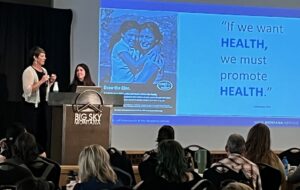
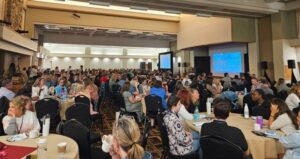
In July, I was honored to co-present at the Montana Summer Institute with the brilliant Sara Thompson, the Montana Institute’s director of communications and training. The summer event, which lasted four days in beautiful Big Sky, was attended by over 300 public health professionals from around the country, all seeking to learn more about using positive community norms to change behavior.
Highlighting positive community norms, also called social norms, can drive positive behavior change while discouraging risky behaviors.
Our presentation, The Question is the Answer, focused on asking new questions and finding new norms in the data to continue to promote the health and positives that already exist in the community.
Here are some of the key takeaways from the presentation and the approaches SE2 has used on a variety of issues, from youth prevention to childhood immunization, in behavior change campaigns across the nation.
- Identify the story you want to tell – what relevant positive norms exist in your community?
- What data is available to you? Are there any surveys that have been done recently, like a state survey?
- Based on the data available, what do you know? What hypothesis could be tested? What new questions could uncover new norms?
- What kinds of messages can you test that would highlight different norms?
- Descriptive norms, “what most people do,” describe what people actually do in a community or social circle. (Example: Most teens have never used fentanyl.)
- Injunctive norms, “what most people think or believe they should do or feel,” describe people’s attitude toward a protective behavior in a community or social circle. (Example: Most teens would support a friend who was trying to quit.)
- Bystander norm messaging says if most people perceive their peers support being active bystanders (in other words, taking action to protect others) then they may be more likely to personally support a peer.
- How are you reaching your intended audience in message testing? Can you partner with local organizations, like school districts, nonprofits, or community centers to distribute a survey?
- Finally, what new norms are appearing in your data?
A key issue is how to promote positive community norms without stigmatizing those who are outside the norm. On the issue of opioids, for example, stigma can be fatal by causing people to use opioids alone, which means no one is there to help if they overdose. Stigma can also deter people from seeking treatment.
One solution we discussed to avoid unintentional stigma was promoting positive bystander behavior. Try using bystander behavior like “x out of x teens support their friends in quitting x,” “x percent of teens would try and stop a friend from using x,” or “most teens would carry naloxone to protect a friend from overdose.” This creates a positive norm without stigmatizing those who have used or are using.
 Positive community norms campaigns can help discourage unhealthy behaviors like substance use or violence, and encourage people to change their behavior by correcting misperceptions about what is normal or typical in a group. These campaigns can also promote positive behaviors, attitudes, and the health and hope that already exists in a community.
For more than 25 years, the Montana Institute has been a leader on this topic, and we’re grateful for our long-time collaboration with the fantastic team there. Their insights have helped inform various prevention campaigns over the years, and we remain committed to sharing and educating people about the positive behaviors and attitudes that can save and change lives.