
A Turning Point for Democracy & Belonging in Colorado
Last week’s killing of conservative political commentator and activist Charlie Kirk is a tragedy – for his loved ones, of course, and for anyone who believes in the principle of being able to express their opinions without fear or retribution.
It was another in a string of attacks on political leaders in recent years but hopefully is a turning point for a country that surely now sees that something inside us is broken.
We can’t look at political leaders, pundits, or influencers to solve this problem. It’s something only we can fix – one relationship, interaction, and conversation at a time.
Seeing the humanity in others and approaching conversations with tolerance and a commitment to working together is what a bold new effort here in Colorado is all about. Belonging Colorado is focused on bringing Coloradans together across lines of difference – regardless of their race, political affiliation, income, or where we are from – to foster a greater sense of belonging in our state. Across Colorado, people are stepping up to lead locally based efforts to bridge differences and create belonging in their communities.
This unique, innovative statewide approach includes support for community-based organizations that are bringing people together to connect around shared interests and address shared challenges; funding for entrepreneurs to pioneer new ways to increase connection and belonging; and training and support for community-led leadership networks that are working to spread strategies for bridging differences. The initiative is made possible by a special fund at The Denver Foundation and supported with the expertise of the Greater Good Science Center, Colorado Health Institute (CHI), and Startup Colorado.
The Belonging Colorado project is based on research conducted by CHI that found that only about half of Coloradans feel a strong sense of belonging in their local community. According to the 2024 Colorado Belonging Barometer:
“While a majority of Coloradans reported belonging, there was a significant percentage who felt uncertain, at best, about whether they belonged in the state, community, workplace, and in their child’s school. Socioeconomic factors, such as education level and income, as well as people’s feelings about belonging, loneliness, and political ideology, are most often associated with whether someone feels they belong.”
The effects and benefits of belonging range from individual to community wide.
“An emerging body of research,” the CHI report says, “indicates that belonging is associated with better physical and mental health, greater workforce retention, increased trust in one’s neighbors and in local government, more openness to diversity and less fear of demographic change, and greater satisfaction with U.S. democracy.”
Bridging our inevitable differences involves seeing the humanity of people whose backgrounds or views differ from our own and better understanding them. It does not ignore the differences that make us unique, nor does it mean agreeing on everything – or tolerating hate, bigotry, or incitement to violence. It is about valuing one another, extending mutual respect, and working towards shared goals and a future we can co-create.
Regardless of whether you shared Kirk’s opinions, no person deserves to be dehumanized or killed because of their views, background, or beliefs. Belonging means being valued and accepted for who you are, without the need to act in ways that erase your identity or what you believe.
When people are given a seat at the table and treated as valued participants in shaping their future, they feel heard, connected, and supported – which benefits everyone. Belonging ensures that progress for one person strengthens the whole community.
Colorado is not immune to many of the political and social dynamics that divide people. But, by focusing on ensuring all voices are welcome at the table to talk about our issues, we can walk out of this darkness together and create a brighter future in a state where everyone can thrive.


Change That Lasts: Lessons from SE2’s CEO
In a rapidly changing world, SE2’s Principal and CEO Susan Morrisey sees “change for good” as both a responsibility and a privilege. Reflecting on her team’s legacy, she shares insights on creating lasting impact, connecting authentically with audiences, and the progress and persistent challenges women face in executive roles. Her guidance emphasizes the power of amplifying real voices, embracing community-driven change, and advancing meaningful conversations in every project.
Q: What is the “change for good” SE2 has had a part in that you’re most proud of?
A: If I look for the throughline of our impact over the past 25 years, it’s been generating energy and enthusiasm around issues and stories that might have gone unnoticed. Whether we’re working to change policy, public opinion, or personal behavior, these are the issues that have real impact on people’s lives. Moving forward, our challenge is to support community conversations and priorities – not the other way around. That’s how we get to meaningful, sustainable change.
Q: What’s your biggest piece of advice for copywriting/storytelling?
A: Our role as storytellers is to simply amplify the real, authentic stories people want to tell. Often, we come into it with our idea of what makes a compelling story driving the narrative. If we listen, rather than direct, the results can be surprising and moving.
Q: As a woman in business, especially in an executive role, what challenges do you feel women still today face? What challenges have improved or gotten worse?
A: I think it depends on where women are “in business”. In many areas – including government, nonprofit, and corporate settings – women’s power and influence has continued to grow. But there continues to be a barrier for many top executive roles. I look forward to a time when women aren’t only appreciated for the “soft skills” we bring to the table but are judged fairly for and in positions of power.
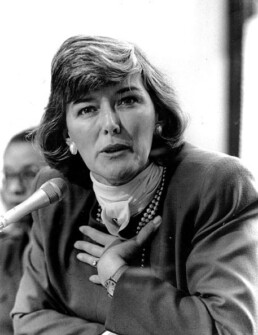
Remembering Pat Schroeder: Champion for My Family and Yours

When former Congresswoman Pat Schroeder passed away last month, Colorado and the nation lost one of our most influential champions of women’s rights. She was also a fierce advocate for the needs of American families.
Much has been written about Schroeder’s work spearheading groundbreaking legislation to support families and advance the rights of women. When she started her first term in 1973, there were just 16 women in Congress. Every voice mattered – a lot – and hers was loud and passionate.
Over the next 24 years, Schroeder sponsored legislation to protect pregnant women at work, advance equitable treatment of women in the military, and increase protections for victims of domestic violence. She was relentless in her support of the Family and Medical Leave Act, which took nearly a decade to pass.
Over many years and since her death, I have reflected on the impact Schroeder had on my life and career. I had the honor of serving as a congressional aide in her Denver district office for five years, supporting her work on women, children, and family issues.
Those were pivotal years in my life and career. I worked for Pat when I had my first child, now 28. She made sure I had the time and support I needed as a new mom and working mother.
It was also when I found my passion and commitment to working on important and pressing issues.
Through experience and observation, I learned a great deal from Pat about communications strategy and practice. She had a keen mind, a quick wit, and was a talented orator.
Staff would labor over talking points for her speeches. She would then jot a couple of bullets on a napkin, take to the podium, and talk extemporaneously for an hour, laser-focused on the most important issues and messages.
The media loved her because she always brought a compelling story, delivered with memorable quips.
She referred to then-President Ronald Reagan as the “Teflon president” to describe how it seemed no controversies stuck to him. (While the controversies didn’t stick, her description of Reagan did, and was often repeated.)
When asked how she could be a mother and serve in Congress, she replied, “I have a brain and a uterus, and I use both.”
Those of us who worked with Pat also witnessed first-hand her thoughtful attention to the issues and residents of Colorado’s first congressional district.
For more than two decades, constituents called and walked into Schroeder’s offices in Denver and Washington, D.C.
Many came to advance the priorities of their organization or movement; others came to discuss more individual, personal challenges they faced. When they didn’t know where to turn, people reached out to Schroeder because they knew she would get something done. She remembered their issues and asked after their families. Handwritten notes with her iconic “Pat” signature – a smiley face in the “P” – were common.
Pat Schroeder paved the way for generations of women leaders because she lived and worked by the values and standards set by important women and feminists of history:
Say and do what’s right.
Don’t wait for permission, don’t apologize, and don’t back down.
Keep going until the job is done.
As Pat was known to say, “You can’t wring your hands and roll up your sleeves at the same time.”
The life of the Honorable Patricia Schroeder will be celebrated on Friday, April 28 at 2 p.m. (doors open at 1:30) at History Colorado Center, 1200 Broadway, Denver. The event is free and open to the public.

Protecting Youth From Online Threats Starts with Conversation
Recently I had the opportunity to talk with Brooke Istook, vice president/youth and communities at Thorn, a nonprofit and recent SE2 client. Thorn works to protect youth from online exploitation by educating young people and their parents and caregivers, and builds technology to defend children from sexual abuse.
We talked about how Thorn’s focus and priorities have changed since the organization was created a decade ago and what it is doing to respond to an evolving landscape in which youth are increasingly at risk.
SM: What is Thorn currently doing to educate parents and caregivers about online risks so they can better protect youth?
BI: There is a lot that parents don’t understand about the technology their kids are using to communicate because they don’t have a shared experience. Unlike their kids, most parents didn’t have to worry about their private messages or private moments being documented and shared online for all the world to see.
Today, young people are growing up online, and that includes how they experience transformational phases like puberty. In many respects, doing things like sharing nudes is considered part of normal sexual exploration in the digital age. So, we recommend that parents and other caregivers have conversations with kids early and often so that they understand the risks of sharing personal information or private images.
SM: How widespread is the problem?
BI: Kids are engaging online sooner, some as young as 9 years old. A quarter of 9- to 12-year-olds say they have had an online sexual interaction, and one in six have shared intimate images. This behavior puts kids at risk of their images being shared with others and potentially being groomed by a predator. Half of kids who have shared nudes of themselves say they shared them with someone that they only knew online, while 40% believe that the person they sent them to is an adult.
SM: What do parents and caregivers need to think about when having conversations with kids?
BI: They need to understand the role that shame plays in these conversations and approach their child with empathy and understanding. Online situations, particularly those that are sexual in nature, can be wrought with shame and groomers use that to influence and manipulate youth. Many young people are reluctant to let parents know when they have shared something online, or if someone they don’t know is communicating with them.
Parents need to be curious about digital safety and talk to their kids about healthy relationships and how to make friends and avoid risks online. They also need to let their kids know that it is never their fault if someone tricks or coerces them, and to come to them if they have any concerns about interactions they have had online.
So, the message for younger kids is don’t share private information or photos of yourself or someone else, and if anyone makes you uncomfortable you should not feel bad. It’s never your fault, and you can always come to me if you feel scared or concerned.
SM: What is Thorn doing to educate and support older youth who might be sharing nudes more frequently, even as part of a dating relationship?
BI: It’s important for older youth to be able to identify red flags so they can protect themselves — whether that’s being involved in an unhealthy relationship or being approached and groomed online by someone they don’t know. They need to understand the risks of sharing nudes with a friend, partner or someone else, because those images can be reshared without their consent. In the wrong hands, they can also be used as leverage to get them to do something they don’t want to do such as sharing more images, which we refer to as sextortion.
Parents also need to talk to their kids about not resharing photos they receive from someone and to model good behavior by avoiding victim-blaming if something happens. We know that half of kids and parents blame the person in the photo when a nude is leaked. Blaming the victim leads to the dangerous dynamic of youth staying silent when something bad happens to them out of fear of judgment. In 2017, 85% of victims of sextortion cited embarrassment as their reason for not getting help.
SM: How is Thorn partnering with tech companies to keep kids safe online?
BI: We work with industry partners and develop technologies to make reporting resources more accessible when youth need help. Often, social media platforms are the only ‘person’ that a child talks to when something is going wrong — such as when they are being asked to send nudes or other information they don’t want to share. If a child feels that something is wrong, there is a critical moment when they can decide to report the interaction to the platform. The platform needs to be able to immediately provide them with support and resources to help them.
Many platforms are moving to make these safety features easier to use — and parents should know about them. For example, Apple is rolling out a new safety feature in its messaging app that can be turned on in a child’s device. The feature detects when a nude image is about to be sent or is received and messages support and alternatives to the child. It just puts a bit of friction in the path and provides youth with an off-ramp to a difficult conversation.
These are the types of features that will help to make young people’s online worlds a bit safer, which we will continue to pursue in the coming years.
To learn more about ways parents and caregivers can support and protect youth online, visit Thorn.org.

Want a Bigger Impact with Your Public Health Campaign? Partner with Other State Agencies that Share Your Goals
Excerpted from original story on GovLoop — a publication that serves a community of more than 300,000 government leaders by helping them to foster collaboration, learn from each other, solve problems and advance in their government careers.
####
Across the country, state-run agencies create programs and resources to advance their missions — whether those are public health, higher education, child care, transportation or something else. Their goals typically center on supporting the health, happiness, prosperity and well-being of their states and residents.
During this process, clarity of purpose and collaboration are essential, as they seek to impact the same audiences from issue to issue: their states’ residents. However, cross-collaboration between departments can be elusive. It is inefficient and frustrating when the actions of one department or agency greatly impact the others. The solution comes in working to advance shared objectives across departments and programs, helping to achieve greater collective impact.
Colorado’s Department of Human Services (CDHS) and Department of Public Health and Environment (CDPHE) are collaborating on a public health behavior change campaign that seeks to address the upstream factors that influence young people’s decisions to engage in healthy behaviors. The effort focuses on building stronger relationships among youth and between youth, their parents, and other adults in the community.
Visit GovLoop to see three strategies CDHS and CDPHE used to create a smooth process that helped to launch one of the most ambitious intra-agency public health campaigns in our state’s history, called Forward Together.

Diapers are a Basic Need that Too Many Colorado Families Can’t Afford
One in every three Colorado families with babies and toddlers need help meeting their diaper needs.
This is an issue with far-reaching impacts – the lack of access to clean diapers negatively impacts babies’ health and the ability of their caregivers to work and provide for their families.
That’s why we’re celebrating the fact that SB 21-027, Emergency Supplies for Colorado Babies and Families, has gotten the final OK from the Colorado legislature and $4 million for diaper assistance over the next two years. The vote of approval in the Senate was 19-13, and now the bill is headed for Governor Jared Polis’s desk.
SE2 is proud to support SB 21-027and we congratulate the bill’s sponsors, as well as the community-based partners that will be instrumental in getting diapers to families that need them. These partners include WeeCycle based in Aurora, The Nappie Project based in Loveland and others. An amendment was also added for a grant program to support food pantries and food banks.
SB 21-027 is a cost-effective solution to the urgent and ongoing need for diapers, which was made more visible by the economic strain of the pandemic on low-income families.
The funding from SB 21-027 will go to statewide community-based organizations, including WeeCycle and The Nappie Project, that are experienced with diaper distribution. These organizations buy diapers at a significantly reduced cost and have broad experience getting diapers to Colorado families that need them.
SE2 believes that we all have a role to play in giving the next generations of Coloradans a strong start, and that’s why we are proud to work on this project.
As parents ourselves and passionate supporters of access and opportunity for all Colorado families, we invite you to learn more about SB 21-027 and the positive impacts this legislation would have on our state’s most vulnerable children and families.